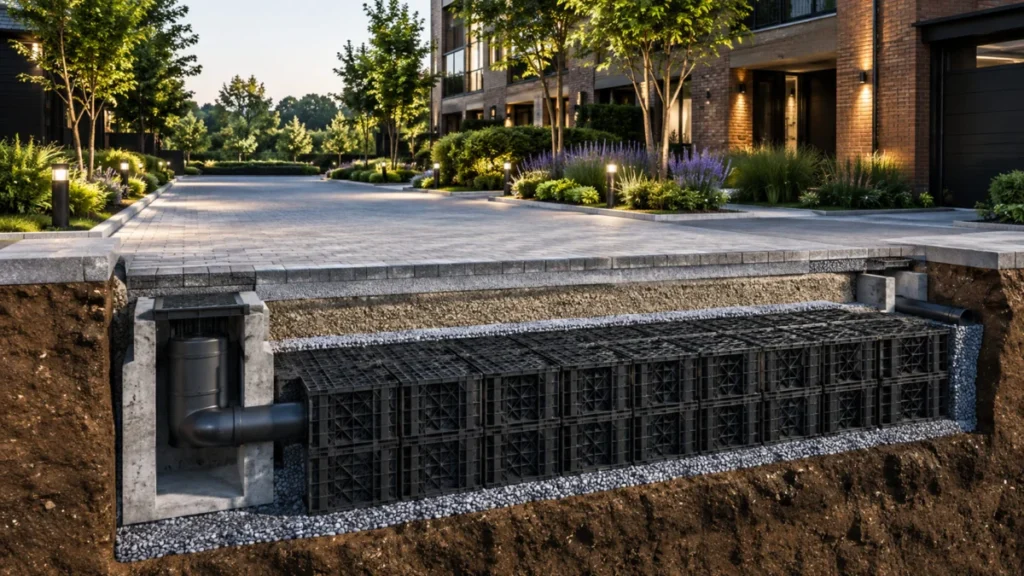
In the high-stakes world of property development, land is the ultimate currency. Every square meter saved—reclaimed from the footprint of necessary infrastructure—represents potential revenue, increased amenity, or enhanced biodiversity. Among the most effective tools in the developer’s arsenal is the modular underground stormwater storage system. By moving attenuation tanks, soakaway crates, and StormTank modules beneath driveways, podiums, and landscaped areas, developers can preserve the utility of the surface while solving the complex challenges of urban runoff.
However, the industry is shifting its perspective. It is no longer enough to simply "bury and forget." Today, leading developers and engineering firms are recognizing that the true value of an underground drainage asset is not found in its invisibility, but in the meticulous coordination of structural performance, hydraulic capacity, and, crucially, long-term operational viability.
Main Facts: The "Spatial Bargain"
The central premise of modern drainage design is the "spatial bargain." A developer gains surface space—such as a visitor parking bay or a high-quality green space—in exchange for a hidden liability. If that liability is not managed through rigorous planning, the asset can become a "dead" zone that hinders future development or incurs astronomical maintenance costs.
Modular systems, such as the StormTank, offer incredible flexibility in shape and volume, allowing them to fit into tight urban footprints. But these systems are components of a wider "drainage train." A fundamental error in development is treating an underground void as a universal panacea. While a tank manages water quantity, it rarely addresses water quality, amenity, or ecological health. These require surface-level interventions. Therefore, the successful project is one where the underground storage is a silent, supportive partner to a vibrant, functioning landscape.
Chronology: From Concept to Handover
The lifecycle of a high-value drainage asset should follow a disciplined progression to ensure that the "land-saving" benefit does not turn into a long-term burden.
- Site Assessment (The Discovery Phase): Before a single module is specified, the site must dictate the drainage logic. Is the soil suitable for infiltration, or does the project require a sealed attenuation tank? This decision is not merely technical; it is a financial risk assessment involving groundwater levels, soil contamination, and proximity to building foundations.
- Integrated Briefing (The Design Phase): The drainage engineer and the landscape architect must collaborate early. If the surface is intended to be a residential driveway, the load-bearing requirements for the tank must account for heavy maintenance vehicles. If it is a landscaped amenity, the planting strategy must be designed so that root systems do not compromise the tank’s structural integrity or access covers.
- Implementation (The Construction Phase): As the project moves from blueprint to reality, the "as-built" reality often diverges from the design. Rigorous site supervision is required to ensure that access chambers remain accessible, not buried under future paving or dense shrubbery.
- Operational Handover: The final phase is the transfer of the asset to the owner or management company. This includes clear documentation of the maintenance schedule, ownership of the drainage route, and the "red lines" for future excavation.
Supporting Data: Balancing Surface Value and Hidden Liability
To determine the viability of an underground system, stakeholders must move beyond storage volume calculations and perform a "whole-life" review.
| Property Objective | Buried-System Requirement | Key Question for Approval |
|---|---|---|
| Preserve Parking | Coordinated traffic/chamber ratings | Can the surface carry daily and maintenance loads? |
| Protect Landscape | Root-safe zones, access, levels | Will the planting obstruct or damage the tank? |
| Reduce Flood Risk | Accepted outlet and overflow route | What happens during extreme inflow or blockage? |
| Long-term Ownership | As-built records, clear funding | Who is responsible when performance declines? |
The data indicates that projects failing to ask these questions often face "maintenance shock"—where a small, late-stage design decision, such as moving a manhole cover to accommodate a parking space, renders the system effectively unserviceable for the next thirty years.
Official Perspectives and Industry Standards
Regulatory bodies, particularly in the UK and under various international standards, have pivoted toward a "Source Control" philosophy. The objective is to manage water as close to the point of origin as possible.
Professional guidance from entities like Storm Manage emphasizes that modular systems are not a "set-and-forget" technology. There is a distinct, legally-binding requirement to manage both routine and extreme rainfall. Official standards increasingly demand that developers prove they have considered the "failure scenario." What happens if the system blocks? What is the exceedance route? These are not theoretical questions; they are essential criteria for project approval.
Furthermore, there is a push back against the "over-claiming" of benefits. Developers are cautioned against marketing underground tanks as "sustainable" in the sense of providing biodiversity or water quality. A tank is a storage vessel; a garden is an amenity. A successful development must ensure that the underground system facilitates the surface’s purpose rather than replacing the necessity for natural drainage features.
Implications: The Cost of Neglect
The implications of poor integration are severe. When maintenance is considered as an afterthought, the cost of clearing a blocked filter or inspecting a damaged module can spiral. If an access point is paved over, the entire surface may eventually need to be excavated, destroying the very amenity the developer spent millions to create.
Moreover, there is the issue of ownership. In multi-unit residential developments, clarity regarding who is responsible for the maintenance of the "drainage train" is often murky. If a property is sold to an individual or a body corporate without a clear, documented maintenance contract and a sinking fund for repairs, the developer risks inheriting future litigation or reputational damage when the system inevitably requires professional intervention.
The Path Forward: Strategic Stewardship
True professional excellence in development requires a holistic view of the property. When a developer opts for an underground system, they are entering into a long-term relationship with the site. The strategy must be:
- Transparency: Every stakeholder—from the architect to the facilities manager—must understand the limits of the underground system.
- Visibility: Maintenance routes must be mapped onto the site plan as clearly as the building entrances.
- Documentation: Handover packages must be comprehensive, serving as the "owner’s manual" for the drainage system, detailing not just where it is, but how it behaves under stress.
Conclusion: Value Beyond the Void
The trend of utilizing underground space for stormwater management is undoubtedly positive. It allows for higher density, better aesthetics, and more efficient use of land in our increasingly crowded urban centers. However, the value of such an installation is not inherent to the plastic or concrete modules themselves; it is derived from the thoughtfulness of the engineering and the robustness of the management plan.
By shifting the focus from simply "hiding the tank" to "protecting the surface value," developers can ensure that their projects stand the test of time. A well-managed drainage system is invisible, silent, and reliable—the hallmark of a truly high-quality development. As we look to the future of urban design, the most successful developers will be those who recognize that the most important part of an underground system is the clear, professional, and accessible plan that keeps it running long after the construction crews have departed.
In the final analysis, the underground storage array is not a substitute for proper land use, but an enabler of it. When that distinction is honored, the result is a safer, more sustainable, and ultimately more valuable property for all stakeholders involved.