For the dedicated cinephile, the quest for the ultimate viewing experience is an endless pursuit. We calibrate our home theater systems, obsess over contrast ratios, and endlessly debate the merits of physical media versus streaming. Recently, that quest led me to the XREAL a01, a set of smart glasses released in May of this year that promises to transform any location into a personal cinema. While the device offers a fascinating glimpse into the evolution of wearable technology, it also underscores the growing pains of a hardware category still struggling to find its true purpose.
The Hardware: A Functional, if Unrefined, Display
The XREAL a01 is not a piece of high-end, standalone augmented reality (AR) hardware in the vein of Meta’s ambitious Orion or the latest iteration of Snap’s Specs. Instead, it is best described as a "wearable monitor." Eschewing the internal battery and complex processing units that characterize more expensive headsets, the a01 is a tethered device. A single USB-C cable serves as its lifeline, drawing both power and data from your smartphone, handheld gaming console, or laptop.
Priced at approximately $300, the a01 occupies an accessible middle ground in the wearable market. The visual performance is undeniably impressive for its size: the glasses utilize dual mini-OLED panels capable of 1080p resolution and a peak brightness of 1,600 nits. When powered on, the display feels akin to sitting in the back row of a drive-in theater or viewing content on a virtual 147-inch screen. The colors are vibrant, the blacks are deep, and the clarity is sufficient to appreciate the snakeskin textures of Nicolas Cage’s wardrobe in David Lynch’s Wild at Heart.
A Chronology of the Testing Experience
To properly stress-test the a01, I integrated it into my daily media consumption routine over the course of two weeks.
- Day 1–3: The Desktop Dilemma: I began by connecting the glasses to my primary workstation. While the visual fidelity was high, the redundancy quickly became apparent. I found myself sitting at my desk, staring at a virtual projection while my physical 27-inch monitor sat idle less than a foot away. The lack of true "passthrough" or multitasking functionality meant that if I wanted to work, I had to remove the glasses. The a01 is a consumption device, not a productivity tool.
- Day 4–7: Mobile Trials: Seeking to test the "travel" potential, I attempted to connect the glasses to my smartphone. Here, I hit a significant hardware roadblock. As an older iPhone user, the proprietary port mismatch necessitated an adapter that was not included in the box. Once I sourced an adapter, the experience improved—the glasses truly shine in transit—but the tethered nature of the device remained a nuisance.
- Day 8–14: The Heat Factor: My final week was marred by the device’s thermal performance. After about 45 minutes of continuous use, the bridge of the glasses began to radiate a distinct, uncomfortable heat. While this is a well-documented challenge in the XR industry—the result of packing high-speed processing into a compact frame—it remains a significant barrier to long-form cinema viewing.
Supporting Data and Technical Limitations
The XREAL a01 operates primarily through screen-mirroring, a limitation that creates several usability friction points. Because the glasses act as an extension of the host device, the host screen must remain active and powered throughout the session. This creates a "double-screen" scenario: you are tethered to your phone, which is likely sitting in your pocket or lap, and any movement risks disrupting the connection.

For users seeking a more seamless, standalone experience, XREAL offers the "Beam Pro," a $200 dedicated streaming hub. The Beam Pro functions as a mini-tablet, allowing users to download content locally and bypass the need for a phone or laptop. While this solves the "tethered device" issue, it increases the total cost of ownership to $500, pushing the product into a more competitive price bracket where consumers might expect more robust AR features.
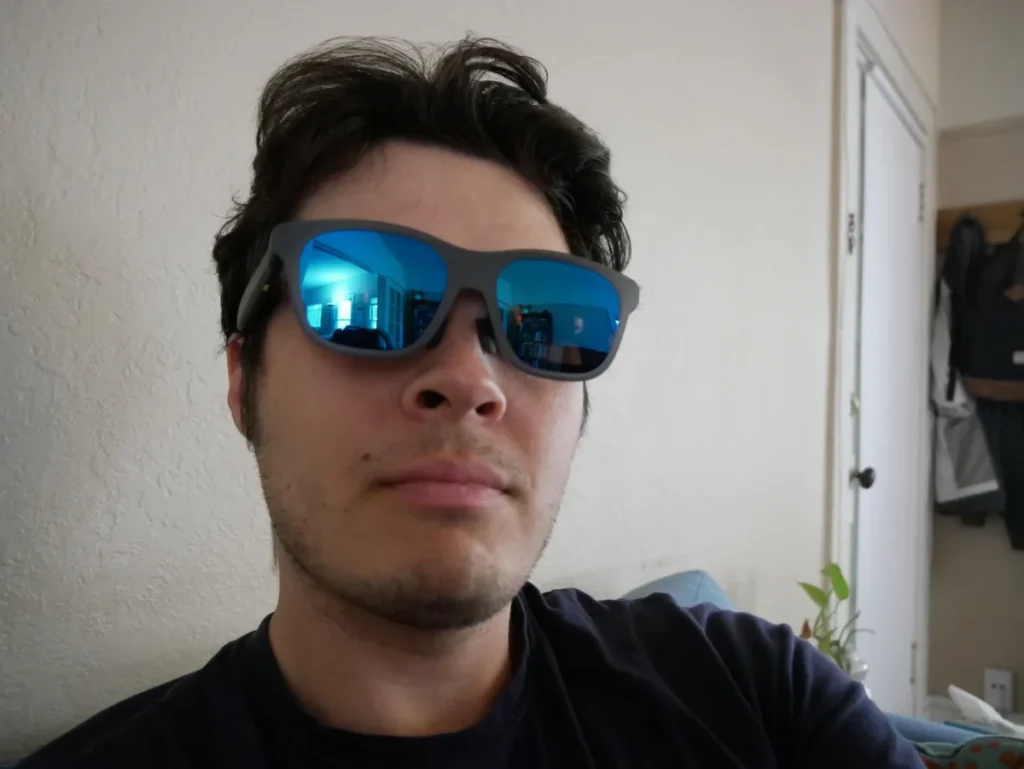
Furthermore, the lack of native hand-tracking or spatial computing in the a01 limits it strictly to 2D content projection. Unlike the more advanced prototypes hitting the lab floors at major tech firms, the a01 is a static display. It is, for all intents and purposes, a pair of fancy sunglasses with internal OLED monitors.
Industry Implications and the Road Ahead
The current state of the XR industry is characterized by a "tethered versus standalone" divide. The XREAL a01 represents the former, providing a lightweight, comfortable experience at the cost of mobility and internal processing. However, the industry is clearly pivoting.
During a visit to Google I/O earlier this year, I received a preview of "Project Aura," an upcoming XREAL device that seems to address nearly every critique leveled at the a01. Powered by Android XR—a platform co-developed by Google and Samsung—the Aura promises native hand tracking, direct access to the Google Play Store, and a dedicated compute "puck" that resides in the user’s pocket. By moving the processing away from the glasses and into a pocketable unit, XREAL is attempting to solve the thermal issues and weight distribution problems that currently plague the a01.
The implications for the consumer are clear: we are in a transitional phase. Current devices like the a01 are proof-of-concept hardware. They are perfect for early adopters who want a private theater experience on a flight or a train, but they are not yet a replacement for the living room television.

Conclusion: Is the Virtual Cinema Ready for Prime Time?
For a cinephile, the ultimate measure of a device is whether it enhances or detracts from the film. While the a01 provides a high-quality, immersive image, it cannot replicate the communal or physical comfort of a large-format television. Watching a film on a 55-inch TCL screen in my living room remains a superior experience to the "goggles on" approach of the a01.
The XREAL a01 is an intriguing milestone in hardware evolution, but it is not yet the revolution it aspires to be. It is a niche accessory that excels at mobility but fails at ergonomics and integration. As the technology matures—moving toward the promise of platforms like Android XR and hardware like Project Aura—we may eventually reach a point where wearable cinema is indistinguishable from the real thing. Until then, the a01 remains a fascinating, if flawed, toy for the curious, while the true future of the medium remains just over the horizon.
Disclaimer: When you purchase through links in our articles, we may earn a small commission. This does not affect our editorial independence or the objectivity of our hardware reviews.