Introduction: The Invisible Shield of International Trade
The vast expanse of the world’s oceans remains the lifeblood of the global economy, facilitating over 80% of international trade. Yet, beneath the veneer of tranquil shipping lanes lies a persistent and evolving threat: maritime piracy and armed robbery. For over three decades, the International Maritime Bureau (IMB) Piracy Reporting Centre (PRC) has stood as the primary bulwark against these criminal enterprises.
Operating as a 24-hour nerve center, the IMB PRC serves as a critical lifeline for mariners facing existential threats in some of the world’s most dangerous waters. From the Gulf of Guinea to the treacherous straits of Southeast Asia, the PRC’s work is not merely administrative; it is a tactical necessity that bridges the gap between distress signals and decisive intervention.
The Genesis and Evolution of the PRC
A Response to the Rise of Maritime Crime
Founded in 1991, the IMB Piracy Reporting Centre was born out of a necessity to address the escalating levels of piracy that threatened global supply chains in the late 20th century. At the time, maritime law enforcement was fragmented, and information sharing between coastal states and the private shipping industry was virtually non-existent.
The PRC was designed to be the "first responder" of the maritime world. By centralizing the reporting process, the IMB transformed piracy from a series of isolated, local crimes into a globally tracked phenomenon. This consolidation allowed for the identification of trends, the mapping of hotspots, and the dissemination of actionable intelligence that has saved countless lives and billions of dollars in cargo.
Core Functions and Operational Doctrine
The PRC’s operational mandate is multifaceted. Its primary duty is to maintain a 24-hour manned station capable of receiving distress calls from any vessel, regardless of flag or ownership. When an incident occurs—whether an actual boarding, an attempted hijacking, or a suspicious approach—the PRC initiates a rapid response protocol. This includes:
- Immediate Alerting: Broadcasting warnings to vessels in the vicinity to heighten their security posture.
- Liaison with Authorities: Coordinating with regional coast guards, navies, and law enforcement agencies to ensure that resources are deployed to the coordinates of the incident.
- Data Aggregation: Maintaining a global database that tracks the tactics, techniques, and procedures (TTPs) of pirates, which informs international policy and shipping industry security guidelines.
Chronology: Thirty-Three Years of Maritime Vigilance
The history of the IMB PRC is a timeline of adaptation.
- The 1990s (Establishment): The focus was on formalizing reporting structures and convincing shipowners that reporting incidents was not a sign of failure, but a strategic necessity.
- The 2000s (The Somali Crisis): This era saw the PRC thrust into the global spotlight as Somali piracy reached epidemic proportions. The Centre’s role became central to the international naval coalitions that were subsequently formed to secure the Gulf of Aden.
- The 2010s (Shifting Hotspots): As piracy in East Africa was suppressed, the PRC directed its efforts toward the Gulf of Guinea and the Singapore Strait, adapting its warning systems to counter kidnapping for ransom and violent armed robbery.
- The 2020s (Digital Integration): Today, the PRC leverages advanced satellite tracking, email alerts, and digital reporting platforms to provide real-time updates to shipmasters, ensuring that even in the most remote areas, vessels remain connected to a global support network.
Supporting Data: Why Reporting Matters
One of the most persistent challenges faced by the IMB is the "under-reporting gap." Some shipping companies fear that reporting piracy will lead to increased insurance premiums or negative publicity. However, the IMB emphasizes that data is the only language that governments and international naval forces understand.
The Power of the 2025 Mid-Year Report
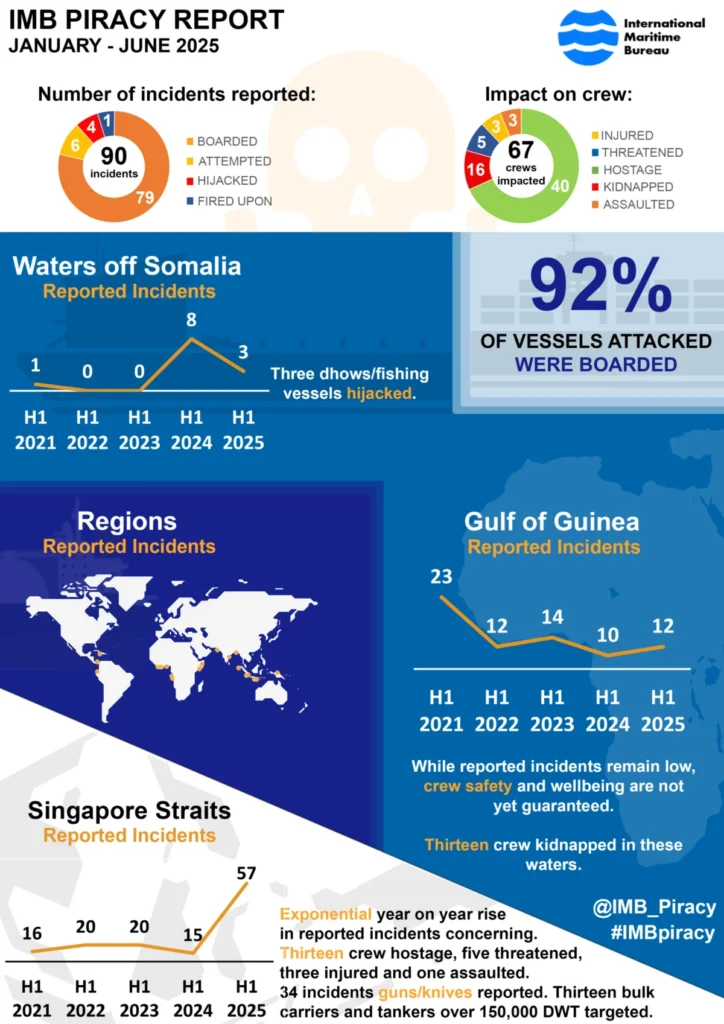
The recently released Piracy and Armed Robbery Against Ships (Jan–June 2025) report highlights a complex landscape. By analyzing these data points, the PRC identifies:
- Trends in Violence: Whether pirates are moving toward theft of cargo or crew kidnapping.
- Geographic Shifts: Identifying "new" hotspots that emerge due to political instability in coastal states.
- Security Gaps: Assessing the effectiveness of "Best Management Practices" (BMP) implemented on board vessels.
Without these reports, the international community would be operating in a vacuum. Authorities cannot allocate naval assets to protect shipping lanes if they do not have evidence-based proof that those lanes are under threat.
Official Responses and Strategic Collaboration
The Role of Industry and State
The IMB acts as a force multiplier. By providing a neutral, third-party reporting mechanism, the PRC creates a bridge between the private sector and sovereign authorities. Michael Howlett, Director of the ICC International Maritime Bureau, has consistently advocated for a "whole-of-ocean" approach to security.
Official responses from international bodies like the International Maritime Organization (IMO) often cite IMB data as the gold standard for assessing regional risk. When the IMB issues a warning, it carries the weight of thousands of historical precedents, compelling governments to take action. This collaborative model ensures that the burden of security is shared between those who operate the ships and those who govern the seas.
Implications for the Future of Global Trade
The Economic Cost of Insecurity
Maritime piracy is an economic tax on global consumers. When a ship is hijacked or forced to divert its route to avoid a high-risk area, the cost of insurance, fuel, and security personnel increases. These costs are ultimately passed down to the consumer. Furthermore, the human cost—the trauma of crew members held hostage—is a moral imperative that the IMB PRC works tirelessly to mitigate.
Emerging Threats: Cybersecurity and Hybrid Piracy
As the maritime industry digitizes, the IMB PRC is also evolving. Modern piracy is no longer just about skiffs and rifles; it involves sophisticated reconnaissance and, increasingly, the potential for cyber-interference. The PRC’s role is expanding to incorporate these modern threats, ensuring that the "digital bridge" of a vessel is as secure as its physical hull.
Conclusion: A Call to Action for Shipmasters
The effectiveness of the IMB Piracy Reporting Centre is entirely dependent on the participation of the global shipping community. The IMB’s standing request remains clear: Report all actual, attempted, and suspected incidents.
Whether it is a suspicious approach by a skiff at night or a full-scale boarding, every report is a data point that contributes to a more secure maritime environment. By reporting, shipmasters are not just protecting their own vessels; they are contributing to a cumulative intelligence effort that protects their colleagues, their companies, and the integrity of global trade.
For those seeking to understand the current threat landscape, the 2025 Jan–June Piracy and Armed Robbery Against Ships report is essential reading. It provides the empirical foundation required to navigate today’s challenging maritime environment safely.
Contact Information
For further inquiries, to report an incident, or to request the latest statistical analysis, please contact the ICC International Maritime Bureau:
Michael Howlett
Director, ICC International Maritime Bureau
Tel: +44 207 423 6960
Email: [email protected]
Request the 2025 Jan–June Report: Click here to access the official ICC-CCS request form.
Disclaimer: The maritime environment is fluid. Mariners are advised to always consult the latest IMB PRC alerts and follow established regional security protocols.