Across the globe, the survival of coastal civilization is being threatened not just by the encroaching ocean, but by a silent, downward movement of the earth itself. While the global conversation regarding sea level rise has historically focused on melting glaciers and the thermal expansion of warming oceans, a new study published in Nature Communications reveals a more complex and urgent reality: the land beneath our feet is sinking, and it is exacerbating the climate crisis for hundreds of millions of people at an alarming rate.
Researchers from the Technical University of Munich (TUM) and Tulane University have unveiled findings that demonstrate a profound "double jeopardy" facing coastal populations. As ocean levels rise due to climate change, the ground in many densely populated deltaic and coastal regions is subsiding, effectively "doubling down" on the risk of catastrophic flooding.
The Core Data: A Multiplier Effect
For the more than 500 million people living in low-lying coastal zones, the "relative" sea level rise—the difference between the water level and the ground—is significantly higher than the global average.
The joint study conducted by the German Geodetic Research Institute at TUM (DGFI-TUM) and Tulane University indicates that people living in heavily populated coastal regions are currently experiencing an average relative sea level rise of approximately 6 millimeters per year. To put this into perspective, this figure is nearly triple the coastline-weighted global average of 2.1 millimeters per year. Furthermore, it is nearly double the absolute sea level rise attributed solely to climate-driven ocean expansion, which stands at roughly 3.15 millimeters per year.
This discrepancy confirms that land subsidence is not merely a localized nuisance; it is a global accelerant of coastal vulnerability.
Understanding the Mechanics of Subsidence
The downward movement of the Earth’s crust, known as land subsidence, is a multifaceted phenomenon. While natural geological processes play a role, the study emphasizes that human activity is a primary driver in many of the world’s most vulnerable cities.
Human-Induced Factors
- Groundwater Extraction: The most significant driver of subsidence in major cities. When water is pumped from aquifers faster than it can be replenished, the porous subsurface structure collapses, leading to a permanent loss of elevation.
- Resource Extraction: The industrial extraction of oil and gas often leaves behind void spaces in the subsurface, which compact under the weight of the overlying strata.
- Urban Loading: The sheer mass of high-density infrastructure—skyscrapers, heavy transportation networks, and sprawling concrete developments—exerts significant pressure on soft, young deltaic sediments.
- Sediment Trapping: Large-scale damming of rivers prevents the natural replenishment of deltaic soil, which would otherwise compensate for natural sinking.
Natural Geological Drivers
- Tectonic Movement: Shifts in tectonic plates can cause land to tilt or sink over geological timescales.
- Isostatic Adjustment: Areas that were once weighed down by massive ice sheets during the last Ice Age are still reacting to the removal of that weight, leading to complex crustal adjustments.
A Geography of Vulnerability: The Subsidence Hot Spots
The research highlights a stark divide between countries effectively managing their land and those facing a crisis. Nations such as Thailand, Bangladesh, Nigeria, Egypt, China, and Indonesia are witnessing the most rapid relative sea level rises, with population-weighted coastal averages ranging from 7 to 10 millimeters per year.
Major City Profiles
The study identifies specific "hot spots" where the combination of dense population and rapid sinking creates a humanitarian ticking time bomb:
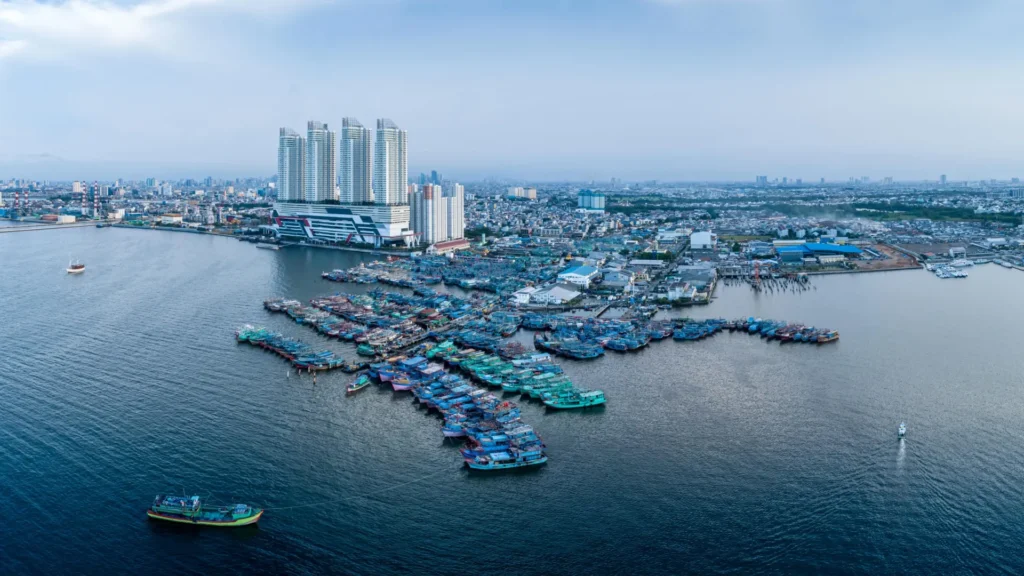
- Jakarta, Indonesia: 13.7 mm/year (with localized areas sinking up to 42 mm/year).
- Tianjin, China: 13.5 mm/year.
- Bangkok, Thailand: 8.5 mm/year.
- Lagos, Nigeria: 6.7 mm/year.
- Alexandria, Egypt: 4 mm/year.
The internal variability within these cities is particularly alarming. In Jakarta, for instance, the ground is so uneven that some neighborhoods are sinking at a rate of over 4 centimeters annually, while adjacent areas may remain stable or even rise. This creates a nightmare scenario for urban planning, where infrastructure cannot be protected by a "one-size-fits-all" flood wall.
The Exception: Isostatic Uplift
It is critical to note that the Earth is not sinking everywhere. In parts of Scandinavia, particularly Sweden and Finland, the land is actually rising. This phenomenon, known as "postglacial rebound," occurs because the Earth’s crust is still slowly springing back upward following the melting of the immense ice sheets that covered the region thousands of years ago. In these specific locations, the rate of land uplift is currently faster than the rate of sea level rise, providing a natural buffer against climate-driven coastal threats.
Official Perspectives: The Need for Integrated Policy
Dr. Julius Oelsmann, the lead author of the study and a researcher at DGFI-TUM, emphasizes the urgency of shifting our scientific and political focus.
"If we want to understand sea-level rise along coastlines and respond effectively, we must not only observe the ocean but also the land itself," Dr. Oelsmann notes. "Especially in densely populated coastal regions, human activities cause the land to subside more strongly. By extracting water and resources that previously stabilized the subsurface, we are effectively removing the foundation beneath our cities."
Florian Seitz, Professor of Geodetic Geodynamics and Director of the DGFI-TUM, adds that the situation is not entirely hopeless. Because human activity is the primary culprit in many regions, human policy can be the cure. "Improved groundwater management, stricter regulation of withdrawals, or targeted recharge of aquifers can at least slow subsidence rates and, in some cases, largely halt them," Seitz explains.
Lessons from the Field: Success Stories in Regulation
The history of Tokyo and the Harris-Galveston region in Texas provide clear blueprints for how policy can mitigate the subsidence crisis.
The Tokyo Model
In the mid-20th century, Tokyo faced a catastrophic subsidence crisis. As the city industrialized and grew, excessive groundwater pumping caused parts of the city to sink by more than 10 centimeters annually, with extreme cases hitting 24 centimeters. Through strict groundwater regulations, the transition to alternative water sources, and heavy investment in infrastructure, the Japanese government effectively halted the sinking. Tokyo serves as the gold standard for how municipal intervention can decouple industrial growth from land subsidence.
The Harris-Galveston Experience
In Texas, the rapid depletion of aquifers to support a booming population and petrochemical industry led to severe land loss in the Harris-Galveston region. In 1975, the state took a decisive step by creating the Harris-Galveston Subsidence District. This regulatory body was empowered to limit groundwater usage and mandate water conservation. By incentivizing the use of surface water and regulating well usage, the district successfully slowed the rate of sinking, proving that localized governance can reverse even severe geological trends.
Future Implications: The Path Forward
The findings from the TUM and Tulane research team underscore a vital shift in climate adaptation strategies. For decades, international climate agreements have focused heavily on carbon emissions and ocean temperatures. While these remain the ultimate drivers of the global sea level, the local experience of sea level rise is dictated by the ground beneath the city.
As we look toward the mid-21st century, the following implications are clear:
- Integrated Monitoring: Coastal cities must invest in high-precision geodetic monitoring (GPS, InSAR, and satellite altimetry) to understand exactly how their land is moving. Global averages are no longer sufficient for local urban planning.
- Water Security as Climate Adaptation: Protecting an aquifer is now just as important as building a sea wall. Groundwater management must be elevated to a top-tier national security issue for coastal nations.
- Urban Planning Reforms: The "weight" of cities must be factored into future development. Planners must consider the geological stability of soil before greenlighting massive high-rise projects in deltaic regions.
The crisis of sinking land is a silent, creeping disaster. Unlike a hurricane or a flash flood, it does not announce itself with a storm surge. However, it is fundamentally changing the map of our world. As the ocean rises to meet the sinking land, the window for effective intervention is narrowing. By treating subsidence as a manageable variable—rather than an inevitable geological fate—coastal communities can buy themselves the time necessary to adapt to a changing climate.
The evidence is clear: the path to coastal resilience must be built from the ground up, quite literally. If nations prioritize groundwater stabilization and land-use regulation today, they may prevent the worst of the flooding that threatens to submerge their future.