

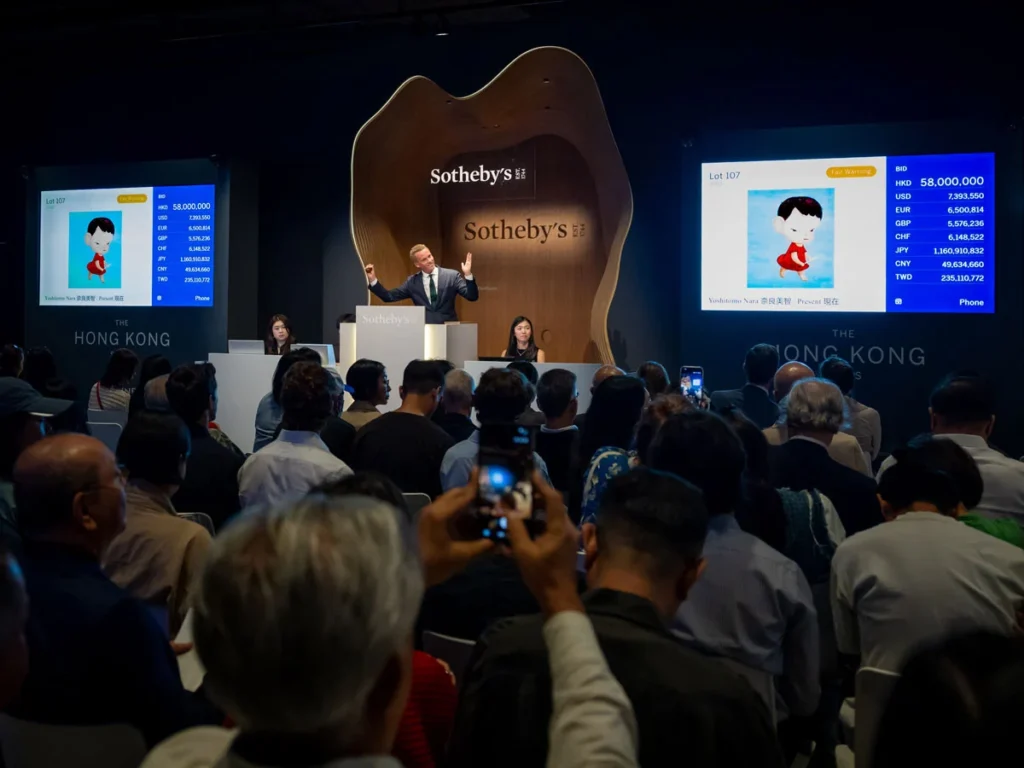
The Hong Kong art market, long the undisputed epicenter of the Asian trade, currently finds itself at a critical crossroads. The autumn 2024 auction cycle, anchored by the "Big Three" houses—Sotheby’s, Christie’s, and Phillips—concluded this week with a total haul of $184.6 million for modern and contemporary art evening sales. While this figure represents a modest increase from the $164.9 million achieved during the spring season, the numbers mask a more complex reality. The market is currently navigating a landscape defined by extreme selectivity, strategic withdrawals, and a macroeconomic environment that has left even the most seasoned collectors hesitant to cross the eight-figure threshold.
Main Facts: A Market in Transition
The headline figure of $184.6 million serves as a testament to the market’s survival, yet it underscores a significant cooling from the feverish heights of 2021 and 2022. The recovery remains strikingly uneven, dictated by a "K-shaped" economic reality across Asia. While the Japanese yen reached a multi-decade low and mainland Chinese equities struggled against a 13-month low earlier this month, other sectors showed surprising strength. South Korea’s semiconductor-led growth and a steady influx of capital from the Middle East into Hong Kong and Singapore have provided a necessary, albeit cautious, floor for the market.
However, the primary market—often the canary in the coal mine—is already feeling the chill. The sudden closure of Tang Contemporary’s Wong Chuk Hang space earlier this month, following reports of significant rent arrears and a sharp contraction in sales, sent a clear signal to the industry: the era of rapid, unbridled expansion in the region has paused. In its place is a market driven by "defensive buying," where collectors prioritize blue-chip provenance and historical significance over speculative "wet-paint" contemporary works.
Chronology of the Autumn Sales: From Momentum to Hesitation
The auction week unfolded in three distinct acts, each reflecting a different facet of the current market psychology.

Monday: Sotheby’s and the "Lewis Effect"
Sotheby’s kicked off the week with a dual-pronged strategy. The evening began with a "white-glove" success: a single-owner collection belonging to British billionaire Joe Lewis. The sale focused on the works of Léonard Tsuguharu Foujita, the Japanese-French master of the "School of Paris." The results were stellar, realizing $8.7 million, with 80 percent of the 15 lots exceeding their high estimates. The top lot, Le rêve (Hommage à La Fontaine) (1949), soared to $3.38 million—nearly seven times its low estimate.
However, the momentum shifted during the main marquee sale. The atmosphere grew somber when the season’s most anticipated lot—Mark Rothko’s 1965 masterpiece Untitled (Plum and Dark Brown)—was withdrawn just hours before bidding was set to begin. Estimated between $9.94 million and $16.3 million, the withdrawal suggested a lack of sufficient pre-sale interest at the required price point. Despite this, the house managed an 88.5 percent sell-through rate for the main sale, buoyed by Yoshitomo Nara’s Present (1994), which fetched $9.13 million.
Tuesday: Christie’s and the Pursuit of "Perfect" Results
On Tuesday night, Christie’s took a more curated approach. The house achieved a 100 percent sell-through rate, but only after strategically withdrawing two major lots—works by Jonas Wood and Cheong Soo Pieng—to protect the "white-glove" status of the evening.
The sale highlighted a growing appetite for European Old Masters among Asian collectors. A notable moment occurred when Peter Paul Rubens’s Landscape with Willows sparked a bidding war, eventually hammering at $1.5 million—150 percent above its low estimate. The top lot of the night, and indeed the entire Hong Kong season, was Jean-Michel Basquiat’s Ancient Scientist (1984), which sold for $9.81 million. While a significant sum, the price sat just above the low estimate, reflecting the difficulty of pushing prices into the double-digit millions in the current climate.

Wednesday: Phillips and the Strategy of Agility
The week concluded at Phillips, a house currently navigating internal turbulence following the departure of its Asia chairman, Jonathan Crockett, and a broader global staff exodus. Operating with a lean catalog of just 16 lots, Phillips generated $6.4 million. The strategy here was one of "niche-filling," focusing on experimental and edgy works. Their top lot was Gerhard Richter’s Abstraktes Bild (522-1) (1983), which sold for $2.93 million. This result was significantly lower than the Richter sold at Christie’s the night before, illustrating how specific periods and media—even within the same artist’s oeuvre—are being scrutinized by buyers.
Supporting Data: The Eight-Figure Ceiling
The data from this season highlights a burgeoning structural challenge: the "shrinking pool" for top-tier trophies. According to market analysts, there is a robust and intuitive buyer base for works priced between $1 million and $5 million. However, once a lot exceeds the $10 million mark, the number of active participants drops precipitously.
| Metric | Sotheby’s (Incl. Lewis) | Christie’s | Phillips |
|---|---|---|---|
| Total Revenue (USD) | $124.3 Million | $92.6 Million | $6.4 Million |
| Top Lot | Yoshitomo Nara ($9.13M) | Jean-Michel Basquiat ($9.81M) | Gerhard Richter ($2.93M) |
| Sell-Through Rate | 91% | 100% (after withdrawals) | 87.5% |
The Basquiat sale at Christie’s is particularly telling. Having previously appeared at a joint Phillips and Poly Auction sale in 2020, the work’s return to the block required "fresh capital"—new high-net-worth individuals who were not active in the market four years ago. The fact that it hammered only slightly above its low estimate suggests that even for "trophy" artists, the days of aggressive bidding wars for repeat-market material are, for now, over.
Official Responses: Navigating the Headwinds
Auction house executives have been quick to frame these results as a sign of market "health" and "stability" rather than decline.

Cristian Albu, Head of Auction and Private Sales for Christie’s Asia Pacific, noted the risks taken with specific consignments. Referring to a Gerhard Richter work executed in oil on wood—a medium rarely seen in the Asian market—he admitted, "We took a bit of a risk… but the consignor had acquired the piece in 2006 for a fraction of its current value." He suggested that more regional education and exhibitions are needed to help Asian collectors contextualize non-traditional media from Western masters.
Ada Tsui, Vice President for Christie’s Asia Pacific, emphasized the resilience of the market for established names like Yayoi Kusama. Despite a Kusama pumpkin painting hammering below its low estimate, Tsui remained bullish: "The artist’s passing was priced in a long time ago… we think this is a very respectable price. Having multiple clients bidding at that level is encouraging."
At Phillips, Dina Zhang, Head of Modern and Contemporary Art for China, addressed the rumors of a regional scale-back. "We remain very competitive in certain categories," she stated, emphasizing a strategy of "transparent feedback" and "flexible consignment" to win over clients who might otherwise gravitate toward the larger two houses.
Implications: The Future of the Hong Kong Hub
The implications of the autumn season are twofold. First, it confirms that Hong Kong remains the essential gateway for international art in Asia, but its dominance is no longer effortless. The market is maturing; the "professionalization" of the Asian collector means that buyers are more price-sensitive and research-driven than ever before. They are no longer buying purely for status but are looking for value and historical importance.

Second, the season reveals a shift in capital flow. The "China-only" focus of a decade ago has been replaced by a more diversified Asian collector base. The strength of South Korean buying and the emergence of Middle Eastern capital are providing a buffer against the domestic economic headwinds in mainland China.
However, the "wait-and-see" approach regarding eight-figure lots suggests that the market will likely remain in a consolidation phase through the end of the year. For Hong Kong to reclaim its momentum, it will need more than just blue-chip names; it will need a stabilization of the broader regional economy and a renewed sense of confidence among the billionaire class that art remains a premier asset class in times of geopolitical friction.
In the words of Yuki Terase, co-founder of Art Intelligence Global: "We have a vast pool of collectors who can comfortably spend up to a few million dollars, but the top-tier market trophies increasingly rely on unlocking fresh capital." For the remainder of 2024, the industry’s focus will be on finding exactly where that new capital is hiding.



