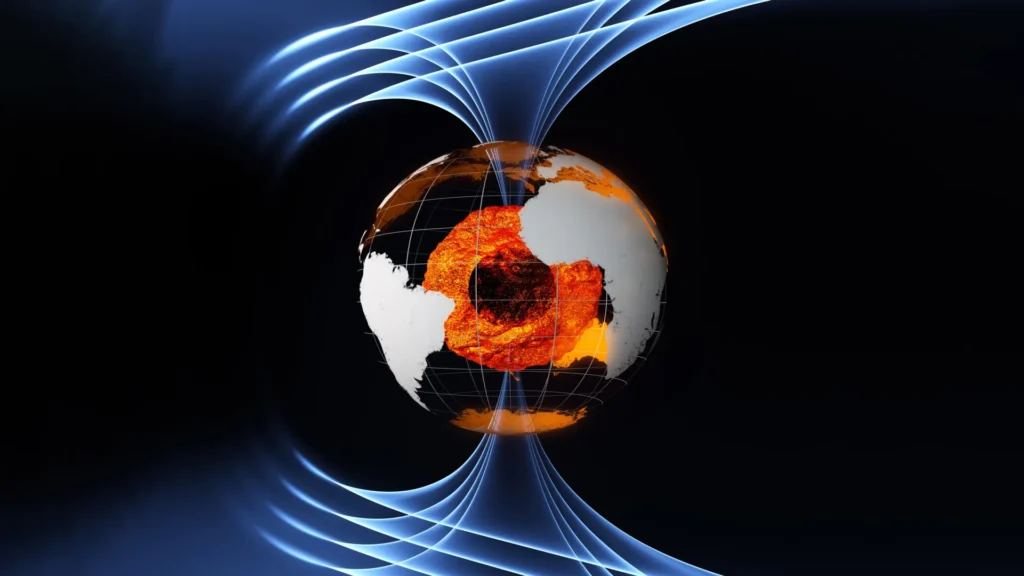
Beneath our feet, 2,200 kilometers below the surface, lies a chaotic, churning ocean of liquid iron. This outer core, a swirling furnace of electrically conducting metal, serves as the engine for Earth’s geomagnetic field—the invisible shield that protects our atmosphere from the scouring effects of solar radiation. For decades, geophysicists operated under the assumption that the fluid motions driving this "geodynamo" were relatively stable, characterized by a persistent, slow westward drift.
However, a landmark study published in the Journal of Studies of Earth’s Deep Interior has shattered that consensus. By synthesizing nearly three decades of satellite and ground-based data, researchers have identified a dramatic and abrupt reversal in the flow of molten material beneath the Pacific Ocean—a shift that began in 2010 and continues to challenge our fundamental understanding of planetary dynamics.
The Pacific Anomaly: A Sudden Shift in the Deep
For years, the scientific community held that the bulk of the outer core’s liquid iron followed a steady westward trajectory. This model was based on long-term observations of the geomagnetic field, which acts as a proxy for the movements occurring at the core-mantle boundary.
In 2010, that pattern encountered a violent disruption. Data indicates that a massive, regional flow of iron-rich fluid beneath the equatorial Pacific pivoted from its traditional weak westward drift to a powerful eastward movement. This was not a minor fluctuation; it was a fundamental change in the core’s large-scale circulation.
"The large-scale flow reversal beneath the Pacific raises new questions about the behavior of Earth’s deep interior," says lead author Frederik Dahl Madsen of the University of Edinburgh’s School of Geosciences. "Scientists now want to understand whether the reversal represents a short-lived fluctuation, part of a repeating oscillation, or a new stable equilibrium for core circulation."
Chronology of Discovery: From Ørsted to Swarm
The discovery of this reversal is the result of a multi-generational effort in space-based geophysics. Tracking the movement of fluid thousands of kilometers underground is notoriously difficult, as the core is shielded by the thick, rocky mantle. Researchers must instead rely on "magnetic fingerprints"—minute fluctuations in the magnetic field measured at the surface.
The study tracks these fingerprints from 1997 through 2025, utilizing a sophisticated "constellation" of missions:
- 1997–2000s: Data from the Danish Ørsted mission and Germany’s CHAMP mission provided the foundational baseline for core behavior.
- 2010: The critical pivot point. Satellite data identified the initial signs of the Pacific flow reversal.
- 2013: The launch of the European Space Agency’s (ESA) Swarm trio of satellites. These highly sensitive magnetometers allowed for unprecedented precision in isolating the core’s magnetic signals from "noise" generated by the crust, oceans, and ionosphere.
- 2017: The occurrence of a "geomagnetic jerk"—an abrupt change in the acceleration of the magnetic field—which researchers linked directly to the ongoing flow reversal.
- 2020–Present: Observations indicate the strong eastward flow beneath the Pacific has begun to weaken, suggesting a potential return to a previous state or the continuation of a complex, long-term cycle.
Supporting Data: The Power of Satellite Precision
The ability to map these movements with such granularity is a triumph of modern engineering. Because the Swarm satellites travel in coordinated, polar orbits, they can effectively "deconvolve" the complex web of magnetic signals.
By stripping away the magnetic noise of the Earth’s surface—such as the influence of currents in the salty oceans and the electrical interactions in the upper atmosphere—scientists were able to isolate the "core-mantle boundary signal." This high-fidelity data revealed wave-like accelerations and rapidly shifting fluid structures that were previously invisible in the coarser datasets of the late 20th century.
The consistency of the Swarm data has been a game-changer. Unlike ground-based magnetic observatories, which are limited by geographic distribution and surface interference, the satellites provide global, continuous, and consistent monitoring. This allows researchers to track the geodynamo in near-real-time, effectively creating a "weather map" of the Earth’s interior.
Official Responses and Scientific Inquiry
The scientific community has responded to these findings with a mixture of excitement and cautious re-evaluation. The discovery suggests that the Earth’s core is far more dynamic than previously modeled.
"This study shows that regional changes can emerge rapidly within just a decade," says Elisabetta Iorfida, ESA’s Swarm Mission Scientist. "The findings may also help scientists investigate possible interactions between Earth’s outer core, inner core, and lower mantle."
Anja Stromme, ESA’s Swarm Mission Manager, emphasized the importance of longitudinal data. "Although Swarm was launched after the dramatic reversal event of 2010, it has provided high-precision data that tell us about Earth’s inner core in the period that followed. It allows scientists to track how core dynamics evolve over time rather than relying on snapshots."
One of the most provocative aspects of the study is the suggested link between the outer core and the inner core. Madsen notes that the rise of the strong eastward flow in the Pacific is contemporary with specific changes in the inner core detected through geodesy and seismology. "We hypothesize that these changes in the deep interior are associated with the changes in flow beneath the Pacific," he explains. This suggests a mechanical coupling between the solid inner core and the liquid outer core that scientists are only beginning to quantify.
Implications: Why the Core Matters to Life on the Surface
While the turbulence in the outer core occurs at a depth inaccessible to human technology, its impacts are felt globally. The geodynamo is the heartbeat of our planet; it generates the magnetic field that deflects lethal solar wind and cosmic rays.
If the core’s flow patterns are more volatile than we once believed, what does that mean for the future of the magnetic field?
- Technological Reliability: Our modern navigation systems, including GPS and satellite-based communication, rely on accurate models of the Earth’s magnetic field. As the field shifts due to underlying core dynamics, these models must be constantly updated to prevent errors in navigation and orbital mechanics.
- Space Weather: The magnetic field is our first line of defense against space weather. Understanding the "turbulent" nature of the core allows researchers to better predict how the magnetic shield might evolve, which is crucial for protecting the global power grid and satellite infrastructure from solar flares.
- Deep Earth Dynamics: The core-mantle boundary is a critical "heat exchange" zone. The fact that the core can change its flow so rapidly suggests that there is a complex, high-energy feedback loop between the core and the mantle. This interaction likely influences the distribution of heat within the planet, which in turn affects long-term tectonic activity.
A New Frontier in Geophysics
The "Pacific Reversal" serves as a stark reminder that our planet is not a static rock, but a living, breathing, and shifting system. The realization that the core can undergo massive, rapid shifts in circulation within a single decade challenges the "steady-state" paradigm that dominated geophysics for most of the 20th century.
As we look toward the next decade of satellite observation, the focus will shift from simply documenting these changes to predicting them. Researchers are now tasked with determining if the 2010 reversal was an anomaly, a sign of a looming, larger-scale magnetic instability, or simply the "background noise" of a planet that is much more active than we once dared to imagine.
For now, the ESA’s Swarm mission continues its silent, orbital vigil. Every revolution around the planet brings in new data, peeling back another layer of the mystery. As Madsen and his colleagues continue their analysis, one thing is certain: the more we learn about the center of the Earth, the more we realize that our planet’s greatest secrets are not found on the surface, but in the churning, metallic heart of the world itself.