Introduction: The Architecture of Becoming
In the quiet, light-drenched corners of Elizabeth Glaessner’s Brooklyn studio, the boundaries between the human, the animal, and the elemental do not merely blur—they dissolve entirely. Glaessner’s practice is defined by a distinct, mythic sensibility that treats the canvas as a primordial site of creation, a threshold where forms are caught in the perpetual act of coming into being. Her paintings do not present static images; they present metamorphic events.
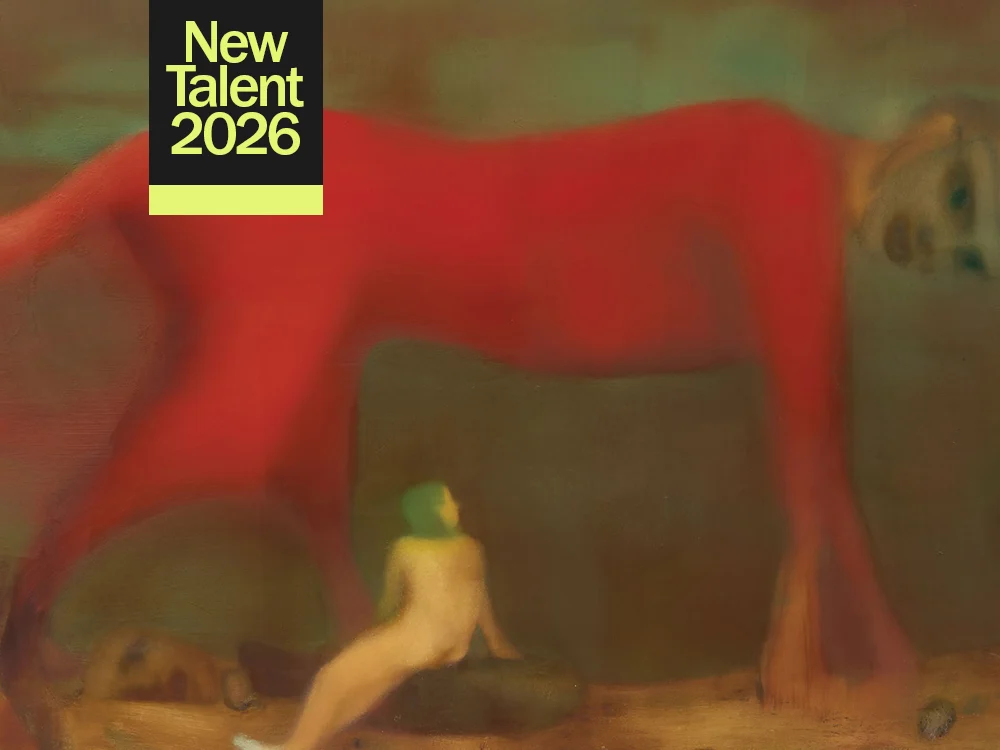
To stand before a Glaessner canvas is to witness a struggle between form and fluidity. In one specific, untitled work currently anchoring her studio space, a humanoid figure is caught in a precarious embrace with a mammalian creature. The figure folds inward, its limbs dissolving into a translucent, greenish mass that suggests a transition from solid bone to atmospheric vapor. This physical porousness—a hallmark of her oeuvre—invites the viewer into a psychological space where traditional definitions of anatomy and identity are rendered obsolete. By leaving these relations open-ended, Glaessner forces the audience to project their own subconscious interpretations, motives, and anxieties onto the canvas, transforming the act of looking into an act of co-creation.
Chronology of a Vision: From ‘Running Water’ to Paris
The trajectory of Glaessner’s career has been one of increasing intensity and scale. Following her acclaimed solo exhibition Running Water, which graced the walls of P.P.O.W. in New York last year, the artist has entered a period of intensive production. This retrospective look at her career reveals a steady movement toward larger, more complex narratives that test the limits of the figurative tradition.
As she looks toward early 2027, the focus of the art world shifts to Perrotin Paris, where Glaessner is currently preparing a highly anticipated exhibition. This upcoming show promises to be a departure point, moving beyond the individual figure to explore larger, multi-panel compositions that challenge the physical capacity of her medium.
The preparation for such a monumental undertaking is not merely technical; it is intellectual and atmospheric. A recent visit to her studio revealed the "DNA" of the upcoming show pinned to the walls. These are not merely sketches, but a dialogue with history and literature. Fragments of Sylvia Plath’s haunting poems—"Metamorphosis" and "Mirror"—sit alongside Beatriz Miralles de Imperial’s poignant lines, "I bring forth voids." These textual touchstones are placed in direct proximity to reference images by the titans of dark art: William Blake’s visionary mysticism, Otto Dix’s visceral realism, and Francisco de Goya’s psychological shadows. This collage of influences suggests that the 2027 Paris exhibition will be a synthesis of internal reflection and external, art-historical confrontation.
Supporting Data: The Anatomy of the Process
Glaessner’s methodology is as much about the physical labor of painting as it is about the conceptual framework. For her upcoming multi-panel triptych, which is expected to feature a cast of at least ten different figure-creatures, the planning process is rigorous.
The Evolution of the Image
Glaessner begins her process with charcoal drawings, treating the canvas as a site of discovery rather than a map to be followed. She describes the process of moving from paper to canvas as a period of "catching."
"It takes time for the figures to ‘catch,’" she explains. "It’s as if the environment is putting tension on the painting and pushing the image to the forefront."
This "tension" is the primary engine of her work. In recent pieces like Hot Spring (2025) and Workhorse (2025), this concept is pushed to its limit. In Workhorse, a feminine figure is rendered in a crouched, animalistic stance, while a smaller, secondary figure—partially obscured by the frame—reaches toward a disembodied head. The edges of these forms are not delineated by crisp lines, but are softened, appearing as if viewed through a lens clouded by steam or condensation. This lack of definition is deliberate, serving to emphasize the "in-betweenness" of the subjects.
Materiality and Sedimentation
Glaessner’s technical approach rejects the sterility of traditional portraiture. Even when working on small, intimate panels, she employs large, heavy brushes. This forces her to use broad, bodily gestures that discourage the artist from falling into the trap of over-definition.
Her process involves a complex layering technique:
- Poured Pigments: The base of the work is established through fluid, unpredictable washes of pigment.
- Oil Layering: Oil paint is applied over the dried pigment, allowing the under-layers to bleed through.
- Incidental Traces: Glaessner embraces the "detritus" of the studio. Stray hairs, sediment, and dust are intentionally (or accidentally) folded into the paint.
These elements serve as a physical record of the painting’s history, ensuring that the final work is a map of accumulated decisions rather than a static replication of a sketch.
Official Responses and Curatorial Perspectives
The critical reception of Glaessner’s work has consistently highlighted her ability to bridge the gap between surrealism and contemporary existentialism. Curators and critics have noted that by eschewing the "finished" look, she creates a space that feels contemporary and urgent.
During the Running Water exhibition, P.P.O.W. noted that Glaessner’s figures function as "vessels of human experience," capable of containing contradictory emotions—joy and sorrow, terror and serenity—simultaneously. Her work is viewed as a necessary antidote to the hyper-defined, digital-first aesthetic of much contemporary art. By returning to the visceral, tactile nature of paint, she forces the viewer to acknowledge the fragility of the human body in a world that is increasingly obsessed with digital perfection.
The upcoming Perrotin exhibition is expected to expand on these themes, particularly the idea of the "void" as a space of potential. As one gallery representative suggested, "Glaessner is not painting people; she is painting the act of becoming human, and the inevitable return to the earth."
Implications: The Future of Figurative Painting
What does it mean to paint the human form in 2027? For Elizabeth Glaessner, the answer lies in the rejection of the "whole" human. Her work suggests that in an age of fragmented identities and shifting environmental realities, the human body can no longer be depicted as a static, sovereign entity.
The Mythic Sensibility
Glaessner’s reliance on mythic archetypes—the animal-human hybrid, the threshold, the metamorphic body—is not an act of nostalgia. Instead, it is an act of reclamation. By invoking the history of Goya and Blake, she is positioning her work within a lineage of artists who understood that the truth of the human condition is often found in its most monstrous, fluid, and unrecognizable states.
Impact on the Viewer
The primary implication of her work is the decentralization of the viewer’s authority. Because her paintings are "unfinished" or "in-process," the viewer is denied the comfort of a clear narrative. We cannot say for certain if the figure in Workhorse is suffering or undergoing a transformation, if the animal is a predator or a protector. This ambiguity creates a unique psychological demand on the viewer. We are not merely observers; we are participants in the instability of the scene.
Final Thoughts
As Glaessner continues to refine her triptych in her Brooklyn studio, the weight of her ambition becomes clear. She is not merely creating art for the sake of aesthetic beauty; she is documenting the "tension" of existence. Her upcoming exhibition at Perrotin will likely serve as a definitive statement on the state of contemporary figuration—a testament to the power of the canvas to hold space for the messy, porous, and perpetually changing nature of life itself.
In a world that demands clarity, Elizabeth Glaessner offers the beauty of the fog. By allowing her figures to blur at the edges, she grants us the permission to exist in that same state of uncertainty—a place where, as she suggests, the environment is always pushing, and we are always in the process of becoming something new.