In the fast-paced world of horology, where brand identity is often defined by singular, iconic silhouettes, Bamford London has carved out a distinct niche. While George Bamford is arguably best known for the bespoke, high-end customization work performed by the Bamford Watch Department, his eponymous brand, Bamford London, tells a different story. It is a story of accessibility, design-forward thinking, and a profound appreciation for the "travel watch."
The current flagship of this mission is the GMT collection. With a staggering 40 distinct variations out of 93 total timepieces currently in the brand’s catalog, the GMT has firmly established itself as the backbone of the Bamford London identity. This review explores the latest iteration: the Bamford London GMT Forged Carbon "Black with White Accents – Gloss Black Dial," a watch that challenges preconceptions about size, material science, and the utility of the multi-timezone complication.

Main Facts: The Anatomy of a Modern Traveler
At its core, the Bamford London GMT is a masterclass in functional design. The watch aims to solve the age-old problem of the frequent flyer: how to track multiple time zones without cluttering the dial or compromising legibility.
The timepiece utilizes the robust Swiss Made Sellita SW330-2 automatic movement. A reliable successor to the venerable ETA 2893, this caliber offers a 4Hz frequency and a 56-hour power reserve. Functionally, it allows for independent adjustment of the GMT hand in one-hour increments via the crown, making it a "caller" GMT that is perfectly suited for the modern traveler.

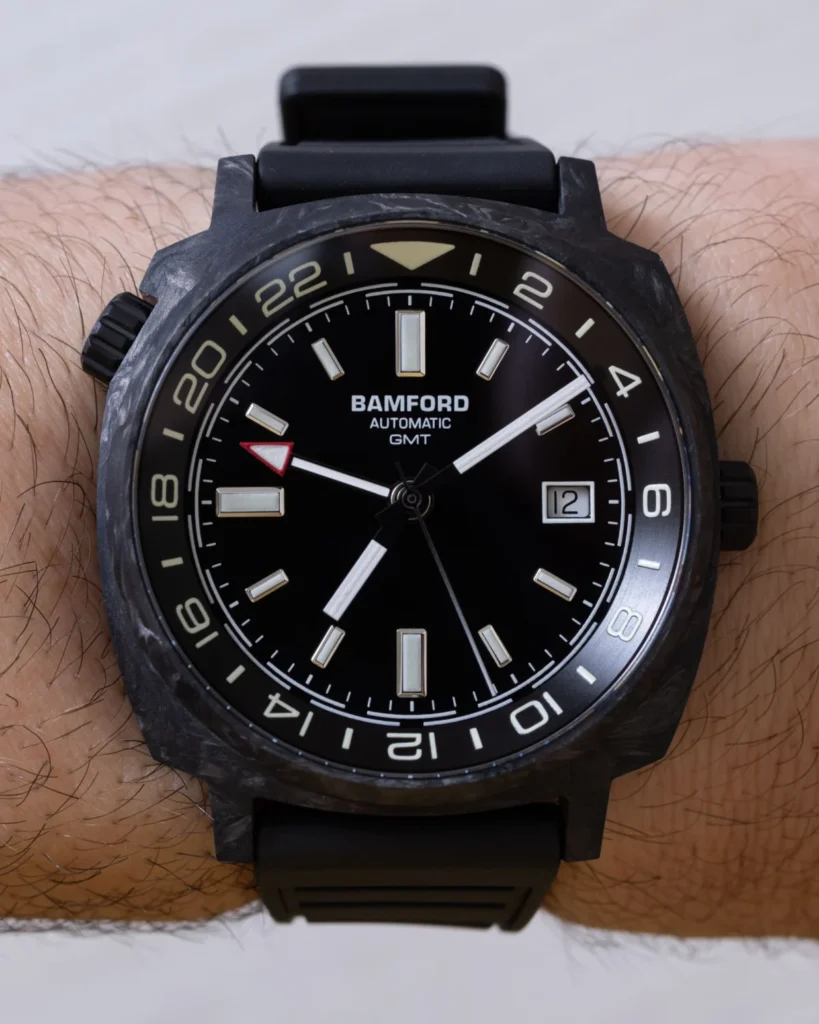
The standout feature of this specific model is the forged carbon case. Unlike traditional stainless steel, forged carbon offers a unique, organic "marbled" aesthetic that is entirely individual to each watch. Beyond the visual flair, the material provides a significant reduction in weight, elevating the watch from a daily tool to a featherweight companion for long-haul flights.
Chronology: From Bespoke Roots to Independent Success
To understand the trajectory of the Bamford London GMT, one must look at the evolution of George Bamford’s career.

- The Early Era (The Customization Years): George Bamford initially rose to prominence through the Bamford Watch Department, a company that became world-renowned for applying PVD coatings and bespoke modifications to luxury timepieces from brands like Rolex and Patek Philippe. This era allowed Bamford to study the "DNA" of the world’s most successful sports watches.
- The Pivot to Originality: Recognizing a demand for his specific design language at a more accessible price point, Bamford launched the Bamford London label. The goal was to create proprietary designs that borrowed the spirit of vintage sports watches while maintaining a distinct, modern identity.
- The Rise of the GMT: The GMT collection was not an overnight sensation; it was a slow, deliberate build. By iterating on dial colors, strap options, and case materials (ranging from steel to titanium and now forged carbon), Bamford transformed the GMT from a singular model into a comprehensive "family" that accounts for nearly half of the brand’s current output.
Supporting Data: Why the "Cushion" Shape Matters
One of the most persistent myths in watch collecting is that a 40mm cushion-style case is "too large." The marketing photography of the Bamford London GMT often creates an illusion of a hulking, oversized timepiece. However, the reality of the dimensions tells a different story.
Technical Specifications:
- Case Width: 40mm
- Thickness: 11.7mm
- Lug-to-Lug Distance: 46.5mm
- Water Resistance: 100 meters
- Crystal: AR-coated sapphire
- Strap Width: 20mm (with quick-release spring bars)
The 46.5mm lug-to-lug distance is particularly critical. It ensures that the watch sits securely on a variety of wrist sizes without the "overhang" common in larger sports watches. While the cushion shape—historically associated with the original Rolex Oyster and early Panerai commissions—often implies a lack of refinement, the Bamford GMT wears with a surprisingly low profile.

The internal rotating 24-hour bezel, operated by a secondary crown at the 10 o’clock position, provides a seamless user experience. By rotating this ring, the wearer can track a third time zone, or, in a pinch, use it as a 60-minute countdown timer. The tactile feedback of the crown is smooth, reflecting the brand’s obsession with the "feel" of a watch—a trait carried over from years of handling the world’s finest horological specimens.
Official Perspectives and Design Philosophy
In discussions regarding the collection, George Bamford has often emphasized the "user experience" over the "heritage chase." He is, by his own admission, a fan of the Rolex GMT-Master II. This is evident in the red arrow GMT hand and the graphic layout of the internal bezel.

However, there is a distinct refusal to simply clone the icons. By choosing an internal bezel rather than a traditional external rotating bezel, Bamford avoids the "homage" trap. The result is a watch that is clearly inspired by mid-century tool watch aesthetics but executed with a modern, industrial, and somewhat "goth-tech" sensibility.
The inclusion of high-contrast white hands and markers against a gloss black dial provides a legibility that is arguably superior to many of the more "cluttered" GMTs on the market. One subtle detail that speaks volumes about the brand’s attention to detail is the seconds hand with a reverse-tapered lume application. It is a microscopic flourish—nearly invisible to the naked eye—that exists simply because the design team felt it made the watch "right."

Implications for the Future of the Brand
The Bamford London GMT, particularly in its Forged Carbon variant, represents a pivot point for the brand. It is an "underdog" in the luxury market, yet it occupies a space where value meets technical competence.
1. The Market Position
At a retail price of £1,800 GBP (or £1,450 for the steel versions), the GMT sits in a competitive "sweet spot." It is affordable enough for the enthusiast who has already purchased a few entry-level pieces, but sophisticated enough (thanks to the Sellita movement and the high-tech carbon case) to hold its own against established luxury brands.

2. The "Collector’s Choice"
The shift toward forged carbon indicates that Bamford is listening to the "seasoned enthusiast." While steel is the standard for the novice, the marbled texture of carbon is an artistic statement. It signals that the wearer is not looking for a traditional status symbol, but rather a piece of modern, lightweight engineering.
3. The Need for Naming
One point of critique remains: the nomenclature. Simply calling it the "Bamford London GMT" is functional, but perhaps lacks the branding punch of a "Deep Diver" or "Mayfair." In a market saturated with "GMT" labels, a unique model name might help the collection transcend its descriptive identity and move into the realm of iconic status.

4. The Verdict
The Bamford London GMT is a triumph of balance. It manages to be sporty without being aggressive, technical without being intimidating, and retro-inspired without being a replica. As the brand continues to expand its offerings, the GMT remains the cornerstone upon which the rest of the collection is built. Whether you are a pilot, a frequent traveler, or simply a fan of high-contrast, lightweight watchmaking, the Forged Carbon GMT is a compelling argument for the modern, independent British brand.
For those who have been hesitant to pull the trigger due to the "large" visual appearance of the cushion case, the advice is simple: try it on. The comfort, the lightness of the carbon, and the sheer utility of the GMT function make it a formidable daily driver that is far more versatile than it appears on a screen.

As we look toward the future, it is clear that Bamford London is not just keeping time; they are setting a pace for how independent watch brands can remain relevant by staying true to their own, albeit unconventional, design ethos.