Introduction: The Ticking Clock of the Frozen North
The Arctic, a region long defined by its crystalline, frozen landscape, is undergoing a profound and rapid transformation. As global temperatures climb, the vast, icy expanse of permafrost—ground that has remained frozen for millennia—is beginning to yield. Buried within this subterranean freezer lies a colossal reservoir of organic carbon, a remnant of ancient ecosystems trapped in time.
For decades, climate scientists have viewed this thawing permafrost with trepidation, fearing that the release of this carbon into the atmosphere would create a catastrophic feedback loop, further accelerating global warming. However, a groundbreaking study published in Nature Geoscience by researchers from the Alfred Wegener Institute (AWI) and MARUM at the University of Bremen has unveiled a more nuanced reality. By investigating the coastal waters of Qikiqtaruk (Herschel Island) in Canada, the team has discovered that the ocean acts as a complex gatekeeper, potentially trapping much of this carbon before it can ever reach the atmosphere.
Main Facts: The Great Carbon Migration
The scale of the carbon stored in the Arctic is difficult to comprehend. The terrestrial permafrost ecosystem contains approximately 1,300 gigatonnes of organic carbon, largely comprised of ancient plant material. An additional 400 gigatonnes are locked away in river deltas and marine sediments.
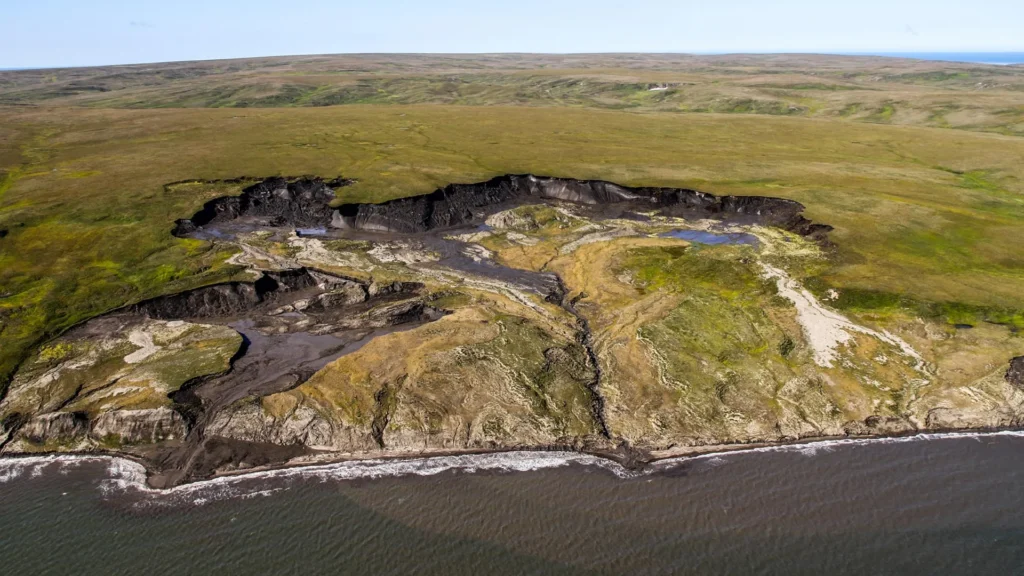
As the Arctic warms faster than any other region on the planet, the structural integrity of the coastline is failing. This erosion, combined with riverine discharge, is funneling carbon into the Arctic Ocean at an alarming rate. Current estimates suggest that up to 0.02 gigatonnes of organic carbon enter the marine environment annually. According to climate forecasts, this outflow is projected to increase by 70 to 150 percent by the year 2100.
Until recently, the scientific community operated under a shroud of uncertainty regarding the ultimate fate of this carbon. Did it return to the atmosphere as a greenhouse gas, or was it sequestered in the depths of the ocean floor? The research led by Dr. Manuel Ruben suggests that while the influx of carbon is significant, the ocean’s role in managing that carbon is far more complex than previously modeled.
Chronology: A Decade of Investigation
The journey to understand this cycle has been a multi-year effort that combines field expeditions with advanced laboratory analysis.
- Pre-2015: Theoretical models identified Arctic coastal erosion as a major, yet poorly understood, variable in the global carbon cycle.
- The Fieldwork Phase: Researchers from the AWI and MARUM established a rigorous monitoring program at Herschel Island. By extracting sediment cores, the team accessed a vertical timeline of the seafloor, effectively reading the history of the region’s carbon deposition over the last 50 years.
- 2020–2023: Laboratory analysis, utilizing sophisticated isotopic tracking, was conducted to distinguish between "old" carbon (from thawing permafrost) and "fresh" carbon (from modern marine life).
- 2024: The culmination of these studies, published in Nature Geoscience, provided the first high-resolution data on the microbial processing of permafrost-derived carbon.
- 2027 (Looking Ahead): The upcoming "Arctic Pulse" campaign is scheduled, aiming to scale these findings to the broader Arctic through a combination of ship-based, aerial, and land-based observations.
Supporting Data: The "Gourmet" Microbes
The most striking revelation of the study lies in the behavior of microorganisms living within the seabed. The researchers utilized isotopic signatures—specifically the 13C and 14C isotopes—to trace the diet of these tiny, single-celled organisms.
The 13C isotope provided the "what" (land-derived vs. sea-derived carbon), while the 14C isotope provided the "when" (old vs. fresh carbon). What they discovered was a distinct preference: the microbial life in the sediment acted like "gourmet eaters." They overwhelmingly favored fresh organic matter, such as recent algal blooms, over the older, more chemically complex carbon released from thawing permafrost.
Consequently, only about ten percent of the organic carbon deposited on the seabed is being converted into greenhouse gases. The vast majority remains buried, effectively locked away in the marine sediment. This suggests that the "carbon bomb" scenario, where all released permafrost carbon immediately converts to atmospheric CO2, may be a significant overestimation.
Official Responses and Expert Analysis
Dr. Manuel Ruben, the lead author of the study, emphasized the gravity of these findings for future climate projections. "Although the sea here carries away huge quantities of organic carbon from the coast, surprisingly little of it ends up in the ocean’s active carbon cycle," Ruben stated. "Our study shows, more precisely than ever before, how much carbon is safely stored in the seabed."
Prof. Gesine Mollenhauer, a geochemist at the AWI and co-spokesperson for the ‘The Ocean Floor – Earth’s Unexplored Interface’ Cluster of Excellence, highlighted the methodology that allowed for this breakthrough. "Carbon isotopes represent our atomic indicators that can identify the food source of the microorganisms," she explained. By identifying that bacteria are selective, the team has provided a new mechanism that needs to be integrated into global climate models.
However, the researchers remain cautious. They acknowledge that the study provides a snapshot of a specific coastal environment and that more variables are at play. As Dr. Ruben noted, "Some of the organic carbon from the permafrost may already have been broken down before it reaches the seabed," meaning that the journey from the soil to the water is a multi-stage process where carbon can be lost or transformed at every turn.
Implications: A New Era of Climate Modeling
The findings from Herschel Island have far-reaching implications, not just for climate science, but for the ecological health of the Arctic.
1. Re-evaluating Greenhouse Gas Contributions
The revelation that microbes prefer "fresh" food sources means that older permafrost carbon is more stable than previously feared. This does not mean it is benign, but it suggests that the "active" contribution to the greenhouse effect from this specific source is smaller than anticipated. Climate models must now adjust their parameters to account for this selective microbial consumption.
2. The Clouding of the Arctic
The physical impact of coastal erosion extends beyond chemistry. As massive amounts of sediment and organic matter enter the water, they significantly increase turbidity. This "cloudiness" limits the penetration of sunlight, which is vital for primary producers like phytoplankton and algae. If these producers cannot thrive, the entire food web—including fish, crustaceans, and the marine mammals that support local Arctic communities—could face severe disruption.
3. The Future of Research: The Arctic Pulse
The path forward is defined by the 2027 ‘Arctic Pulse’ campaign. This initiative aims to bridge the gap between small-scale observations and large-scale regional trends. By utilizing the Polarstern research icebreaker, alongside high-altitude aircraft and land-based sensors, the team hopes to capture a holistic view of the Arctic’s metabolism.
As we look toward 2030 and beyond, the goal is clear: to move from speculative warnings to precise, data-driven predictions. The Arctic is changing, but through the lens of modern geochemical research, we are beginning to understand the mechanisms of that change—and perhaps, identifying the ways in which the Earth’s natural systems are working to buffer the impact of a warming world.
Conclusion
The Arctic remains a volatile frontier. While the "gourmet" bacteria of the seabed provide a temporary reprieve, the continued thawing of the permafrost remains an urgent concern. The research from the Alfred Wegener Institute and MARUM reminds us that the climate system is not a simple machine, but a complex, biological entity. Understanding the intricate dance between ancient carbon and modern microorganisms is not just a scientific exercise; it is a critical requirement for navigating the future of our planet. As we continue to monitor the thawing north, the lessons learned from the sediment of Herschel Island will undoubtedly serve as a cornerstone for the next generation of climate policy and environmental stewardship.