

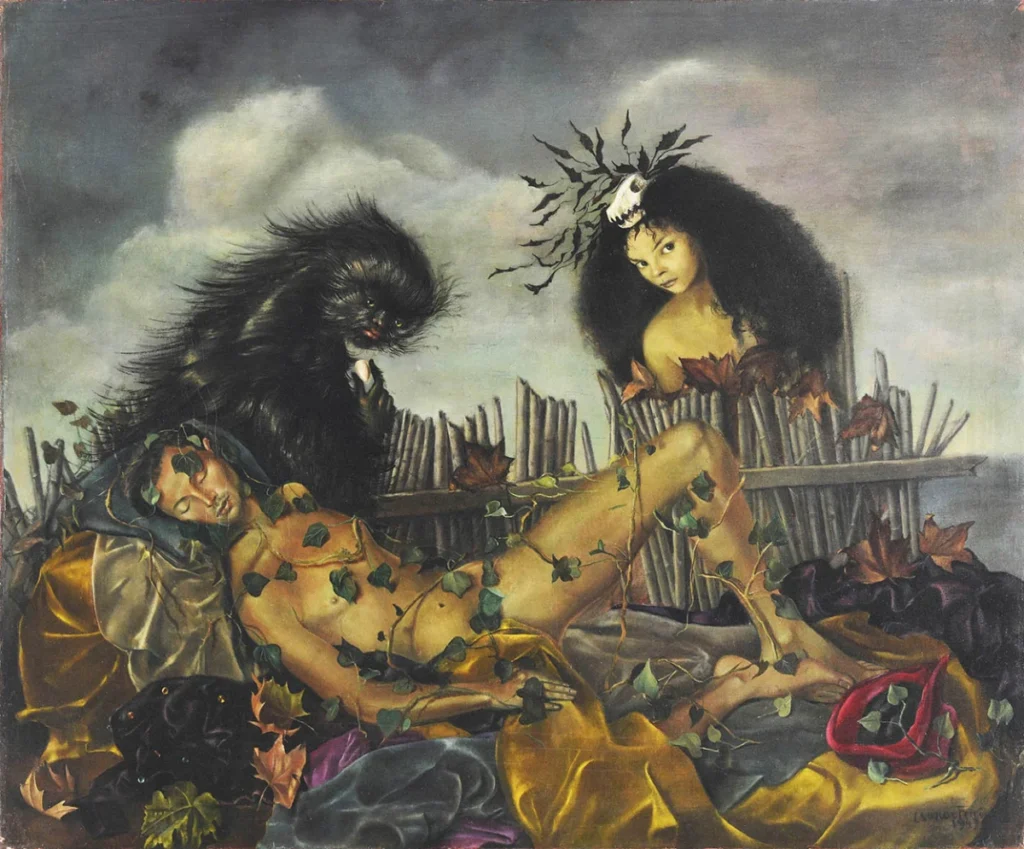
Leonor Fini was an artist who existed in a constant state of flux. To encounter her work—and the legend she meticulously curated around her own persona—is to witness the "sensation of changing dimension, species, and space." Throughout her prolific career, Fini stood as a monumental, if often misunderstood, figure in 20th-century art. While frequently tethered to the Surrealists by critics and historians, she spent her life aggressively distancing herself from their circles, rejecting the misogyny of André Breton, and forging a path that prioritized feminine autonomy, erotic agency, and a fluid, androgynous identity.
As a major retrospective of her work prepares to open at the Schirn Kunsthalle Frankfurt, the art world is finally grappling with the full scope of her legacy: an oeuvre that did not merely illustrate dreams but actively reconfigured the power dynamics of the gaze.
Chronology: A Life of Disguise and Defiance
The foundations of Fini’s aesthetic—a preoccupation with disguise, the liminal, and the theatrical—were laid in the trauma of her childhood. Born in 1907 in Argentina to an Argentine father and an Italian mother, her early years were marked by a harrowing flight from an abusive patriarch. Upon escaping to Trieste, Italy, her mother frequently dressed the young Fini in boy’s clothing to evade the hired kidnappers sent by her father. This childhood paradox—of being simultaneously hunted and protected, hidden and performed—became the bedrock of her creative practice.

The Path to Paris (1930s–1940s)
- 1932: Fini arrives in Paris, quickly becoming a sensation in the orbit of the Surrealists. Her debut is marked by her penchant for provocation; she famously appeared at a café frequented by the movement’s leaders dressed in the robes of a Catholic cardinal, explicitly challenging the gendered boundaries of authority.
- 1936: Her inclusion in the landmark "Fantastic Art, Dada, Surrealism" exhibition at the Museum of Modern Art in New York cements her international reputation.
- 1944: Fini takes on the ambitious task of illustrating the Marquis de Sade’s Juliette. Her twenty-two drawings for the text marked a definitive moment in art history, as she was one of the few women of her era to effectively reclaim the sadistic, erotic imagery traditionally reserved for the male gaze.
The Era of the Ménage à Trois (1950s–1970s)
- 1952: Fini settles into a stable, long-term arrangement with her lovers Constantin Jelenski and Stanislao Lepri. This unconventional domestic life allowed her to cultivate a space that prioritized intellectual and emotional freedom over traditional bourgeois marriage.
- 1960s–70s: Her work matures into a dialogue with art history, incorporating the aesthetics of the Vienna Secessionists (Klimt and Schiele) and continuing her focus on the "sphinx" as a symbol of female power.
- 1996: Fini passes away in Paris, leaving behind a legacy that continues to challenge the definitions of queer identity, artistic independence, and the "woman artist" label.
Supporting Data: The Anatomy of a Myth
Fini’s work is characterized by a specific visual vocabulary: the glossy, idealized finish of the Italian Mannerists, combined with a surrealist penchant for the uncanny. However, unlike the Surrealists who sought to "free" the unconscious, Fini was interested in the sovereignty of the individual.
The Sphinx and the Hybrid
The sphinx, a recurring motif in her paintings, serves as the ultimate distillation of Fini’s philosophy. To André Breton, the sphinx represented the "terrifying" changeability of women. To Fini, it was an empowerment. By merging the feline and the feminine, she created a hybrid creature that was both monstrous and divine, effectively reclaiming the power that had been stripped from women in the classical canon.
The Reversal of the Voyeur
Fini’s subversion of the male gaze is most evident in her depictions of men. In works like In the Tower (Self-Portrait with Constantin Jelenski) (1952), the roles are inverted: the male subject is rendered as a submissive, nude, or peripheral figure, while the female subject—often a proxy for Fini herself—retains the position of the observer and the architect of the scene. She turned the "Venus" archetype on its head, painting men as the objects of the gaze rather than the masters of it.

Official Responses and Scholarly Perspectives
For decades, the art-historical establishment struggled to categorize Fini. She famously hated the label "woman artist," preferring the simple, gender-neutral designation of "artist."
Whitney Chadwick, in her seminal 1991 text Women Artists and the Surrealist Movement, provided a critical turning point for Fini’s scholarship. Chadwick argued that by assuming the form of the sphinx, Fini was not merely painting a monster, but was actively exercising the powers lost to contemporary women. Scholars today point to Fini’s refusal to be the "muse" for the men in her life—despite her romantic entanglements with artists like Max Ernst—as proof of her fierce independence.
Her relationship with Leonora Carrington is frequently cited as a testament to this solidarity. During the Second World War, as Ernst was imprisoned, the correspondence between Fini and Carrington revealed a profound, messy, and deeply supportive bond between two women who refused to be defined by the men who sought to possess them.

Implications: Why Fini Matters Now
The upcoming retrospective at the Schirn Kunsthalle Frankfurt is not merely a celebration of a historical figure; it is a correction of a narrative that has long sidelined those who refuse to fit into neat "isms."
Breaking the Flow Chart of Art History
Fini’s work serves as a reminder of the limitations of art history. Our habit of categorizing artists into schools—Surrealist, Mannerist, Expressionist—often fails to capture the complexity of those who, like Fini, draw from a vast, temporal, and stylistic well. Fini was, in essence, an anachronism. She utilized the techniques of the Renaissance to comment on the psychological states of the 20th century, effectively creating her own timeline.
A New Mythology
Fini’s legacy lies in her construction of a "new mythology." By imagining a world where women are not victims of the unconscious, but rather its masters—priestesses, sorceresses, and sovereign beings—she provided a blueprint for future generations of queer and feminist artists. Her life, spent in a "big house with my atelier and cats and friends," was a political statement in itself: an assertion that one could live outside the traditional structures of the nuclear family and the commercialized art world.

As we look back at her career, we see that Fini was not just painting figures; she was painting the possibility of a different reality. Her work remains a provocation—a demand that the viewer acknowledge the power of the "other" and the transformative potential of living, and creating, without labels. As Fini herself once remarked regarding the androgynous ideal, she sought to unite the rational and the imaginative, the masculine and the feminine. In doing so, she became something entirely her own: a singular, indomitable force in the history of art.



