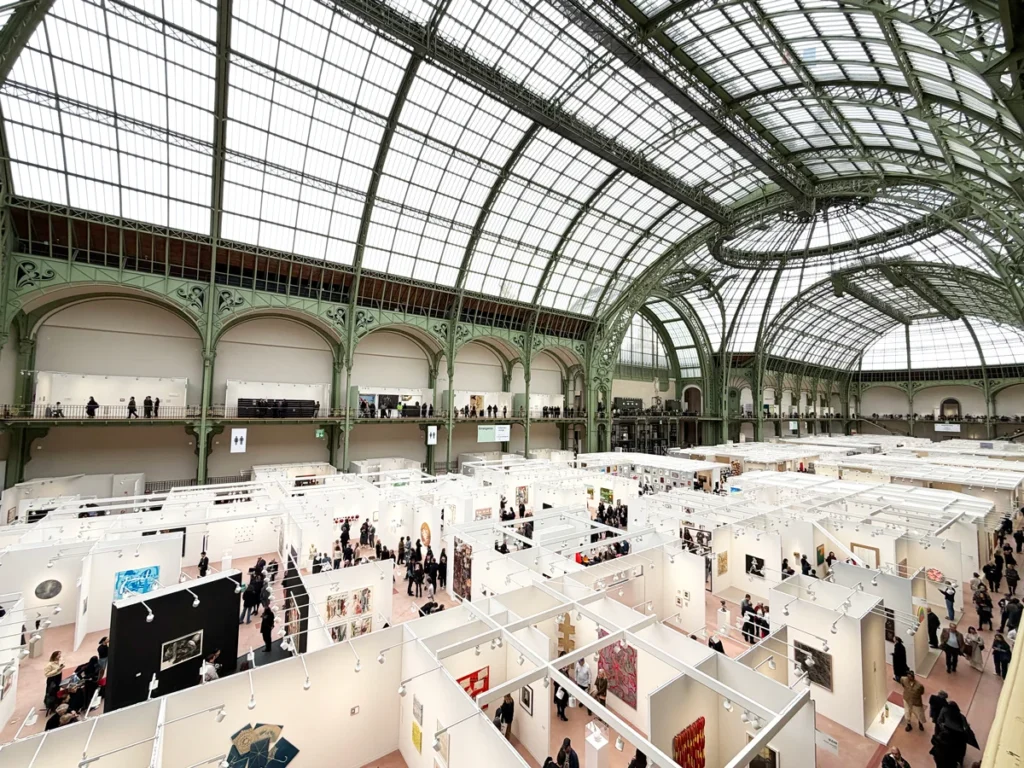
The international art world has converged upon the French capital this week for the 2026 edition of Art Basel Paris, an event that has rapidly evolved from a promising newcomer to the undisputed crown jewel of the European autumn art season. Held within the meticulously restored, sun-drenched nave of the Grand Palais, the fair’s third full-scale iteration marks a definitive shift in the global market hierarchy.
As the Swiss-owned conglomerate continues to refine its French presence, the 2026 fair signals a departure from the "discovery" atmosphere of previous years, pivoting instead toward a high-stakes arena for blue-chip masterpieces. With approximately 200 premier galleries occupying the historic venue, the narrative of the week is clear: Paris is no longer just a romantic destination for the arts; it is the primary engine of the high-end European art trade.

Main Facts: The Transformation of the Grand Palais
Art Basel Paris 2026 is defined by its scale and the sheer density of its financial valuation. While the fair occupies two levels of the Grand Palais, the ground floor has become a concentrated corridor of "trophy" art. Major international powerhouses, including Gagosian, Hauser & Wirth, David Zwirner, and Pace, have brought works that frequently command prices in the six-, seven-, and even eight-figure ranges.
The venue itself serves as a vital protagonist in this commercial drama. The Grand Palais, with its iconic green-painted steel structure and expansive glass ceiling, provides a natural light that few other convention centers can replicate. This architectural prestige mirrors the "maturation" of the fair. As Art Basel’s French subsidiary has grown, it has shed the experimental tentativeness of its early years (when it was known as Paris+ par Art Basel) and fully embraced the "Art Basel" branding, bringing with it a level of corporate polish and VVIP exclusivity that rivals the flagship fair in Switzerland.

The 2026 edition features 195 galleries from 42 countries, showing a slight increase in international diversity, though the dominance of Western blue-chip galleries remains the fair’s economic backbone. The presence of works by Gerhard Richter, Georg Baselitz, and other canonical figures underscores a market that is currently prioritizing "safe-haven" assets over speculative emerging talent.
Chronology: From VVIP Preview to Public Opening
The fair’s trajectory over the first 48 hours illustrates a market that is both resilient and highly focused.

Tuesday: The Avant-Première VVIP Preview
The fair commenced on Tuesday afternoon with the "Avant-Première," an invite-only window reserved for the world’s most significant collectors, museum directors, and advisors. Reports from the floor indicated a frenetic pace of acquisition within the first two hours. Unlike the broader market hesitation seen in late 2024 and 2025, the 2026 Paris preview suggested a renewed confidence among the ultra-high-net-worth (UHNW) demographic.
Galleries reported that many of the eight-figure works—including a significant late-period Richter—were reserved or sold before the clock struck 4:00 PM. The atmosphere was described by attendees as "transactional and efficient," a testament to the pre-fair vetting and digital PDF sales that now precede the physical event.

Wednesday: Consolidating the Gains
By Wednesday, as the second day of VIP previews concluded and the fair prepared for its public opening, the narrative shifted toward mid-market stability. While the "trophy" sales dominated the headlines on Tuesday, Wednesday saw a steady stream of sales in the $100,000 to $500,000 range. Exhibitors noted that while the ground floor remained the center of financial gravity, the upstairs galleries—often featuring more curated, thematic, or avant-garde presentations—began to see significant foot traffic from institutional curators looking for "discovery" pieces that the ground floor’s blue-chip focus had pushed aside.
October 23–25: Public Access and Cultural Programming
As the fair opens to the general public through October 25, the focus expands to include the "Conversations" program and the various city-wide installations. However, for the galleries, the bulk of the commercial heavy lifting is traditionally completed within those first 48 hours, leaving the remainder of the week for networking and public relations.

Supporting Data: The Shift to Eight-Figure Transactions
The data emerging from the 2026 fair highlights a significant "upscaling" of inventory. In 2023 and 2024, the average price point of works sold at the Paris fair hovered in the mid-six figures. In 2026, that average has trended upward, driven by a concentration of secondary-market masterpieces.
- Primary Sales Trends: Several galleries reported selling out their entire booths within the first day. Hauser & Wirth, for instance, highlighted the sale of a major Georg Baselitz painting, while Thaddaeus Ropac saw strong movement in works by Robert Rauschenberg.
- The Richter Factor: A notable Gerhard Richter abstract work was the subject of much discussion, reportedly carrying a price tag exceeding $20 million. Such a listing would have been rare in the fair’s inaugural years but is now a hallmark of the Paris event.
- Geographic Wealth: Data from fair organizers suggests a 15% increase in American collectors attending the Paris fair compared to the previous year, likely incentivized by the "Paris effect"—the combination of high-end hospitality, luxury brand tie-ins (such as those from LVMH), and the perceived decline of London’s Frieze Week as the primary European destination.
Official Responses: Insights from the Organizers and Exhibitors
The leadership at Art Basel has been vocal about the strategic importance of the Paris fair within their global portfolio.

Clément Delépine, Director of Art Basel Paris, remarked on the fair’s evolution: "We have seen a remarkable stabilization of the market in Paris. The Grand Palais is not just a backdrop; it is a catalyst. The galleries have responded to this venue by bringing the very best of their inventory, knowing that the world’s most serious collectors are now making Paris their primary autumn stop."
Exhibitors have echoed this sentiment, though some offer a more nuanced view of the fair’s "maturation." A prominent New York-based dealer, speaking on the condition of anonymity, noted: "The energy is incredible, but the barrier to entry for new artists is getting higher. This has become a ‘masterpiece’ fair. If you aren’t bringing something that belongs in a museum or a top-tier private collection, you risk being overlooked in the noise of the seven-figure deals."

Conversely, the "upstairs" exhibitors—those in the Emergence sector—have praised the fair for maintaining a space for younger galleries. "While the ground floor is about the history of art and big capital, upstairs we are still allowed to take risks," said one Parisian gallerist. "The challenge is ensuring the VVIPs actually make it up the stairs before they finish their champagne and head to the Dior party."
Implications: Paris as the New Capital of the Art World
The success of Art Basel Paris 2026 has profound implications for the global art market, particularly regarding the rivalry between London and Paris. For decades, London’s Frieze week was the undisputed leader of the October calendar. However, post-Brexit regulatory hurdles and the sheer cultural momentum of Paris have tipped the scales.

1. The Institutionalization of the Fair
Art Basel Paris has moved beyond being a mere trade show. It is now an institutional event. The alignment of the fair with major museum openings—such as retrospectives at the Centre Pompidou and the Bourse de Commerce—creates a "Paris Art Week" that functions as a cohesive cultural machine. This institutionalization ensures that the fair remains relevant even during broader economic downturns.
2. The Displacement of Emerging Art
The shift toward high-priced, "safe" blue-chip works poses a long-term risk to the ecosystem of emerging art. If Art Basel Paris continues to prioritize eight-figure sales, the space for discovery may continue to shrink, potentially pushing younger collectors and experimental artists toward satellite fairs or alternative platforms.

3. The Grand Palais as a Commercial Powerhouse
The 2026 fair has proven that the Grand Palais is perhaps the most effective commercial space for art in the world. The architectural "wow factor" contributes to a psychological environment conducive to high-spending. As one collector noted while looking up at the glass ceiling: "It’s hard to haggle over a million dollars when you’re standing in a cathedral of light."
Conclusion
As Art Basel Paris 2026 continues through October 25, the early results confirm that the fair has reached its "adult" phase. It is a polished, high-value, and strategically vital event that has successfully repositioned Paris at the center of the international art trade. While the focus on blue-chip works and high-priced sales reflects a conservative market trend, the vibrancy of the city and the majesty of the Grand Palais ensure that Art Basel Paris is not just a marketplace, but a cultural phenomenon that will define the art world for years to come.

For those attending, the advice remains the same: marvel at the Richters and Baselitzes on the ground floor, but do not forget to climb the stairs to see the future of the medium—and, of course, remember to look up at the ceiling.