
VANCOUVER, BC – Yukon Metals Corp. (CSE: YMC, FSE: E770, OTCQB: YMMCF) has announced a significant milestone in the exploration of its 100%-owned Birch Project in western Yukon. A comprehensive Induced Polarization (IP) geophysical survey has successfully identified a substantial new target zone, reinforcing the company’s hypothesis that the property hosts a robust, intrusive-related mineralizing system. This discovery, situated approximately two kilometres south of previously drilled skarn mineralization, represents a strategic breakthrough in the company’s efforts to unlock the broader potential of its 7,000-hectare land package.
The Core Discovery: A New Frontier in Southern Birch
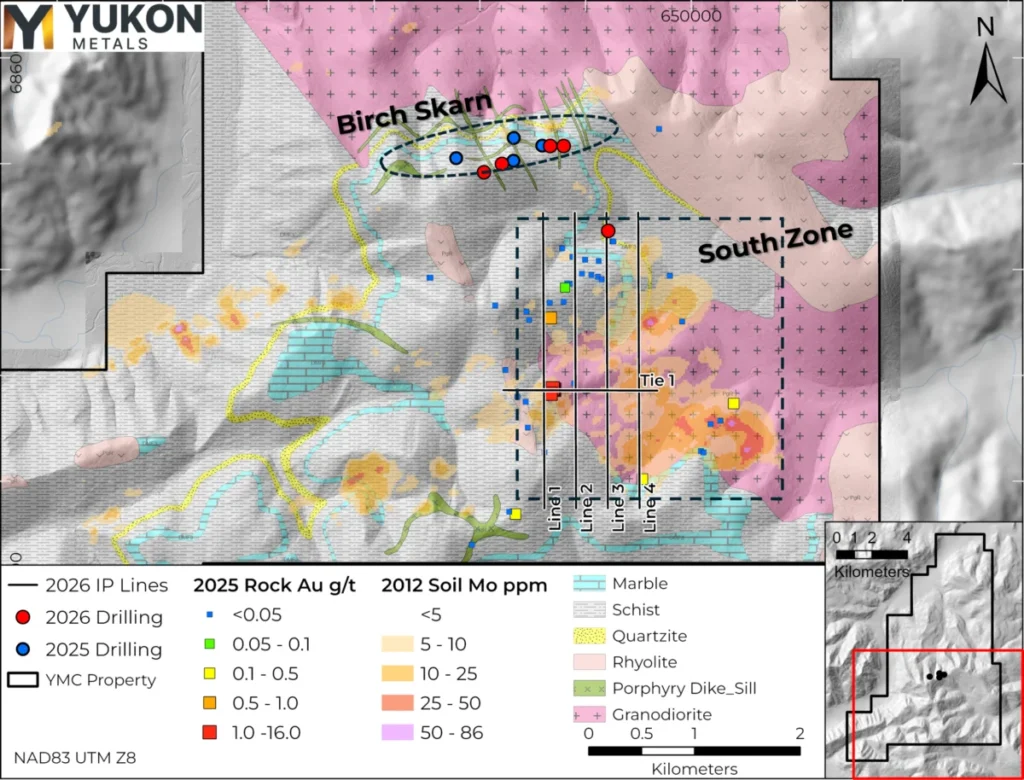
The most compelling development from the 2026 exploration season is the detection of a large, deep-seated chargeability anomaly. According to geophysical data processed by Aurora Geosciences Ltd., this anomaly is present across all four principal survey lines, indicating a continuous subsurface feature that aligns with previous geological, geochemical, and magnetic indicators.
Jim Coates, CEO of Yukon Metals, emphasized the strategic importance of this finding. “The IP survey identified a large chargeability anomaly approximately two kilometres south of the skarn zone we had identified and drilled in 2025,” Coates stated. “The anomaly sits directly beneath the area where geochemistry, geology, and magnetics had already directed our attention. It was subsequently tested by drilling hole 12 this season. The IP data, alongside our completed surface work, provides multiple independent methods that guide our efforts toward a potential major mineralizing system.”
Chronology of Exploration at Birch
The Birch Project, located roughly 65 kilometres northeast of Burwash Landing, has undergone a structured and methodical exploration evolution since the company began its systematic assessment.
2025: Establishing the Baseline
In 2025, the company focused its efforts on near-surface skarn mineralization. The program included 1,685 metres of HQ diamond drilling across six holes. While this phase confirmed the existence of a copper-gold skarn footprint, it also provided the structural and lithological data necessary to hypothesize that the skarn was merely an indicator of a much larger, deeper-seated intrusive source. High-grade grab samples collected during this period—returning values as high as 16 g/t gold, 1,825 g/t silver, and 0.43% copper—validated the area’s prospectivity.

2026: Geophysical Expansion and Subsurface Targeting
Building upon the 2025 successes, the 2026 program was significantly expanded. The company executed 2,600 metres of additional diamond drilling and commissioned a 12.7 line-kilometre 2D IP survey. The survey was designed to bridge the gap between surface observations and the deeper, suspected porphyry-style mineralization. Throughout the summer, follow-up mapping and prospecting further refined the southern intrusive contact, identifying molybdenite and copper-bearing mineralization within the granodiorite host rocks.
Supporting Data: Decoding the Subsurface
The 2026 IP survey utilized an in-line proximal pole-dipole configuration to achieve high-resolution imaging at depth. By passing electrical current through the ground, the team recorded two vital physical properties: resistivity and chargeability.
- Resistivity: This metric helped the team distinguish between rock types. Granodiorite and limestone/marble appear as high-resistivity bodies, whereas schist exhibits lower resistivity.
- Chargeability: This measurement detects the presence of disseminated sulphide minerals—the primary indicators of economic mineralization in porphyry and skarn systems.
The inversion sections generated from the survey revealed that the southern chargeability anomaly resides approximately 400 metres below the surface. Crucially, the survey data highlights that strong chargeability responses often occur at the contacts between resistive features—a classic "contact-style" geological signature where hydrothermal fluids have historically deposited metals.
Implications for the Birch District
The identification of this anomaly is more than just a geophysical data point; it fundamentally shifts the exploration model for the Birch Project. By linking the previously known skarn mineralization to a deeper, broader intrusive source, Yukon Metals is shifting its focus from simple skarn exploration to the search for a potentially massive porphyry-style deposit.
The presence of garnet-pyroxene skarn boulders near the newly refined intrusive contact further supports the theory that the system is fertile. The company is currently awaiting assay results from the 2026 drilling campaign, which will provide the "ground truth" to the geophysical models. Should the drill results correlate with the IP anomalies, it would confirm the existence of a high-priority mineralized zone that could redefine the economic value of the property.

Professional Perspectives and Industry Context
The Yukon territory remains one of the most underexplored mining districts in North America. Following the success of local projects such as Snowline Gold’s "Valley" discovery at the Rogue Project, investor confidence in the region’s potential for district-scale discoveries is at an all-time high.
Helena Kuikka, P.Geo., and VP of Exploration for Yukon Metals, has been instrumental in overseeing the technical validation of the project. By integrating hyperspectral data, geochemical soil sampling, and the new IP survey, the technical team is creating a robust, multi-layered exploration model that minimizes the "hit-or-miss" nature of grassroots exploration.
Addressing the Risks
It is essential to note that geophysical anomalies are not a guarantee of economic mineralization. As outlined in the company’s recent disclosures, while chargeability anomalies are highly indicative of sulphide presence, they can also represent non-economic minerals like pyrite or graphite. Yukon Metals continues to practice rigorous quality control, as evidenced by the 2026 survey methodology, where roughly 3% to 7% of data was removed during processing to ensure that only the most reliable, high-fidelity signals were used to guide drill targeting.
The Path Forward
Yukon Metals is currently in a state of active synthesis. The coming months will be defined by the integration of the following datasets:
- Pending Assay Results: The primary indicator of the success of the 2026 drill program.
- Hyperspectral Analysis: Providing detail on the mineralogy of the alteration zones.
- Refined Target Mapping: Using the IP survey data to prioritize the next phase of drilling.
The company’s management remains optimistic, citing the "shared prosperity" model they have adopted—a strategy that prioritizes local community engagement and sustainable exploration practices. As the company continues to evaluate the Birch district, it positions itself as a key player in the next generation of Yukon mining, leveraging the 30-year legacy of the Berdahl family’s prospecting expertise.

Conclusion
Yukon Metals Corp. has successfully moved the Birch Project from an early-stage prospect to a defined, high-potential exploration target. By effectively utilizing advanced geophysical techniques to "see" through the subsurface, the company has uncovered a compelling target that warrants further aggressive exploration. With a strong treasury, an experienced board, and a proven geological team, Yukon Metals is well-positioned to continue its momentum as it awaits the final results of its 2026 campaign.
For investors and industry observers, the Birch Project serves as a prime example of modern, technology-driven exploration. As the company integrates its new geophysical data with its historical findings, the focus remains clear: unlocking the full, district-scale potential of one of the Yukon’s most promising copper-gold assets.
Disclaimer: This article is for informational purposes only and does not constitute financial advice. Investors are encouraged to conduct their own due diligence and review the company’s full regulatory filings on SEDAR+ before making any investment decisions.