Executive Summary: Advancing Critical Mineral Exploration
Western Star Resources Inc. (CSE: WSR, OTC: WSRIF, FRA: 4K2) has announced a significant milestone in its exploration of the Rowland Tungsten Property, located in Elko County, Nevada. The company has successfully identified two distinct, spatially coherent tungsten-in-soil anomalies following the completion of its Phase 2 geochemical survey.
These findings are pivotal for the company’s strategic objective of advancing its Nevada-based critical mineral assets. By integrating new geochemical data with previous geophysical inversions and historical site mapping, Western Star has effectively expanded the known mineralized footprint of the Rowland property, signaling a robust potential for future drilling programs.
The Strategic Importance of Tungsten
Tungsten is classified as a "critical mineral" by the United States government due to its essential role in defense, aerospace, and high-tech industrial applications. As supply chain security for such materials becomes a national priority, exploration projects like those at the Rowland Tungsten Property in Nevada are gaining increased attention from investors and industry analysts.
Western Star Resources has positioned itself as a key player in this sector, focusing on past-producing assets that hold the promise of modern-day economic viability. The Rowland property, bolstered by historical geological data from the USGS and recent survey successes, represents a cornerstone of the company’s current exploration portfolio.
Chronology of Exploration: From Historical Data to Modern Surveys
The current success at Rowland is the result of a deliberate, multi-phased exploration strategy. The timeline of development highlights the company’s methodical approach:
- Historical Context: The property has been studied since the mid-20th century, with initial geological mapping conducted by the USGS (Coats, 1964).
- July 2026 Breakthrough: Western Star reported high-grade rock-chip assays, including a standout 4.02% WO₃ result, which established the property as a high-priority target for further investigation.
- Geophysical Foundation: Following the initial positive assays, the company commissioned a three-dimensional magnetic inversion study conducted by East Coast Consulting to understand the subsurface structures.
- Phase 2 Soil Survey: In the most recent phase, 315 samples were systematically collected across the property. Lines were spaced 100 meters apart, with sample points at 25 to 50-meter intervals, providing comprehensive coverage across the target areas.
Supporting Data: Detailed Geochemical Analysis
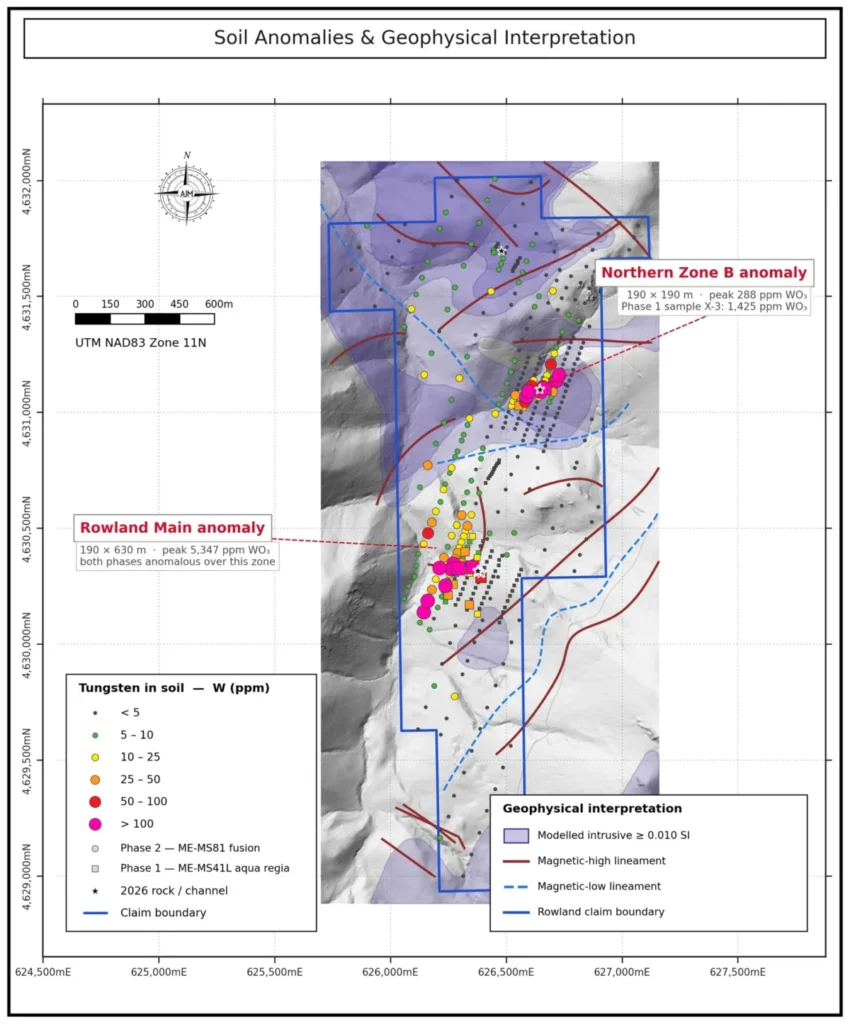
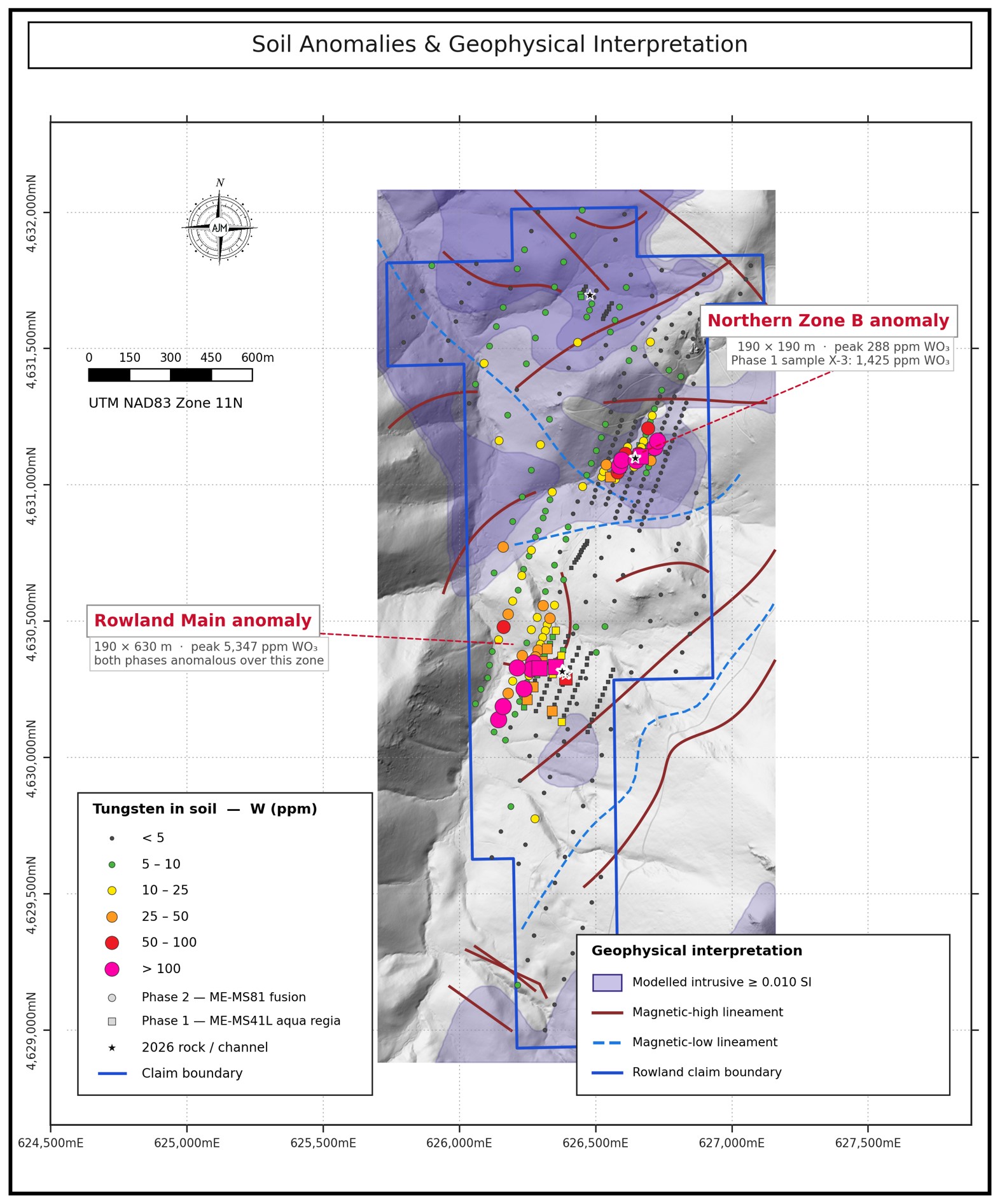
The Phase 2 geochemical survey has successfully demarcated two primary zones of interest: the "Rowland Main" anomaly and the "Northern Zone B" anomaly.
Rowland Main Anomaly
This area, surrounding historical workings, has revealed an impressive mineralization footprint measuring approximately 190 meters by 630 meters. The elongation of the anomaly to the north-northeast suggests a structural control that the company plans to investigate further.
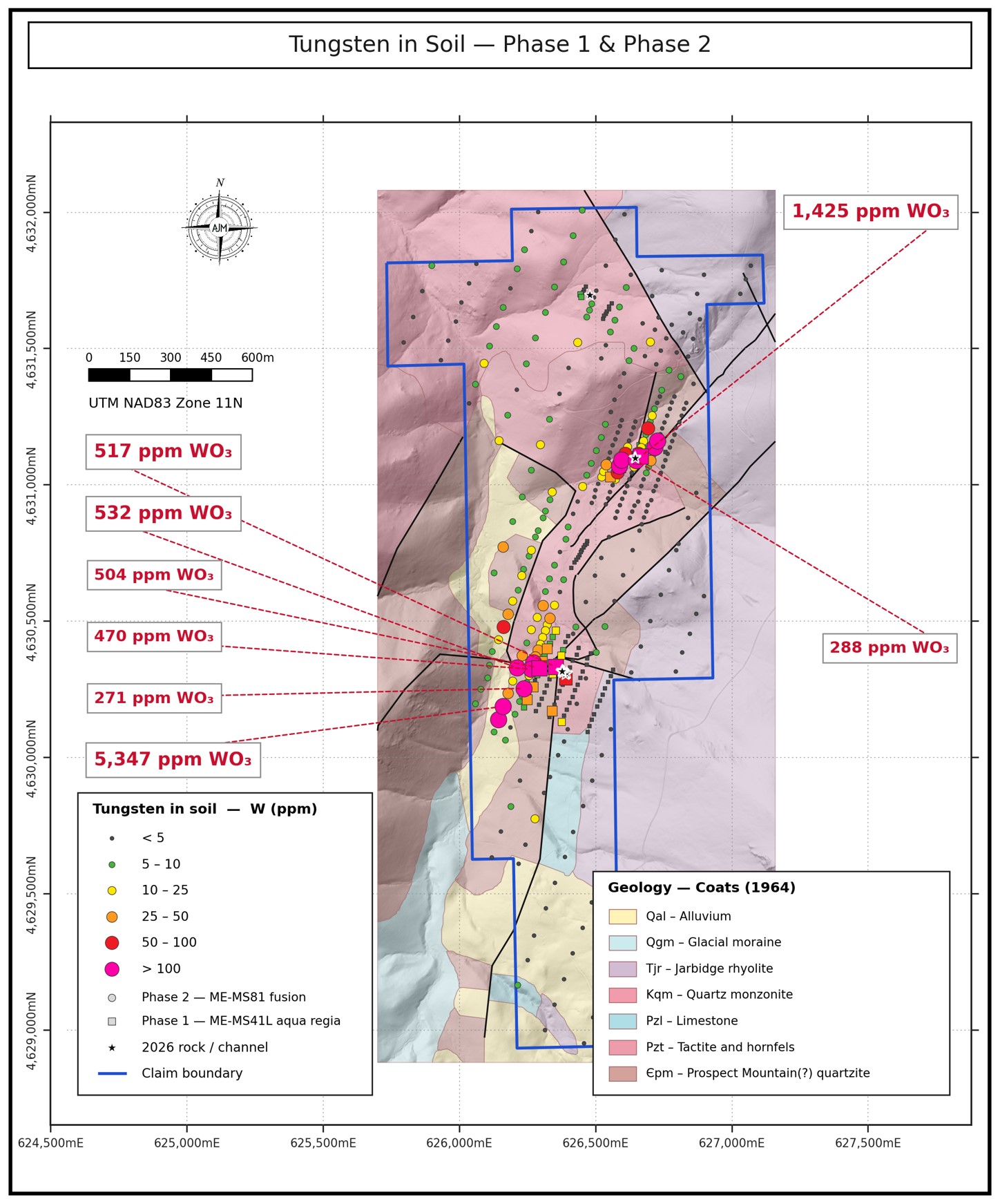
Of particular note is sample R079, which yielded 4,240 ppm tungsten (W). Furthermore, this sample returned 66.9 ppm tin (Sn), compared to a survey median of 2.8 ppm. This specific association—tungsten and tin—is highly indicative of a greisen-modified skarn system, a geological environment often associated with high-grade metal deposits.
Northern Zone B Anomaly
This compact, 200m x 200m zone is centered over tactite and calc-silicate hornfels. The peak value of 228 ppm W confirms that the mineralization in this sector is consistent with previous rock-chip samples that showed grades as high as 1.22% WO₃. Unlike the Rowland Main zone, this anomaly sits directly within the modelled intrusive body, providing a clear geological target for upcoming drill campaigns.
Official Responses and Strategic Vision
Blake Morgan, President and CEO of Western Star Resources, emphasized the significance of testing previously unexplored ground. "These results show our methodical exploration approach is paying off," Morgan stated. "What interests us most is that the strongest result—0.53% WO₃—came from ground nobody has tested before. This discovery extends our known footprint well beyond historical boundaries, proving that the property has significant untapped potential."
The company’s leadership team remains committed to data-driven decision-making. By moving away from relying solely on historical "low-hanging fruit" and instead utilizing modern LiDAR, UAV magnetics, and systematic soil sampling, Western Star is de-risking the project for stakeholders.
Implications for Future Development
The implications of the Phase 2 survey are twofold: geological and operational.
Geophysical Integration
The company has noted that the two anomalies exist in distinct geophysical settings. The Northern Zone B sits within a magnetic susceptibility zone, whereas the Rowland Main anomaly aligns with a magnetic-high lineament. By overlaying these geophysical datasets with the soil geochemistry, the technical team can now "triangulate" the highest probability locations for diamond drilling.
Moving Toward the Drill Bit
The immediate next step for Western Star is to synthesize this data into a comprehensive drill-target model. The objective is to convert these geochemical "hints" into physical drill holes that can define a mineral resource. Additionally, the company is awaiting results from the nearby White Star Tungsten Project, which will further round out their regional understanding of the Jarbidge-Charleston tungsten belt.
Technical Rigor: Quality Assurance and Control
To ensure the integrity of the findings, Western Star implemented a rigorous Quality Assurance and Quality Control (QA/QC) protocol. All samples were processed by ALS Global, an independent, certified laboratory.
Recognizing that tungsten is a refractory metal—meaning it is resistant to standard, less aggressive chemical digestion methods—the team employed lithium borate fusion. This ensures that tungsten hosted in minerals like scheelite and wolframite is fully accounted for in the assay results. The use of field duplicates and certified reference materials provides an additional layer of confidence for investors, ensuring the reported ppm values are both accurate and reproducible.
Forward-Looking Perspectives
While the current results are promising, the company reminds investors that soil geochemistry represents surface-level dispersion. It is a tool for narrowing the search area rather than a guarantee of commercial-grade ore at depth.
Western Star’s forward-looking strategy involves:
- Drill Target Generation: Consolidating the Jarbidge-Charleston footprint into a definitive drilling plan.
- Portfolio Expansion: Continuing to evaluate the White Star property to determine if it shares similar geological characteristics with the Rowland project.
- Capital Efficiency: Maintaining strict cost controls while deploying capital into high-conviction exploration activities.
The successful identification of these anomalies marks a transition for Western Star from an early-stage exploration company to a more mature entity that is actively refining its targets for resource definition. As the company continues to advance, the focus will remain on transparent reporting and technical excellence in one of the world’s most prolific mining jurisdictions.
Disclaimer
This article is provided for informational purposes and does not constitute financial advice. Mineral exploration is a high-risk activity. Investors should conduct their own due diligence and consult with licensed financial advisors before making any investment decisions. The information presented here is based on company disclosures and public regulatory filings as of September 2026.