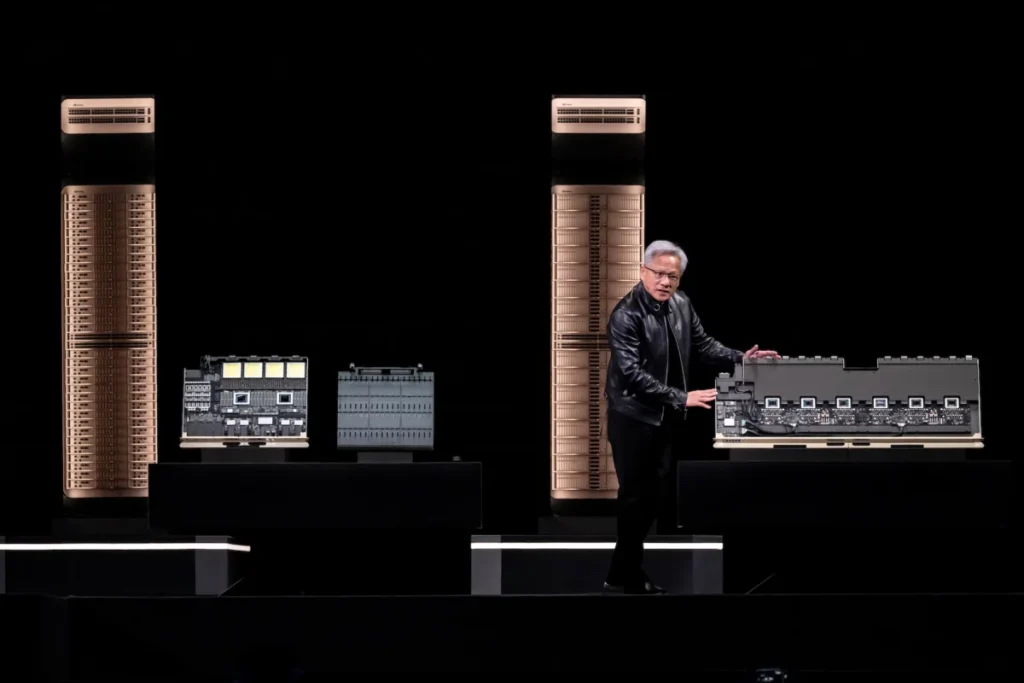
In a seismic shift for the global technology landscape, Amazon Web Services (AWS) and Nvidia have announced a massive expansion of their strategic partnership. This deal, unveiled during Nvidia’s quarterly earnings call, cements a future where the two giants are inextricably linked, despite Amazon’s concurrent efforts to build its own proprietary silicon. The agreement, which includes the deployment of 2 million additional Nvidia GPU chips into AWS data centers between 2027 and 2028, signals that the "AI Gold Rush" is far from cooling down—it is merely entering a more intensive, hardware-heavy phase.
The Core Agreement: A Strategic Infrastructure Overhaul
At the heart of this expansion is a commitment to supply AWS with Nvidia’s most advanced computing hardware. The deal includes the upcoming Blackwell Ultra, Rubin, and Rubin Ultra GPUs. These processors are not merely incremental upgrades; they are the high-performance engines required to train the massive, multi-modal foundation models currently being developed by AI labs worldwide.
Beyond raw processing power, the collaboration extends to the "glue" that holds these systems together: networking hardware. Nvidia’s technology, which enables thousands of GPUs to function as a singular, cohesive supercomputer, will be integrated across the AWS infrastructure. This networking layer is crucial for large-scale AI training, where the speed of data transmission between chips is often the primary bottleneck.
Furthermore, the partnership will see the deployment of Nvidia’s Vera CPUs. These processors, which Nvidia CEO Jensen Huang has identified as a cornerstone of a new $200 billion market opportunity, will be integrated alongside Rubin GPUs or used as standalone compute nodes. The scale of this investment is immense; while financial terms were not disclosed, industry analysts estimate the deal to be worth tens of billions of dollars, reflecting the sheer volume of high-end silicon being moved.
A Chronology of Collaboration: From Pilot to Pervasive
The speed at which this relationship has evolved is unprecedented. Just five months ago, Amazon and Nvidia announced an agreement to deploy 1 million Nvidia GPUs across AWS infrastructure. At the time, that deal was heralded as a major milestone. However, Nvidia noted in its recent statement that "demand has exceeded those expectations."
The accelerated timeline of this new commitment—targeting 2027 and 2028—reflects a market in which "surging demand" from startups, major enterprises, government agencies, and AI research labs has created a permanent state of compute scarcity.
- Early 2024: AWS and Nvidia solidify their initial collaboration to bring large-scale GPU clusters to the cloud.
- Mid-2024: Demand for AI inference and training models skyrockets, leading to capacity constraints across all hyperscalers.
- Late 2024 (Current): The expanded partnership is announced, formalizing the acquisition of 2 million next-generation GPUs and the adoption of Nvidia’s full software stack for robotics and enterprise AI.
- 2027–2028: The planned delivery window for the Blackwell Ultra and Rubin series, marking the next wave of compute capacity for AWS.
The Dual-Track Strategy: Amazon’s Balancing Act
Perhaps the most fascinating aspect of this deal is that it occurs while Amazon is simultaneously positioning itself as a direct competitor to Nvidia. Amazon is aggressively scaling its own custom chip business, which recently crossed a $25 billion annualized revenue run rate.
Amazon’s AI chief, Peter DeSantis, has been clear about the company’s intent to sell its "Trainium" chips to external entities. These chips are designed as a direct alternative to Nvidia’s H100 or Blackwell lines, optimized specifically for deep learning workloads. Additionally, Amazon’s Arm-based "Graviton" CPU continues to gain market share against traditional server processors from Intel and AMD.
By investing in both proprietary silicon and massive Nvidia capacity, Amazon is executing a "hedged" strategy. It ensures that AWS customers have access to the industry-standard Nvidia ecosystem while simultaneously creating a competitive, cost-effective alternative that reduces long-term reliance on a single supplier. This dual approach provides Amazon with significant leverage in future supply chain negotiations and pricing.
Supporting Data: The Engine of Growth
Nvidia’s latest financial disclosures provide the context for why this partnership is so critical. The company reported $96.2 billion in sales for the second quarter, with data center revenue accounting for a staggering $89 billion—an increase of 117% year-over-year.
To maintain this momentum, Nvidia has committed $279 billion to secure supply chain and manufacturing capacity for current and future projects. This includes $92 billion in projected spending for the remainder of the current fiscal year and an additional $87 billion for fiscal year 2028. Such figures illustrate that Nvidia is not merely selling chips; it is building a massive, vertically integrated industrial machine.
For AWS, the motivation is equally data-driven. With over $225 billion in total commitments from AI labs like Anthropic and OpenAI, Amazon must guarantee that it has the hardware to satisfy these contracts. The integration of Nvidia’s software stack—including Omniverse, Cosmos, and Isaac—is designed to turn AWS into more than just a cloud provider; it is becoming a holistic ecosystem for robotics and physical AI.
Official Responses and Industry Outlook
Nvidia CEO Jensen Huang remains bullish on the state of the industry, emphasizing that the focus has shifted from experimental AI to "productive and useful work."
"AI is generating profitable tokens," Huang remarked during the earnings call. "If we had more compute, we could generate more profitable tokens, which results in more profit for all of the services. This is the exact phase where we’re at, which is the reason why everybody’s leaning in."
This sentiment is echoed by Amazon’s heavy capital expenditure. By adopting Nvidia’s "physical AI" stack, Amazon is preparing its warehouse operations for a future dominated by advanced robotics. The adoption of the Jetson platform for entry-level edge AI suggests that Amazon intends to deploy intelligence from the cloud all the way down to the individual robotic unit on the warehouse floor.
Implications: The High-Stakes Future of AI
The implications of this partnership are far-reaching. First, it effectively solidifies Nvidia’s position as the primary architect of the modern AI era. Even as competitors like Amazon develop in-house alternatives, the industry’s reliance on Nvidia’s networking, software, and GPU architecture remains absolute.
Second, the deal raises questions about the long-term sustainability of the current AI investment cycle. As Nvidia and its partners commit hundreds of billions of dollars to infrastructure, the burden of proof rests on the AI companies themselves. They must demonstrate that the "profitable tokens" Huang describes can scale into sustainable business models. If the revenue generated by these AI models does not justify the massive capital expenditure on compute, the industry could face a cyclical cooling period.
Finally, the move toward "physical AI"—where Nvidia’s Omniverse and robotics platforms are integrated into AWS—suggests that the next frontier is not just generative text or images, but the automation of the physical world. By partnering with Amazon, Nvidia is gaining access to one of the world’s largest logistics networks as a laboratory for its robotics research.
As we look toward 2028, the partnership between Amazon and Nvidia serves as a microcosm of the entire AI industry: a complex web of intense competition and deep-seated cooperation. While Amazon aims to build its own future, it recognizes that for the time being, the most efficient path to scaling AI remains through the gates of the Nvidia ecosystem. For investors, tech leaders, and the public, the next few years will be defined by whether this massive investment in silicon leads to a true productivity revolution or a costly correction in the AI market.