

In the late 1950s, as the Cold War reached a fever pitch, the United States Air Force drafted a plan that, by today’s standards, sounds like the fever dream of a science fiction novelist. Codenamed "Project A119," the initiative—officially titled A Study of Lunar Research Flights—proposed the detonation of a nuclear device on the surface of the Moon. While the plan was eventually shelved in favor of the more optics-friendly Apollo program, the documents remained classified for decades, serving as a chilling reminder of the era’s unchecked hubris. Today, this dark chapter of history is being excavated not just by historians, but by contemporary artists who see the project as a mirror to our own geopolitical anxieties.
The Genesis of a Lunar Explosion: Main Facts
In 1958, the U.S. military and intelligence communities were reeling from the successful launch of the Soviet satellite Sputnik. The psychological impact on the American public was profound; the "Space Race" was not merely a scientific competition, but an existential battle for ideological supremacy. Project A119 was born from this desperation.
The primary objective was two-fold: scientific discovery and psychological warfare. Scientists involved in the project believed that a nuclear explosion on the Moon would create a dust cloud that could be illuminated by the Sun, making the blast visible from Earth to the naked eye. The goal was to provide a "show of strength" that would cow the Soviet Union and bolster sagging American morale. The researchers theorized that the detonation would provide invaluable data regarding the lunar surface’s composition, as well as the effects of nuclear radiation in a vacuum—a testing ground that, conveniently, was thousands of miles away from American soil.
A Chronology of Hubris: From 1958 to the Present
- 1958: The U.S. Air Force formalizes A Study of Lunar Research Flights. Research is conducted by the Armour Research Foundation, involving prominent scientists, including a young Carl Sagan.
- 1959: Following intense internal deliberation, the project is officially terminated. The risks of radioactive fallout, the potential for a failed launch to rain nuclear material back onto Earth, and the moral implications of "defiling" the Moon lead officials to pivot toward the manned Apollo program.
- 2000: The existence of the project is finally brought to light when Leonard Reiffel, the physicist who led the research, publicly discloses the classified details.
- 2019: President Donald Trump announces the formation of the U.S. Space Force, renewing interest in the militarization of space.
- 2026–2027: Artist Jitish Kallat debuts Wall Drawing / Redux: A119 at the Menil Drawing Institute in Houston, Texas, recontextualizing the historical documents for a modern audience.
Supporting Data: The Mechanics of the Plan
The feasibility study for Project A119 was remarkably detailed, even by modern standards. The researchers determined that a W25 warhead—a small, lightweight nuclear device—would be the optimal payload. The blast, detonated on the "terminator" (the line between light and shadow on the lunar surface), would theoretically create a massive plume of dust that would remain visible from Earth for weeks.
Despite the technical rigor, the logistical challenges were immense. Guidance systems of the late 1950s were primitive, and the probability of a "miss"—where the rocket might stray from its trajectory or fail during the launch sequence—was unacceptably high. The Air Force concluded that the potential for a catastrophic disaster, such as a rocket carrying a live nuclear warhead crashing back into the American atmosphere, rendered the project far too risky.

Official Responses and the Legacy of Secrecy
For decades, the U.S. government remained silent on the existence of the lunar nuke plan. When the story finally broke at the turn of the millennium, the reaction was a mixture of public shock and historical skepticism. It highlighted a recurring theme in American military history: the tendency to prioritize technological dominance over environmental and ethical caution.
The legacy of this secrecy persists. In recent years, the rhetoric surrounding space has shifted from international cooperation to overt competition. Following the establishment of the Space Force, rhetoric regarding the ownership of celestial bodies has intensified. When political figures assert that "the Moon is ours," it evokes the same Cold War anxieties that fueled the original A119 project. The recent disclosure that the U.S. has stationed defensive weaponry in Earth’s orbit serves as a modern coda to the 1958 proposal—proof that the desire to exert force beyond our atmosphere has never truly left the policy table.
The Artistic Intervention: Jitish Kallat at the Menil
It is against this backdrop of renewed celestial tension that Mumbai-based artist Jitish Kallat has unveiled his latest work. Located in Houston—a city inextricably linked to the history of lunar exploration—Wall Drawing / Redux: A119 serves as a bridge between the clinical, cold calculations of the 1950s and our present-day unease.
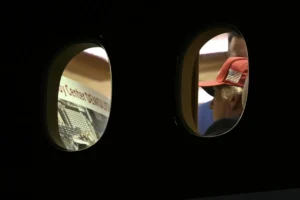
Kallat’s installation is a masterclass in metaphor. By printing redacted pages of the declassified A119 report onto a wall covered in "smart glass"—a material that oscillates between transparency and opacity via electrical currents—Kallat forces the viewer to confront the nature of state secrets. As the glass darkens and clears, the text emerges and disappears, mirroring how information in the intelligence community is revealed, buried, and manipulated.
"There was the question of what constituted a drawing," Kallat explained, "but also what constitutes a wall. Could a wall have a window, and could they go together?" The result is a visceral experience. The viewer is not merely reading a document; they are witnessing the act of erasure.

Implications: The Moon as a Commons or a Battlefield?
The implications of Project A119, and its artistic exploration, extend far beyond the history books. In 1979, the United Nations drafted the "Moon Treaty," which declared the Moon and other celestial bodies the "common heritage of mankind." The treaty sought to prevent exactly the kind of unilateral militarization envisioned in 1958. Yet, as Kallat’s sculptural work Moon Treaty (2025) suggests, the reality is far messier. The sculpture, featuring crumpled aluminum facsimiles of the treaty on the gallery floor, serves as a poignant critique of how easily international agreements are discarded when national interests are at stake.
The tension between space as a scientific frontier and space as a strategic theater is the central conflict of our time. While the scientific community celebrates the potential for lunar bases and mining operations, the military-industrial complex continues to view the vacuum of space as the "high ground."
Kallat’s work forces us to ask: What happens when our reach exceeds our moral grasp? The documents of Project A119 reveal a moment when humanity stood at the precipice of altering the face of the Moon, not for the sake of knowledge, but for the sake of intimidation.
Conclusion: A Window into Our Future
As we look toward the next decade of space exploration, the shadow of A119 looms large. Whether through the lens of artistic inquiry or political discourse, the lessons of the past remain clear: the technologies we project into the heavens are a reflection of the anxieties we hold on the ground.
By utilizing archival materials, lenticular prints, and the very architecture of the Menil Drawing Institute, Jitish Kallat has transformed a forgotten military report into a contemporary cautionary tale. His work, alongside the ongoing debates in Washington, reminds us that the Moon remains a "fugitive" entity—beautiful, distant, and perpetually at risk of becoming a casualty of human hubris. We must decide if the next chapter in space exploration will be defined by the "golden records" of Voyager 1 and 2—those hopeful capsules of human culture intended for the stars—or by the radioactive dust of a nuclear detonation. The choice, as always, remains a matter of optics.