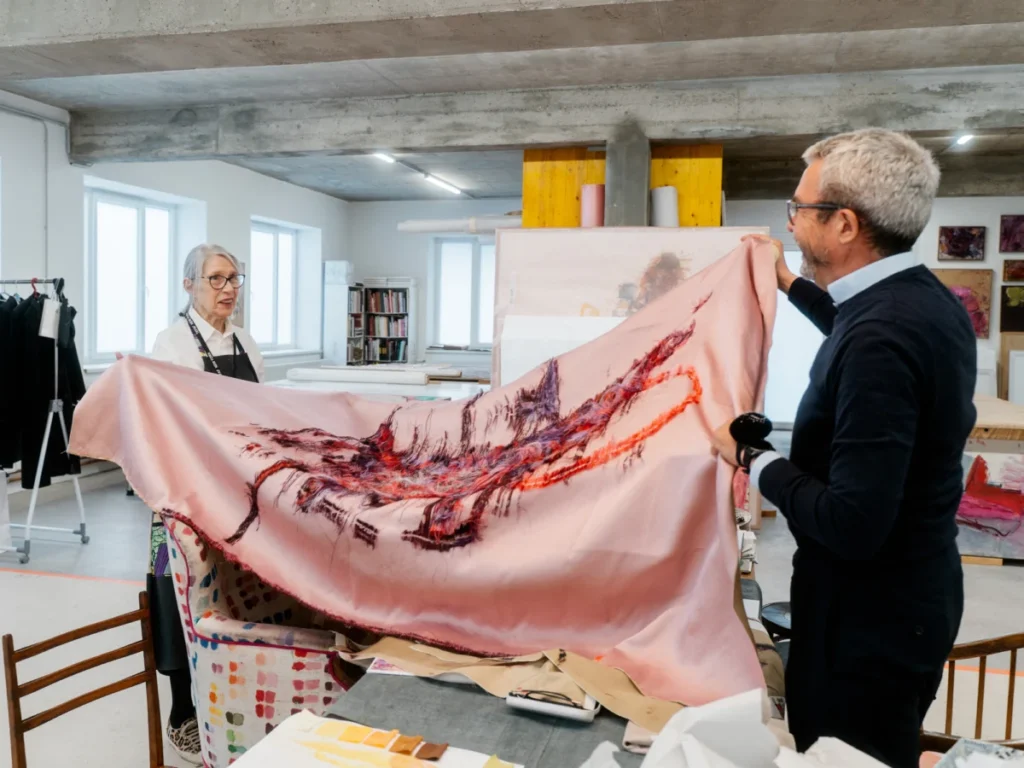
For Albert Kriemler, the creative director of the Swiss luxury powerhouse Akris, the boundary between a gallery wall and a runway is not merely thin—it is nonexistent. Since taking the helm of the family-owned house in 1980, Kriemler has curated a career defined by a relentless, intellectual pursuit of aesthetic synthesis. His work does not simply "feature" art; it inhabits the philosophical frameworks of the artists he admires, transforming the two-dimensional canvas into the three-dimensional architecture of modern clothing.
A Legacy Forged in Fabric and Form
The origins of Kriemler’s artistic obsession are rooted in his formative years. Growing up amidst the hum of fabric fairs and the tactile intensity of the Swiss textile industry, Kriemler was exposed to the mechanics of creation before he was even a teenager. His family, the founders of Akris, provided the technical sandbox, but it was the spectacle of high fashion that provided the vision.
He recalls attending the legendary runway shows of Yves Saint Laurent, a master of cultural alchemy who famously bridged the gap between the studio and the museum. Saint Laurent’s ability to render the works of Vincent van Gogh, Georges Braque, and Piet Mondrian into wearable silhouettes left an indelible mark on the young designer. It was a foundational lesson: fashion could be a vehicle for intellectual discourse, not just a response to seasonal utility.
Chronology of a Creative Dialogue
Kriemler’s integration of art into the Akris identity has been a methodical evolution. The formalization of this practice began in earnest during the brand’s 2004 Paris runway debut. For that landmark event, Kriemler drew inspiration from the Swiss-French painter Félix Vallotton, utilizing the artist’s distinct color palette to anchor the collection.

- 2004: The Paris debut, inspired by the tonal precision of Félix Vallotton, marks the brand’s shift toward art-led design.
- 2014: A pivotal moment in technical experimentation occurs as Kriemler collaborates with German photo artist Thomas Ruff. The collection features LED-equipped garments, merging the “Stars” series with cutting-edge textile engineering.
- 2022-2026: A period of deep exploration where Kriemler pivots toward unconventional textures. From the pixelated abstraction of Reinhard Voigt to the golden, sculptural textile works of Olga de Amaral, the collections grow increasingly bold.
- 2027: The exploration of Austrian painter Martha Jungwirth’s work highlights the importance of natural substrates, mirroring the designer’s own commitment to organic materials.
The Methodology: Beyond the Surface
For many fashion houses, “collaboration” involves printing a masterpiece onto a silk scarf or a hoodie. For Kriemler, it is a process of deep immersion. His work with Colombian artist Olga de Amaral—a 94-year-old visionary—serves as the quintessential example. Kriemler did not merely view her work; he spent days in her Bogotá home, dissecting her approach to light, gold leaf, and the structural integrity of textiles.
"I found out that when you get involved in an artist’s work and how she does art, you get a much broader base for inspiration," Kriemler explains. "You learn how she thinks about color, how she thinks about light, how she thinks about proportion."
This philosophy prevents the clothing from becoming a pastiche. Instead, the collaboration influences the very structure of the garment. In his Fall 2026 collection, the influence of de Amaral’s large-scale textile pieces pushed Kriemler out of his comfort zone of "luxurious understatement." The result was a high-octane display of shine, texture, and radical color that challenged the traditional Akris aesthetic while maintaining its inherent sophistication.
Technical Synergy and the "New Playground"
Kriemler’s genius lies in his ability to pair high-concept art with high-end technology. His fascination with the "Stars" series by Thomas Ruff led him to the doorstep of Forster Rohner, a fabric house in St. Gallen. By working with them to develop electronic-enabled embroideries, Kriemler created clothes that literally pulsed with light, mimicking the night sky.

"It’s always interesting when you can infuse new technologies into the workmanship process, because you create a new appearance," he notes. "It’s like a new playground." This willingness to experiment with the "how" of manufacturing—not just the "what" of the design—has made Akris a darling of both the art world and the technical fashion community.
Supporting Data: The Artist’s Toolkit
Kriemler’s roster of collaborators reads like a curator’s wishlist, yet he consistently avoids the "blue-chip" trap, preferring talents who are on the cusp of redefinition or who operate in niche spaces.
- Carmen Herrera: Her abstract color planes informed the geometry of Akris tailoring.
- Reinhard Voigt: His pixelated oil paintings provided the blueprint for digitized textures.
- Rodney Graham: His multimedia approach allowed for a deconstruction of the traditional "look."
- Martha Jungwirth: Her use of natural linen as a canvas inspired a recent return to raw, earthy materiality.
By selecting artists whose work touches on the fundamental elements of fashion—structure, pigment, and texture—Kriemler ensures that the collaboration is not a marketing stunt, but a genuine exchange of creative energy.
Official Responses and Creative Philosophy
In industry circles, Kriemler is regarded as a "designer’s designer." His reputation for discretion and intellectual rigor has earned him unprecedented access to the archives and studios of the world’s most reclusive artists. Unlike designers who seek out the spotlight, Kriemler views himself as a conduit.

When asked about his process, he emphasizes the importance of the "unexpected." His travel habits are telling: he prefers to visit museums one hour before closing to avoid the noise of crowds, allowing him to experience works in a vacuum of silence. This was how he discovered the work of Vilhelm Hammershøi at the Musée Jacquemart-André in 2019—a moment that remains a benchmark for his creative process.
Implications for the Future of Fashion
The implications of Kriemler’s model are significant for the luxury industry. As the fashion world grapples with the dilution of creative identity through rapid-fire trend cycles, the Akris approach offers a blueprint for longevity. By anchoring a brand in the timelessness of art, Kriemler has ensured that Akris collections remain relevant long after their respective seasons.
Furthermore, his dedication to the local ecosystem of St. Gallen—the historic center of Swiss embroidery—proves that global artistic inspiration can be realized through local craftsmanship. He is not looking to outsource his vision; he is looking to elevate his region’s technical capabilities through the lens of international art.
Conclusion
Albert Kriemler does not design clothes; he constructs a dialogue. By treating the runway as a space for artistic inquiry, he has elevated the Swiss fashion house of Akris into a unique position within the luxury landscape. Whether he is working with gold-leaf tapestries or LED-embedded silk, his commitment remains the same: to honor the artist, respect the material, and redefine the silhouette. In a world that often prioritizes the ephemeral, Kriemler’s work stands as a testament to the enduring power of creative collaboration, proving that when art and fashion intersect, the result is nothing short of transformative.