As rescue teams across Colombia’s northern departments race against the critical 72-hour "golden window"—the period most vital for pulling survivors from the rubble of collapsed buildings—the region is grappling with a secondary, profound loss. While the nation’s attention remains fixed on the urgent humanitarian crisis following Monday’s powerful 7.4-magnitude earthquake, the cultural heartbeat of the country’s renowned "Zona Cafetera" (Coffee Triangle) is flickering in the shadows of the disaster.
For the states of Caldas, Risaralda, and Quindío, the earthquake has done more than just level homes and businesses; it has fractured the region’s cultural infrastructure. Early assessments indicate that at least 14 museums have sustained significant damage, with the Museo de Arte de Pereira—the premier contemporary art institution of the region—left in a state of precarious, structural vulnerability.
A Chronology of the Disaster
The seismic event struck on Monday, sending shockwaves through the heart of Colombia’s coffee-growing region. Located just 35 miles from the epicenter, the city of Pereira, home to nearly 500,000 residents, bore the brunt of the impact.
By Monday evening, as the initial dust began to settle, the severity of the institutional damage became clear. Alejandro Garces, a curator at the Museo de Arte de Pereira, utilized social media to broadcast the grim reality. Through a series of urgent Instagram posts, Garces shared imagery of a building that had been rendered a shell of its former self.

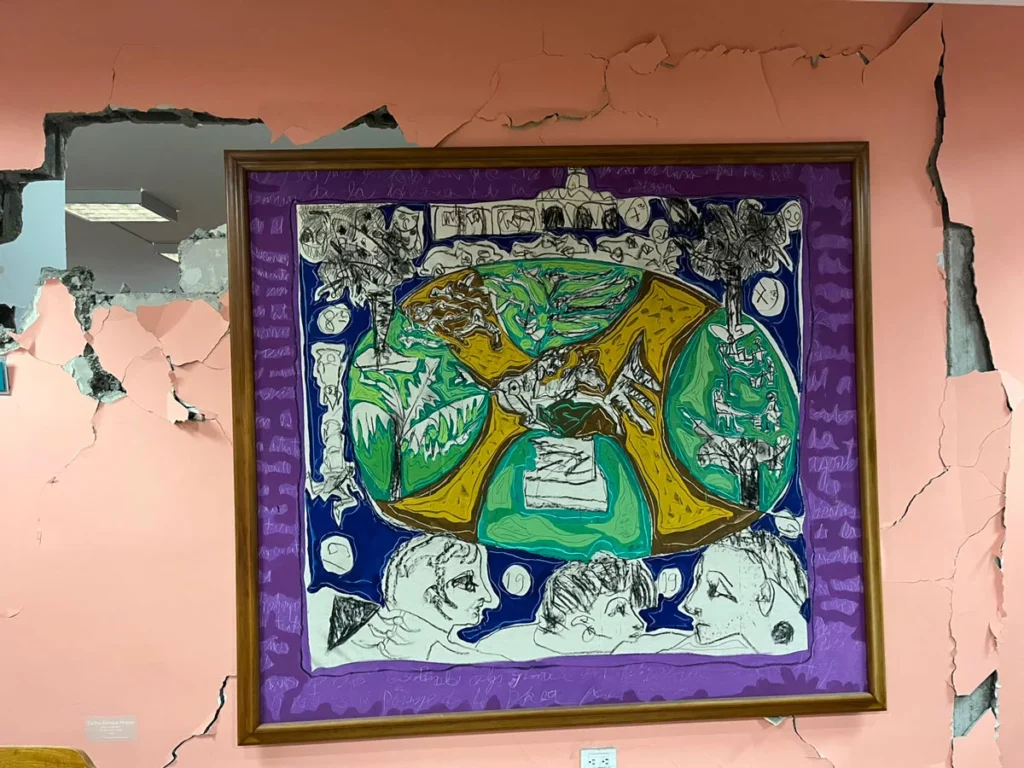
The photos, which have since circulated globally, depict a institution in distress: walls have collapsed, creating jagged, X-shaped fissures that snake through gallery spaces. In some areas, entire exterior sections have vanished, leaving the interior exposed to the elements and offering a haunting, panoramic view of the city’s damaged skyline. Paintings and framed prints, once curated with precision, are now seen clinging to teetering, unstable walls. An exterior wall of an adjacent 300-seat theater failed, crashing through the museum’s roof and leaving a gaping, ruinous void.
While the loss of life remains the primary concern—with Pereira and the nearby city of Manizales accounting for over half of the national death toll—the cultural toll is mounting. Reports from local officials confirm that 70 percent of the cultural infrastructure in the Risaralda department has been severely compromised or reduced to ruin.
Seismic Context and Geographic Vulnerability
Geologists have noted that while the 7.4 magnitude of Monday’s quake matches the intensity of the earthquake that struck Venezuela this past June, Colombia was spared from the absolute worst-case scenario due to the depth of the event.
The epicenter was recorded at a depth of 64 miles, which significantly blunted the seismic energy as it traveled toward the surface. By comparison, the Venezuelan quake occurred at a depth of just 12 miles, causing far more violent surface-level acceleration. Despite this geological "fortune," the sustained vibrations were enough to shatter the integrity of older structures and expose the fragility of even modern institutional designs in the Coffee Triangle.

The Cultural Significance of the Museo de Arte de Pereira
The Museo de Arte de Pereira is not merely a storage facility for art; it is a vital pillar of Colombian contemporary identity. Founded in 1974 as the Center for Contemporary Art, the institution underwent a significant transformation in 1996, following the passage of la ley de la cultura, a landmark legislative effort that established a national fund for the promotion of arts and culture.
With these resources, the institution was able to expand into a purpose-built facility designed by the esteemed Colombian architect Willy Drews Arango. Today, the museum houses a collection of 520 pieces, featuring works from iconic late 20th-century Colombian artists such as Oscar Muñoz, Olga de Amaral, and the late Beatriz González, who passed away in January of this year.
María Paz Gaviria Muñoz, former director of the Bogotá-based ArtBo fair, emphasized the institution’s regional importance. "It’s been key to the decentralization of the arts in the country," Gaviria Muñoz noted. "It provides a crucial cultural anchor beyond the primary hubs of Bogotá, Medellín, and Cali. Its loss is felt not just by the local community, but by the entire Colombian art landscape."
Official Assessments and Structural Reality
On August 11, engineers conducted a comprehensive site inspection of the Museo de Arte de Pereira. According to Rosa Ángel, a board member tasked with overseeing the museum’s emergency response, the findings were a mixture of relief and severe concern.

"The damage is extensive, but thankfully not structural," Ángel reported. "The primary beams and columns remain sound, which prevents total collapse." However, this does not mean the building is safe or functional. Many of the internal walls and roof sections will require complete reconstruction, a task Ángel described as "very complex."
As a result, the museum is indefinitely closed to the public. The logistical nightmare of securing, documenting, and potentially relocating the 520-piece collection while the building remains structurally compromised is an immediate priority for the museum’s board.
Economic Implications and Government Neglect
The disaster strikes at a particularly volatile time for Colombia. The current administration, led by the far-right Espriella government, is only days into its term. Having campaigned on a platform of aggressive austerity—including a proposal to slash government spending by 40 percent—the political climate for cultural funding is hostile.
"Reductions in already very limited national and local government funding have left the museum in a complex economic situation even before this quake," Gaviria Muñoz explained. "Now, we are faced with a massive reconstruction project that requires funding we simply do not have."

The Museo de Arte de Pereira, though operating as an independent nonprofit, has historically relied on a blend of city, state, and federal Ministry of Culture support. With the Ministry’s budget under threat, there is profound anxiety regarding whether the government will prioritize the restoration of cultural heritage or view it as an expendable luxury. ARTnews reached out to the Ministry of Culture for comment regarding emergency grants or aid packages for the 14 affected museums, but has received no response as of the time of publication.
A Society in Mourning: The Human vs. The Cultural
The tension between humanitarian aid and cultural preservation is palpable. For the residents of Pereira, the priority is clear: finding the missing, sheltering the homeless, and mourning the dead.
"The city is trying to rescue people from the rubble," Rosa Ángel acknowledged. "People are homeless, without basic necessities—it is very, very difficult. We are fully aware of that. But we also have to fight for our cultural infrastructure and do the work to protect it."
This sentiment is echoed by those who view the museum as a necessity rather than a luxury. In the wake of such a tragedy, the preservation of the museum is viewed as an act of resilience. "Culture is the cement that keeps us united as a society," Ángel added.

As the "Zona Cafetera" begins the long, arduous process of clearing the debris and rebuilding its neighborhoods, the fate of its museums will serve as a bellwether for the country’s recovery. If the government fails to provide the necessary aid, the loss of these institutions will represent not only a physical collapse but a permanent erosion of the cultural fabric that defines the region.
For now, the works of Oscar Muñoz and Olga de Amaral remain, for the most part, in limbo—lined up against cracked walls or tucked into temporary storage, waiting to see if the institution they helped build will be given the chance to rise again. The "golden window" for rescue may close, but the struggle for the future of Colombian culture is only just beginning.