The mid-twentieth century remains the North Star of modern watchmaking. For the last decade, brands have looked back to the era of the "Tool Watch"—a time when a timepiece was not merely an accessory, but a mission-critical piece of equipment. As consumer fatigue grows regarding the industry’s obsession with "heritage" aesthetics, the challenge for manufacturers has shifted: How does one honor a legendary design while ensuring it serves the demands of the modern wearer?
Ollech & Wajs (O&W) has confronted this question head-on with the launch of the Early Bird EB-24. By reviving a rare Vietnam-era pilot’s watch, the brand has managed to produce a timepiece that functions as both a respectful tribute and a robust, modern-day instrument.

The Historical Context: A Legacy of Military Utility
To understand the significance of the EB-24, one must first look at the foundation of the Zurich-based brand. Founded in 1956, Ollech & Wajs pioneered the mail-order watch market in 1958. By cutting out the middleman, they were able to offer high-quality Swiss engineering directly to those who needed it most: military personnel.
During the conflict in Vietnam, between 1965 and 1973, O&W became an unofficial staple for American ground troops. The brand estimates that tens of thousands of watches were funneled into Post Exchanges (PXs) throughout the region. Among these, the original "Early Bird"—a 24-hour pilot’s watch inspired by the world’s first geosynchronous communications satellite—stood out as a marvel of engineering. With only roughly 500 original production models known to exist, the original Early Bird has become a "holy grail" for collectors of military horology.

Design Evolution: From 1965 to Today
The transition from the 1965 progenitor to the 2026 EB-24 is not a story of replication, but of maturation. While the original Early Bird featured a classic skindiver case, the new EB-24 incorporates design DNA from the O&W "Caribbean"—the legendary diver that, in the late 1960s, was among the first to achieve 1,000-meter water resistance.
Technical Specifications and Ergonomics
The EB-24 has seen a measured increase in proportions. The case diameter has expanded from 38mm to 39.5mm, and the thickness has moved from 10.5mm to 12.5mm. While some purists may argue for the slimness of the original, these changes facilitate a modern standard of durability. Most notably, the watch now offers 300 meters of water resistance—a significant 100-meter increase over its predecessor.

On the wrist, the 48mm lug-to-lug distance creates a commanding yet manageable presence. The curvature of the lugs is particularly well-executed, effectively "sinking" the caseback into the wrist to mitigate the added thickness. Whether navigating a cockpit or a boardroom, the watch maintains a balanced, purposeful stance.
The Dial and Movement: A 24-Hour Challenge
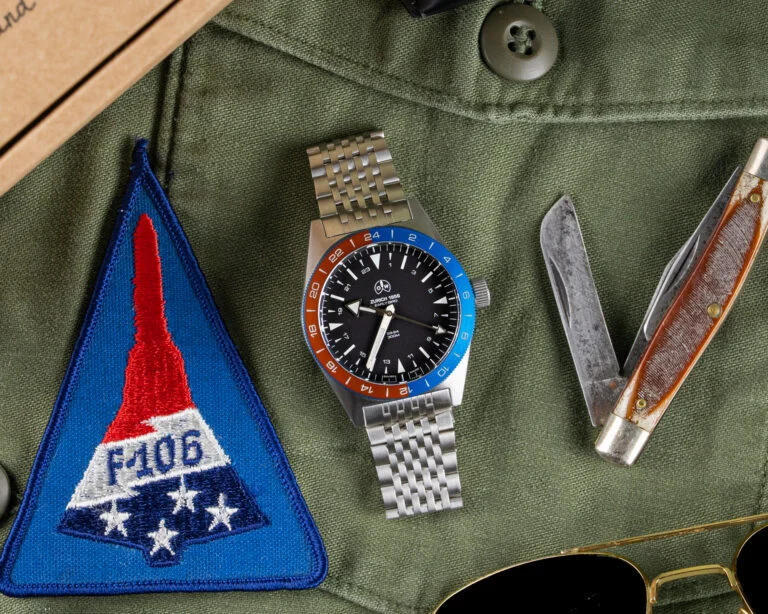
The most striking visual update is the relocation of the 24-hour track. By moving it from the outer dial to the inner section, O&W has achieved a cleaner, more legible layout that avoids the clutter of the original. The printed markers are faithful to the 1960s source material, bridging the gap between vintage charm and contemporary minimalism.

The Engine
At its heart, the EB-24 is powered by a Soprod C-125 movement, specifically modified to handle a 24-hour display. The caliber offers a 42-hour power reserve. For those who demand peak precision, O&W offers a COSC-certified variant, ensuring the watch meets the rigorous chronometric standards of the Swiss testing institute.
Using the watch in practice—specifically tracking a second time zone via the aluminum bi-color bezel—requires a shift in perspective for those accustomed to 12-hour dials. The bezel colors, which shift from a deep blue to a vibrant red-orange depending on the ambient light, provide a tactile and visual delight. However, the experience of reading 24-hour time at night remains a "learning curve" endeavor.

Real-World Performance: The Traveler’s Verdict
During a recent testing period involving air travel and aquatic environments, the EB-24 proved its mettle. While the white Super-LumiNova provides decent legibility in low-light conditions, the lack of a luminous pip at the 24-hour mark on the bezel is a missed opportunity for total dark-environment utility. In environments saturated with modern LED screens—such as an automobile dashboard at night—the dial markers can occasionally lose their prominence.
The bracelet, a classic "beads-of-rice" design, is undeniably beautiful and comfortable. It tapers from 20mm to 18mm, fitting the wrist elegantly. While the pin-and-collar system for link removal can be frustrating for the home tinkerer, the ratcheting extension clasp is a masterclass in convenience. The ability to adjust the fit without removing the watch—even over a wetsuit—solidifies its identity as a true "go-anywhere" tool.

Implications for the Collector Market
The arrival of the EB-24 raises a pertinent question for the watch community: Is a brand better served by a faithful reissue or an evolution?
Ollech & Wajs has opted for the latter. While the purist in many of us might crave a one-to-one replica of the 1965 model—complete with its thinner case and outer 24-hour track—the EB-24 represents the brand’s "present-day sensibility." It is an acknowledgment that the world has changed since the Vietnam era. Today’s consumers expect higher levels of water resistance, refined manufacturing tolerances, and modern movement reliability.

Competition and Positioning
The EB-24 sits in a unique niche. Its closest functional competitor is the Glycine Airman, a watch with a legendary pedigree involving astronaut "Pete" Conrad. While the Airman leans into its space-age and aviation history, the O&W EB-24 feels more grounded in its "skindiver-meets-pilot" identity. At a retail price of $2,400 USD, it is positioned as a serious purchase for the enthusiast who values history but demands a daily wearer that can handle modern abuse.
Conclusion: An Honest Evolution
The Ollech & Wajs Early Bird EB-24 is a testament to the brand’s refusal to simply coast on its archives. By taking the skeleton of a military classic and dressing it in the technical refinements of the 21st century, O&W has created something that honors the past without being held hostage by it.

It may not be a one-to-one recreation, but it captures the spirit of the original: a watch intended for the wearer to take into the field, not to keep in a safe. In an era of sterile, mass-produced luxury, the EB-24 remains a refreshing, tool-first, and highly capable companion. For those looking to bridge the mid-century aesthetic with the requirements of a modern lifestyle, the Early Bird is, quite literally, right on time.