
For decades, the prevailing narrative of planetary science painted Mars as a geologic "stagnant lid"—a world frozen in a state of relative simplicity. While Earth is a vibrant, shifting mosaic of tectonic plates that constantly recycle crustal material, build mountain ranges, and regulate the planet’s thermostat, Mars was viewed as a simpler cousin, a planet whose surface formed in a straightforward, static fashion.
However, a groundbreaking study published in Nature Astronomy has shattered this long-held assumption. Researchers from the University of Oxford, utilizing seismic data harvested by NASA’s InSight mission, have uncovered evidence of enormous, Earth-like magmatic systems lurking deep beneath the Martian surface. This discovery suggests that Mars, despite its lack of plate tectonics, possessed a far more complex and dynamic interior than previously imagined—a finding that forces a radical reassessment of how rocky planets evolve and whether the ingredients for habitability are more common in the cosmos than we dared to hope.
The Paradigm Shift: Moving Beyond the "Stagnant Lid"
To understand the magnitude of this discovery, one must first understand the "stagnant lid" theory. On Earth, plate tectonics is the engine of geological complexity. The movement of massive crustal plates allows for subduction—where one plate slides beneath another—recycling surface material back into the mantle and bringing up fresh volcanic material. This process is essential for the geochemical cycling that keeps our atmosphere stable and our oceans temperate.
Because Mars lacks these moving plates, scientists had long assumed its crustal formation was a rudimentary process: molten rock rose from the interior, cooled, and settled into a static shell. The new study, however, flips this script. By analyzing data from the InSight lander, the research team discovered that Mars may have developed a highly evolved crust through "transcrustal magmatism"—a process of internal recycling that mirrors the complex geological activity seen on Earth, yet operates entirely without the need for tectonic plates.
Unmasking the Interior: A Chronology of the Discovery
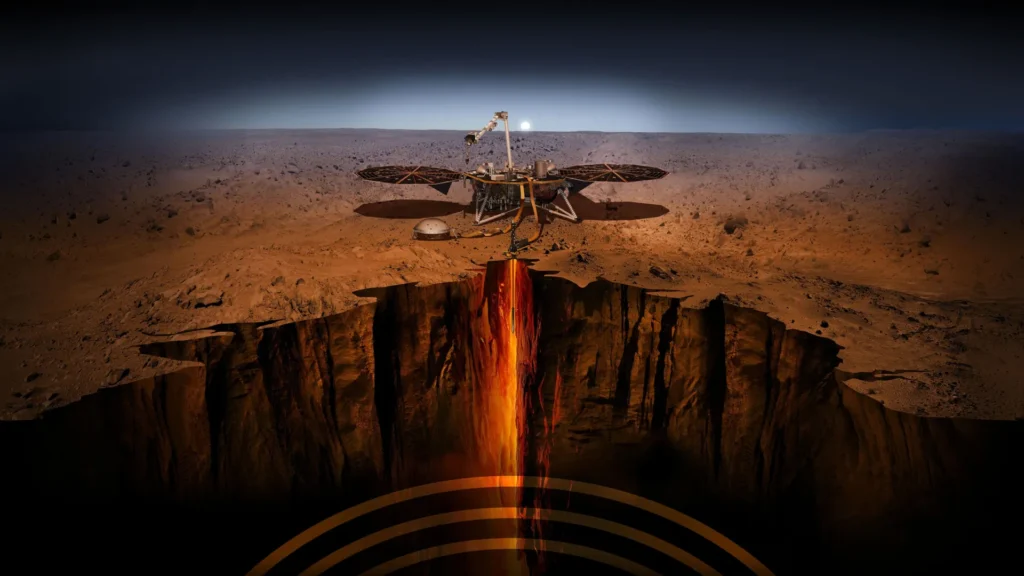
The journey to this discovery began in 2018, when NASA’s InSight lander touched down in the Elysium Planitia, carrying the first seismometer ever deployed on another planet. Over the course of its mission, the lander’s sensitive instruments captured the faint tremors of "marsquakes" and the distant, muffled thuds of meteoroid impacts.
The Mystery of the 24-Kilometer Boundary
Early in the mission, seismic data revealed an unexplained structural boundary approximately 24 kilometers beneath the Martian surface. While scientists knew the boundary existed, its composition and origin remained a riddle. For years, this "seismic discontinuity" was an anomaly that defied standard models of Martian crustal structure.
Decoding the Data: Thermodynamic Modeling
To solve the mystery, researchers from Oxford’s Departments of Earth Sciences and Statistics embarked on a rigorous analytical campaign. They pitted the seismic observations against hundreds of potential rock compositions. By combining advanced thermodynamic modeling with sophisticated statistical methods, the team sought to identify which materials would best replicate the seismic signatures recorded at different depths.
The result was a chemical map of the Martian interior. The analysis revealed that the rock residing below the 24-kilometer mark was "ultramafic"—dense, rich in iron and magnesium, and low in silica. In stark contrast, the material above the boundary was "mafic," characterized by a higher proportion of silica. This chemical stratification provided the "smoking gun" for a complex magmatic history.
Evidence of a Vast Magmatic System
The researchers posit that the boundary is the remnant of a massive, ancient underground magmatic chamber. In this scenario, molten rock accumulated deep within the Martian crust, staying liquid for vast periods. As the magma cooled, a process known as fractional crystallization occurred: dense, iron-rich crystals settled to the bottom, while lighter, chemically evolved melts—rich in silica—migrated toward the surface.
This is not a process of "simple" volcanism; it is the hallmark of a complex, long-lived magmatic system. On Earth, this exact process occurs beneath volcanic arcs and is a primary driver in the formation of continental crust. To find it on Mars suggests that the Red Planet was once an active, thriving laboratory of geological evolution.
The Scale of the Hidden Layer
Perhaps most surprising is the sheer scale of this phenomenon. The study indicates that this buried layer is not a localized curiosity but a global, or at least hemispheric, feature. It could stretch for hundreds, if not thousands, of kilometers across the Martian northern hemisphere. This implies that ancient Mars was not merely peppered with isolated volcanoes, but was instead home to vast, interconnected magmatic systems that spanned large portions of the planet’s crust.
Official Perspectives: Redefining Planetary Potential
The implications of this study are being felt across the planetary science community. The research, led by Dr. Tobermory Mackay-Champion—then of the University of Oxford and now at the University of Bristol—marks a departure from traditional models of Martian geology.
"We’ve traditionally assumed that volcanism on Mars was relatively simple compared to that on Earth," Dr. Mackay-Champion noted following the study’s release. "But this discovery suggests Mars could sustain large, long-lived systems where molten rock evolved and reprocessed itself throughout the entire crust. It raises exciting possibilities for how common such systems might be on rocky planets beyond our solar system."
Professor Jon Wade, a co-author of the study from Oxford’s Department of Earth Sciences, emphasized the broader philosophical shift necessitated by these findings. "One of the big questions in planetary science is whether Earth is unique," Wade stated. "If Mars could develop this kind of complex crust without plate tectonics, then maybe the conditions needed for habitability can emerge on more planets than we realized, including those previously dismissed based on size or their apparent lack of tectonic activity."
Implications for Habitability and Beyond
The connection between geological complexity and the potential for life is one of the most critical avenues of modern astrobiology. Geological recycling—the process of moving materials from the surface to the interior and back—is vital for the long-term maintenance of an atmosphere and the cycling of volatile elements like water and carbon.
Challenging the Tectonic Requirement
For years, the "tectonic requirement" for life has been a cornerstone of the search for habitable worlds. The logic was simple: without plate tectonics, a planet cannot recycle the nutrients or regulate the atmospheric gases necessary for the emergence and sustenance of life. The Oxford findings offer a compelling counter-narrative. If a planet can achieve complex crustal evolution and internal recycling through transcrustal magmatism alone, then the "tectonic prerequisite" for habitability may be far too narrow.
This broadens the search for life in the galaxy. It suggests that rocky planets—even those that appear dormant or "stagnant" from a surface-level scan—might possess the deep-seated geological engines required to sustain a habitable environment.
A New View of the Red Planet
As NASA’s InSight mission data continues to be analyzed, the picture of Mars is shifting from a dead, unchanging rock to a world with a rich, hidden history. The 24-kilometer boundary is likely just one chapter in a much larger story of how planets age, cool, and interact with their own interiors.
The collaboration between the University of Oxford’s Earth Sciences and Statistics departments highlights the interdisciplinary future of planetary exploration. By applying statistical rigor to seismic data, scientists are no longer just looking at the surface of Mars; they are peering through the dust and into the very heart of the planet.
Conclusion: The Horizon of Discovery
The revelation that Mars once harbored vast, Earth-like magmatic systems is more than just a geological curiosity; it is a fundamental shift in our understanding of planetary physics. By proving that complex crustal evolution does not strictly require the moving plates of Earth, researchers have opened a new door in the search for habitable worlds.
As we look toward future missions to Mars—and indeed, toward the thousands of exoplanets currently being cataloged by telescopes like James Webb—we do so with a revised toolkit. We now know that the absence of tectonic movement on a distant planet does not necessarily mean an absence of geological complexity. In the quiet, hidden layers beneath the Martian surface, we have found a clue that the universe may be far more hospitable than our models once suggested. The Red Planet, it seems, still has many secrets left to tell.