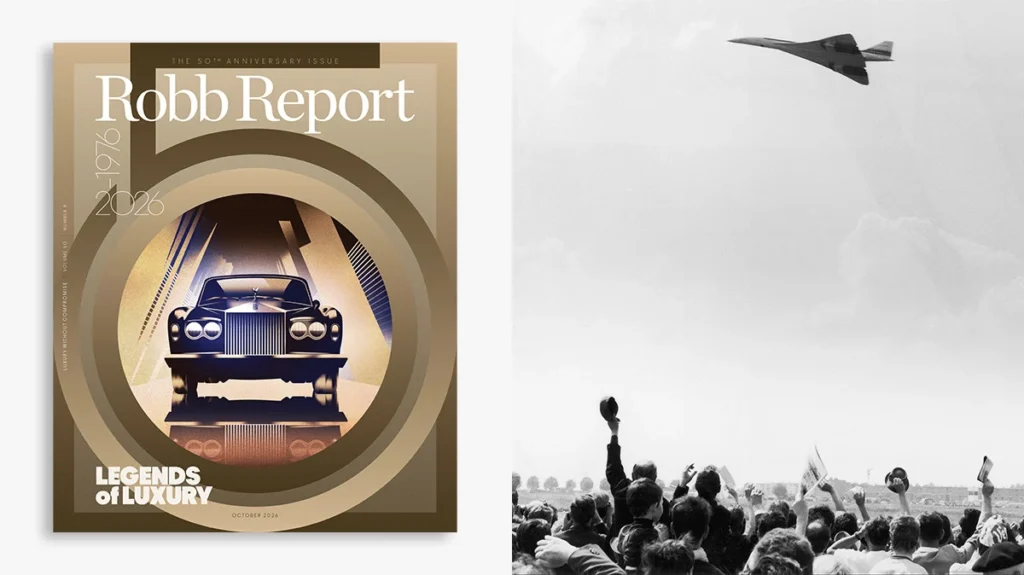
On January 21, 1976, the aviation world tilted on its axis. As the Concorde roared into the skies, carrying passengers at twice the speed of sound, it effectively shrank the Atlantic, transforming the journey between London and New York into a breakfast-time commute. That same year, a new publication—Robb Report—emerged to chronicle this precise intersection of daring engineering, unprecedented access, and the evolving definition of the "good life."
As we celebrate our 50th anniversary this October, we find ourselves in a reflective mood. Looking back at five decades of editorial archives, we aren’t just looking at objects of desire; we are examining a half-century of cultural, technological, and social transformation. The items, experiences, and icons that defined the luxury market since 1976 have served as the vanguard for the rest of society, often debuting as elite curiosities before becoming the scaffolding of modern life.
A Chronology of Disruption: From Analog Dreams to Digital Necessities
The history of the last 50 years is punctuated by "the future arriving early." To understand the arc of luxury, one must look at how the objects of 1976 gave way to the ubiquitous tools of 2026.
- 1976: The Supersonic Dawn. The entry of the Concorde into commercial service marked the pinnacle of mid-century optimism. Speed was the ultimate luxury.
- 1984: The Brick. Motorola’s DynaTAC 8000X hit the market with a price tag of $4,000—the equivalent of $12,000 today. It was a bulky, two-pound symbol of status that made the user appear as if they were tethered to the pulse of global finance.
- Late 1970s–Early 1980s: The Armani Shift. Giorgio Armani revolutionized the male silhouette by stripping the internal structure from the suit. What was once viewed as radical, soft-shouldered rebellion became the universal standard for professional elegance.
- 2003: The Age of Exploration. With the launch of Paul Allen’s Octopus, the yachting industry pivoted. No longer satisfied with mere coastal cruising, the ultra-wealthy demanded expedition-grade vessels capable of reaching the world’s most remote polar regions.
- The Molecular Gastronomy Wave: Ferran Adrià and El Bulli pushed culinary boundaries using scientific rigor, shifting the focus from traditional plating to sensory experience. While the trend eventually spawned kitschy imitators, the foundational shift in how we perceive ingredients remains a permanent fixture of fine dining.
The Luxury Paradox: When Rare Becomes Ubiquitous
One of the most compelling insights gleaned from our 50-year archive is the "Luxury Paradox." Many of the innovations that once marked a person as part of a rarefied, ultra-wealthy class have, over time, been democratized to the point of necessity.
The Motorola DynaTAC is the quintessential example. In 1984, the "Brick" was an instrument of power, wielded by Wall Street titans and high-level executives to signal importance. Today, its successor—the smartphone—is a utility found in every pocket, regardless of socioeconomic standing. This transformation is not a dilution of luxury, but rather a testament to the fact that today’s elite extravagance is often tomorrow’s baseline infrastructure.
This cycle holds true across sectors. We have seen it in aviation, where private jet travel has become more accessible through fractional ownership; in fashion, where the deconstructed silhouettes of the 70s are now standard in high-street tailoring; and in the culinary world, where modern equipment (like sous-vide immersion circulators) has moved from the laboratory of a three-star chef to the home kitchen.

Supporting Data: The Cost of Progress
To understand the scale of change, one must consider the economic and structural shifts that have accompanied these innovations.
| Era | Symbol of Luxury | Primary Utility | Inflation-Adjusted Cost |
|---|---|---|---|
| 1976 | Concorde Flight | Time Savings | Extremely High |
| 1984 | Motorola DynaTAC | Communication | ~$12,000 |
| 2003 | Octopus Yacht | Exploration | Hundreds of Millions |
| 2026 | Generative AI Assistants | Cognitive Leverage | Subscription-based |
The cost of "the future" has shifted from capital-heavy hardware to intellectual property and connectivity. While the barrier to entry for communication has dropped, the barrier for exclusive experiences—such as private space flight or deep-sea exploration—continues to skyrocket, keeping the "luxury" designation firmly attached to the bleeding edge of human capability.
Official Perspectives: The Experts Weigh In
"We have always operated under the assumption that luxury is about scarcity," says a long-time consultant for the luxury automotive industry. "But the last five decades have proven that the true value of luxury lies in the ability to anticipate a paradigm shift before the mass market can adapt."
This sentiment is echoed by historians of design. "The most enduring luxuries are those that fundamentally changed the way we inhabit space or time," says curator Dr. Elena Vance. "The Armani suit changed how we move; the Concorde changed how we perceive distance. These weren’t just products; they were cultural accelerants."
However, not every "next big thing" held up to the test of time. Our editorial team notes that for every triumph like the smartphone, there were countless "inevitable" shifts that crashed upon arrival. We famously predicted the death of the internal combustion engine in the early 2000s—a claim that, while grounded in the logic of the time, proved premature as the passion for mechanical engineering and synthetic fuels has seen a massive resurgence.
Implications for the Next Half-Century
What does this mean for the next 50 years? If history is any indicator, the luxury of 2076 will be born from today’s most "impractical" experiments.

The Future of Status
The nature of status is shifting from possession to access. As the world faces ecological and logistical constraints, the ability to control one’s environment—whether through private, off-grid infrastructure or proprietary, high-tech wellness protocols—will likely define the next tier of the ultra-wealthy.
The Cyclical Nature of Innovation
We have learned to be humble in our predictions. The recent collapse of speculative assets, such as certain digital collectibles, serves as a sharp reminder that not all innovation creates lasting value. True luxury, as we have observed through five decades of Robb Report, is found in craftsmanship, utility, and the human desire to push the boundaries of what is possible.
A Continued Mission
As we look toward the horizon, the mission remains unchanged. We will continue to document the daring, the ingenious, and the occasionally absurd. Whether it is the return of the Rolls-Royce Silver Shadow—a classic that, like the brand itself, proves that true quality is timeless—or the emergence of yet-to-be-named technologies, our lens will remain focused on the future.
In 20 years, one of the extravagances currently sitting on a workbench in a research lab may be as common as a smartphone. Another may vanish, remembered only as a footnote in a future anniversary issue. We won’t pretend to know which will endure. We only know that every so often, the future shows up, disguised as a luxury. And after 50 years, we are as curious as we were on that January day in 1976 to see what it brings next.
Here’s to the next 50 years of chasing the horizon. Enjoy the issue.