Beyond the Bezel: Audemars Piguet Expands Into High Jewelry With the Debut of Royal Oak Joaillerie
By
•
October 11, 2026
PARIS — In an unexpected move unveiled amid the bustling calendar of Paris Fashion Week, Swiss manufacture Audemars Piguet has formally crossed the boundary from haute horlogerie into pure haute joaillerie. The Le Brassus-based watchmaker has officially launched the Royal Oak Joaillerie collection—a 19-piece high jewelry suite comprising sculptural necklaces, cuffs, chokers, and earrings.
Conspicuously absent from the lineup is any mechanism to tell the time. Instead of functioning as diamond-paved bezels or gem-set dials for timepieces, the collection reinterprets the architectural silhouette of the iconic Royal Oak exclusively through the medium of wearable precious art.
Featuring complex fabrications in white gold, blackened titanium, and anodized blue titanium, the collection integrates an array of high-grade precious gems—including sugarloaf emeralds, sapphires, spessartites, and sizable pear-shaped diamonds. The release signals an aggressive strategic expansion by one of Switzerland’s most prominent independent manufactures, targeting luxury’s most resilient product category.
1. Main Facts: The Architecture of Royal Oak Joaillerie
The debut of Royal Oak Joaillerie represents a fundamental pivot in how Audemars Piguet leverages its most famous design asset. Rather than treating jewelry as an ornamental accompaniment to watch dials, the manufacture has deconstructed the legendary 1972 sports watch’s integrated bracelet and re-engineered its components into independent, standalone jewels.
=================================================================================
                     ROYAL OAK JOAILLERIE: COLLECTION AT A GLANCE
=================================================================================
Total Pieces:          19 individual high and fine jewelry creations
Core Categories:       Bib and tie necklaces, rigid chokers, cuffs, earrings
Materials:             18k white gold, blackened titanium, anodized blue titanium
Primary Gemstones:     Sugarloaf emeralds, blue sapphires, spessartite garnets,
                       amethysts, black spinels, pear-shaped and brilliant-cut diamonds
Aesthetic Signatures:  Interlocking bracelet links, alternating satin-brushed and
                       mirror-polished bevels, Florentine "Frosted Gold" hammering
Inspiration:           Topography, frozen waters, and flora of the Vallée de Joux
=================================================================================
The design language leans heavily on the signature geometry that defined the original Gérald Genta timepiece: alternating vertical satin-brushed planes, razor-sharp chamfers, and wide, light-catching facets. By playing with scale and metallurgical weight, the collection replicates the supple drape of the Royal Oak bracelet while incorporating advanced stone-setting techniques.
Key Haute Joaillerie Masterpieces
The Dream of Joux Ensemble: Designed as a dramatic tie-style necklace with matching drop earrings, this set evokes the frozen lakes of AP’s ancestral home. Crafted from 18k white gold paired with vibrant, anodized blue titanium, the necklace is articulated around a cascade of 42 pear-shaped diamonds totaling approximately 63 carats, accented with 1,670 pavé-set blue sapphires exceeding five carats. The accompanying earrings feature eight pear-shaped diamonds (ranging from 1.5 to 3 carats each) framed by 196 micro-set blue sapphires.
The Risoud Eclipse Suite: Named after the ancient Risoud Forest buffering the Vallée de Joux, these pieces embrace an edgier, contemporary aesthetic. Constructed from blackened titanium and white gold, the suite’s centerpiece is a bib necklace mounted with five Colombian-origin sugarloaf-cut emeralds totaling roughly 16.5 carats. A companion cuff carries three complementary sugarloaf emeralds weighing around 12 carats, both bordered by brilliant-cut white diamonds that contrast sharply against the dark titanium framework.
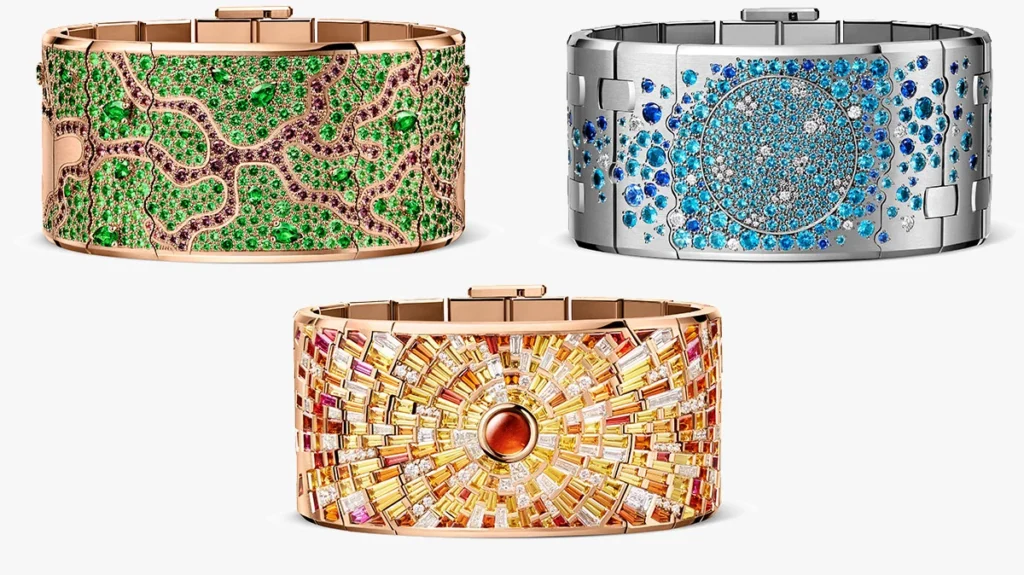
Botanical and Chromatic Cuffs: Demonstrating a departure into expressive color palettes, the collection introduces six statement cuffs.
The Sunburst cuff presents a kinetic array of orange and yellow sapphires interspersed with mandarin spessartite garnets.
The Blueberries cuff recreates native alpine shrubbery using 506 custom-cut leaf-shaped and brilliant-cut diamonds, interspersed with 19 violet amethyst cabochons and 16 polished black spinel cabochons arranged like wild fruit along an articulated golden branch.
Frosted Gold Everyday Pieces: Rounding out the 19-piece collection are fine jewelry chokers and minimalist cuffs finished in "Frosted Gold." This micro-hammering surface technique—adapted in collaboration with Florentine jewelry designer Carolina Bucci—creates a diamond-dust shimmer across gold surfaces without the physical insertion of gemstones, offering daily wearability for collectors seeking understated styling.
2. Chronology: Audemars Piguet’s Evolution From Watchmaker to Jeweler
While the pure-jewelry format of Royal Oak Joaillerie marks a fresh retail category for Audemars Piguet, the maison’s technical affinity with gem-setting dates back nearly 150 years. The company’s historical ledger reflects an evolving creative dialogue between micro-mechanics and decorative jewelry arts:
THE JEWELED TIMELINE OF AUDEMARS PIGUET
---------------------------------------------------------------------------------
Late 19th C.  │ Co-creation of bejeweled pendant, brooch, and ring watches
              │ alongside houses like Tiffany & Co., Cartier, and Bulgari.
              │
1972          │ Gérald Genta conceives the Royal Oak, introducing integrated
              │ bracelet architecture modeled on fine jewelry construction.
              │
1980s         │ Establishment of a dedicated in-house gem-setting and jewelry
              │ atelier in Le Brassus to handle high-complication jewelry watches.
              │
2000          │ Release of the 125th Anniversary Baroque Cuff watch, saturated
              │ with fancy pink and yellow sapphires and white diamonds.
              │
2015–2017     │ The "Diamond Trilogy" debuts: Diamond Punk, Diamond Fury,
              │ and Diamond Outrage demonstrate disruptive, spiky geometry.
              │
2016          │ Partnership with Carolina Bucci launches Frosted Gold.
              │
2024          │ Launch of the 23 mm Royal Oak Mini prompts widespread jewelry-like
              │ stacking among clients, catalyzing the standalone jewelry line.
              │
Present       │ Unveiling of the debut 19-piece Royal Oak Joaillerie collection.
---------------------------------------------------------------------------------
Throughout the late 19th and early 20th centuries, high-end Swiss watch houses routinely functioned as suppliers of calibers for traditional Parisian and New York jewelry maisons. Le Brassus artisans cut movements to fit into lapel brooches, chatelaines, and gem-encrusted rings.
By the mid-1980s, Audemars Piguet brought this technical capability in-house, founding its own specialized jewelry workshops. The creative trajectory surged in the mid-2010s with the Diamond Trilogy secret watches. Those pieces abandoned conventional feminine jewelry tropes in favor of aggressive, punk-rock pyramid spikes and glacier-like stalactite cuffs.
With the Royal Oak Joaillerie, the manufacture has detached these complex structural settings from clockwork movements entirely, concluding that the Royal Oak’s silhouette possesses enough standalone equity to thrive as independent jewelry.
3. Supporting Data & Market Analysis: Navigating a Shifting Luxury Landscape
Audemars Piguet’s calculated entrance into fine jewelry arrives at a pivotal juncture for the hard luxury sector. Over the past 18 months, consumer demand across the high-end landscape has cooled following post-pandemic highs, driven by geopolitical volatility, stubborn inflation, and a broad normalization of the Swiss watch market.
=================================================================================
               HARD LUXURY LANDSCAPE: PERFORMANCE & MARKET METRICS
=================================================================================

Global Luxury Growth Estimate (2026 Revision):    ~2.5% (Morgan Stanley)
Previous Multi-Year Baseline:                     6.0% - 8.0%

H1 Sector Divergence (Richemont Group Benchmark):
  • Jewelry Maisons (Cartier, Van Cleef & Arpels): +24% YoY Growth
  • Specialist Watchmakers (IWC, Jaeger-LeCoultre):+8% YoY Growth

Key Catalysts Driving the High-Jewelry Pivot:
  [1] Flight to Quality:      Consumer preference for tangible asset backing
  [2] Bullion Market Tailwinds: Sustained multi-year highs in gold spot prices
  [3] Consumer Demographics:  Accelerating surge in female self-purchasers
=================================================================================
The "Flight to Quality" and the Surge in Fine Jewelry
Investment analysts have documented a marked divergence between fine timepieces and fine jewelry. While speculative secondary-market watch pricing experienced sharp corrections throughout 2023 and 2024, high jewelry has displayed notable resilience.
Financial disclosures from luxury conglomerates underline this shift. In its recent quarterly reporting, Swiss luxury group Richemont highlighted that its dedicated Jewelry Maisons achieved a 24 percent revenue expansion, decisively outpacing its Specialist Watchmakers division, which grew by 8 percent over the same period.
According to investment bank Morgan Stanley, which revised its overall annual luxury sector growth estimate down to approximately 2.5 percent, affluent consumers are actively participating in a "flight to quality." Amid macro uncertainties, spending has concentrated on pieces backed by intrinsic, physical value. Record highs in the spot price of gold and elevated demand for investment-grade colored gemstones (such as unheated sapphires and Colombian emeralds) have positioned high jewelry as an appealing store of value.
Capturing the Self-Purchasing Female Demographic
For decades, the high-end sports watch demographic skewed predominantly male, with watchmakers approaching women largely through resized, diamond-trimmed versions of existing men’s models.
However, modern consumption patterns show that women represent the fastest-growing demographic of fine jewelry buyers, routinely acquiring pieces for their personal collections rather than waiting for gifting occasions. By entering this category with a distinct non-watch offering, Audemars Piguet directly addresses self-purchasing female connoisseurs while capturing spending that might otherwise flow toward traditional high-jewelry institutions like Cartier, Bulgari, or Van Cleef & Arpels.
4. Official Responses: The Creative Philosophy Behind the Transition
Addressing the launch in Paris, Audemars Piguet’s leadership emphasized that Royal Oak Joaillerie was born from direct observations of client behavior, rather than an abstract exercise in corporate brand extension.
"We saw clients stacking and wearing the 23 mm Royal Oak Mini almost as jewelry, which showed us that there was a very contemporary way of living with the Royal Oak beyond the watch itself."
Resta, who assumed the chief executive role with a mandate to steer the brand through its next phase of institutional growth, highlighted that the design brief intentionally avoided simplistic adaptations. The creative mandate focused on evaluating the Royal Oak bracelet as an independent kinetic sculpture.
"We wanted to explore that design language in a new form. Rather than reproducing familiar Royal Oak codes, we looked at the bracelet almost as an object in its own right and asked how its geometry, rhythm, and movement could translate into jewelry. That opens up a different creative space for us."
Technicians and jewelers working on the collection in Le Brassus noted that executing these forms in mixed media posed considerable manufacturing challenges. Integrating lightweight, industrial metals like blackened and anodized titanium alongside 18-karat gold required developing distinct setting systems. Because titanium cannot be soldered or set using traditional gold-working techniques, gem-setters had to invent custom micro-mechanical retention collars to secure the sugarloaf emeralds and pear-shaped diamonds without putting tension on the stones.
5. Strategic Implications: Brand Longevity and Portfolio Diversification
Audemars Piguet’s diversification into pure high jewelry carries profound operational and reputational implications for the independent watchmaker.
=================================================================================
                        STRATEGIC IMPLICATIONS MATRIX
=================================================================================
CHALLENGE: Mono-Product Risk        --> MITIGATION: Translates the Royal Oak aesthetic
                                        into jewelry, diversifying product lines
                                        without diluting the icon's core design DNA.

CHALLENGE: Margin Pressures         --> MITIGATION: High jewelry provides superior
                                        operating margins and less exposure to the
                                        secondary watch market cycle.

CHALLENGE: Client Retention         --> MITIGATION: Creates complementary cross-selling
                                        avenues for existing watch collectors while
                                        attracting fine-jewelry purists.
=================================================================================
Mitigating Mono-Brand Vulnerability
For nearly two decades, financial analysts and industry observers have pointed out Audemars Piguet’s reliance on the Royal Oak line. The manufacture has made sustained efforts to balance its catalog through alternative collections—most visibly through the circular, complex Code 11.59 platform launched in 2019, as well as heritage capsules like the [RE]Master series.
Royal Oak Joaillerie takes a distinctly different approach to this diversification challenge. Instead of trying to steer consumers away from the Royal Oak, the maison is broadening what the Royal Oak name actually encompasses. By transforming an iconic timepiece into an enduring design language, Audemars Piguet is repositioning the Royal Oak alongside historical luxury motifs like the Cartier Love screw or the Van Cleef & Arpels Alhambra quatrefoil.
Elevating the Client Ecosystem
From a commercial perspective, this 19-piece collection creates substantial cross-selling opportunities across Audemars Piguet’s international network of company-owned AP Houses. The Frosted Gold cuffs and chokers offer clients natural companions to pair with their existing watch collections, while the one-of-a-kind high jewelry creations—such as the Dream of Joux and Risoud Eclipse—compete directly at the pinnacle of high-jewelry artistry.
By claiming a seat in high jewelry during Paris Fashion Week, Audemars Piguet demonstrates that the limits of a traditional watchmaker are fundamentally elastic. If the execution matches the ambition, Le Brassus will no longer be regarded purely as an engine room for complex horological calibers, but as an established house of singular luxury design.