

In the rarified atmosphere of the Paris fashion circuit, where the avant-garde often leans into the ethereal, Rei Kawakubo has long stood as the high priestess of the impossible. For decades, the founder of Comme des Garçons has utilized her runway as a laboratory for existential inquiry, often favoring opulent brocades, intricate lace, and architectural satins to construct her sculptural narratives. However, for her latest Spring collection, Kawakubo executed a pivot that caught the industry off guard: she reached for the humble, the utilitarian, and the distinctly everyday.
By centering her collection on denim—ranging from rugged railroad stripes to crisp cotton gabardine—Kawakubo did not merely present a new aesthetic; she interrogated the very hierarchy of textiles. In doing so, she posed a singular, haunting question: What happens when the majesty of royal regalia collides with the workaday reality of the common thread?
The Main Facts: A Study in Material Contradiction
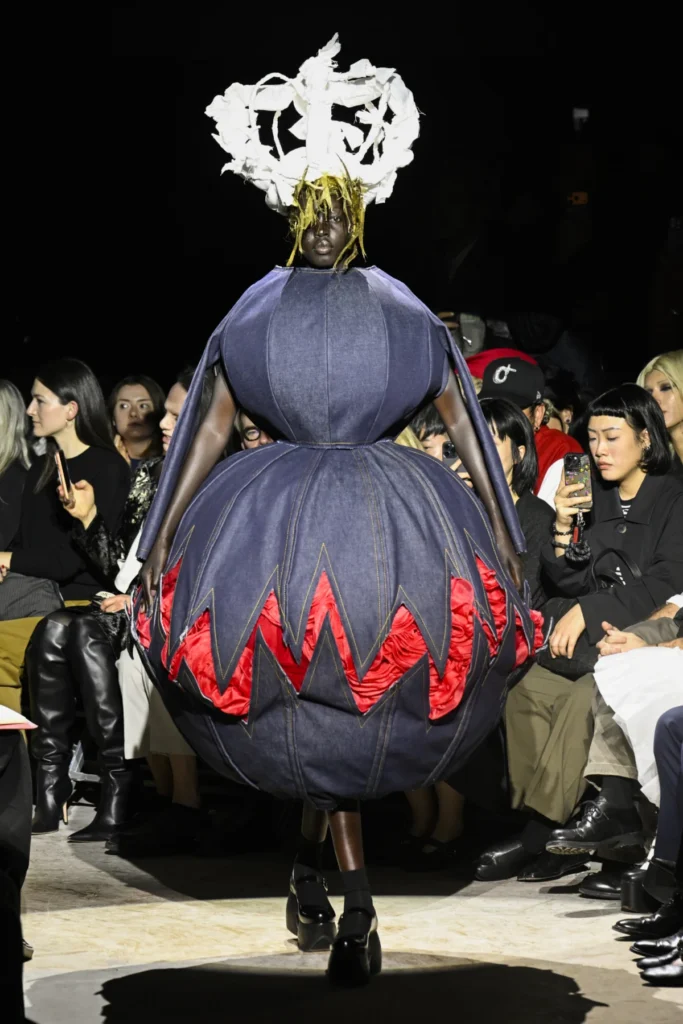
The collection, unveiled to a hushed audience in Paris, saw the designer moving away from the "pretty" aesthetics that have occasionally punctuated her career. Instead, the runway became a landscape of bulging, gravity-defying silhouettes. Models were transformed into abstract forms reminiscent of snowmen, violins, and guitars, yet these avant-garde shapes were rendered entirely in sturdy, unpretentious denim.
The scale of the garments was, by any industry standard, intimidating. These were not clothes designed for the sidewalk; they were monuments of fabric. The models, navigating the narrow confines of the runway, were forced to turn sideways to accommodate the sheer breadth of their skirts, occasionally bumping against the set as they navigated the tight space. Despite the outsized, abstract nature of these forms, sharp-eyed observers could discern the DNA of classic outerwear: the trench coat, the bomber jacket, and the puffer coat were all present, buried within the layers of denim and gabardine.
A Chronological Progression: From Crown to Foil
The show unfolded as a deliberate descent from the ceremonial to the surreal. It began with an imposing intensity. Each model’s head was adorned with a towering fabric crown, a visual signifier of royalty that sat atop the bulky, sculptural silhouettes. This pairing—the crown and the railroad-striped denim—set the tone for the show’s central thesis.
As the collection progressed, the atmosphere shifted. The rigid, somber palette of denim and gabardine began to give way to visceral, unsettling interventions. In one striking look, a pinstriped ensemble was bifurcated by blistered, protruding masses in shades of vivid red and white. The effect was immediate and, for many in the audience, visceral; the protrusions bore a striking, intentional resemblance to internal organs, a sudden injection of biological vulnerability into an otherwise mechanical silhouette.
The finale offered a surprising, almost whimsical resolution. As the show drew to a close, the fabric crowns were swapped for foil domes, reminiscent of finished Jiffy Pop pans. In this concluding sequence, the sculptures relaxed into oversized, wearable iterations of casual classics. The show finished with a parade of supersized denim shorts, barrel pants, and wide-legged jeans, their hems dragging across the floor with an exaggerated, almost ironic weight. One could almost hear the industry shorthand already being drafted: these were not Levi’s 501s; they were, in Kawakubo’s language, the 5,001s.
Supporting Data: The Potency of Fabric
To understand the impact of this collection, one must examine the role of embellishment in Kawakubo’s work. Historically, the "Comme des Garçons look" has been defined by its ability to subvert traditional garment construction. In this outing, the sturdy nature of the denim served as a blunt foil for the delicate ornamentation hidden within.
Tucked into the fissures of these garments, lining their structural appendages, or splayed across the bulging skirts, were intricate details: gold braiding, complex passementerie, and human hair. These elements, often associated with ceremonial military or court dress, felt like relics salvaged from a grander past, now sheltered within the rugged, blue-collar exterior of the denim.
The data of the show suggests a deliberate hierarchy of fabric. By choosing denim, Kawakubo effectively diminished the expected prettiness of the garments. The fabric, known for its longevity and association with labor, forced the audience to reconsider the "potency" of a material. Is silk inherently more "valuable" than denim if the denim is used to create a form of such complex engineering that it renders the wearer immobile? The collection suggests that the value lies not in the material itself, but in the alchemy of the designer’s intent.
Official Responses and Conceptual Framing
Rei Kawakubo is notoriously sparing with her words, preferring the clothes to serve as their own manifesto. However, her one-line explanation for the collection remains one of the most discussed quotes of the season: "When royal life and everyday life become one."
This succinct statement serves as the key to unlocking the collection. It is a commentary on the leveling of status. By pairing the tall, regal crown with the railroad-stripe denim, Kawakubo is suggesting that the divide between the elite and the ordinary is merely a construct of textile. When the two are fused, the "royal" loses its exclusivity, and the "everyday" gains a new, sculptural significance.
Critics and attendees alike noted that the collection required a shift in perspective. To view the clothes as merely "denim" would be to miss the point entirely. The garments were a meditation on the human experience—the weight we carry, the roles we play, and the shells we build around ourselves to navigate the world.
The Implications: Fashion’s New Materiality
The implications of this collection for the broader fashion industry are significant. For years, the luxury sector has struggled with its relationship to the "everyday." We have seen high-fashion houses attempt to elevate streetwear, often resulting in derivative or superficial designs. Kawakubo’s approach is fundamentally different. She does not attempt to "elevate" denim; she consumes it, digests it, and repurposes it into a vocabulary of high art.
By grounding her most experimental, sculptural work in humble materials, Kawakubo has effectively challenged her peers to look closer at their own material choices. She has signaled that the future of avant-garde design may not lie in the sourcing of increasingly rare or expensive fabrics, but in the radical transformation of the accessible.
Furthermore, the "gut-spilling" protrusions and the foil-dome headpieces suggest that Kawakubo is not afraid to lean into the grotesque. In a world of curated social media aesthetics, the willingness to make an audience "wince" is a rare and necessary artistic muscle.
Ultimately, this collection was a testament to the enduring power of Rei Kawakubo’s vision. She remains one of the few designers capable of creating a physical space—a runway—that functions as a mirror for the collective psyche. By marrying the crown to the denim, she has reminded us that the clothes we wear are never just fabrics; they are the tools with which we perform our identities, whether we are peasants or kings. As the models dragged their gargantuan, floor-sweeping jeans toward the exit, the message was clear: the mundane has been conquered, and in its place stands something far more monumental.



