

For over a century, the floor of the North Sea has served as a silent, liquid cemetery. Beneath the restless waves, thousands of steel hulks rest in the dark, acting as mausoleums for sailors lost to the brutal naval attrition of the early 20th century. However, as these iron skeletons continue their slow, inexorable decay, they are leaking more than just memories. They are releasing a toxic chemical legacy into the marine ecosystem.
At the center of this modern environmental crisis is the UC-30, a German submarine that vanished in April 1917. Long considered a lost relic of the Great War, its rediscovery has become a focal point for researchers attempting to quantify the chemical threat posed by thousands of submerged munitions across the North Sea.
The Tragic Final Voyage of the UC-30
The story of the UC-30 is one of technical failure and sudden catastrophe. In April 1917, the submarine was operating in the waters near Rømø, a Danish barrier island. Having been deployed on a mission toward Ireland, the vessel suffered debilitating engine problems that forced the crew to abort the operation and turn back toward the safety of German waters.
It never made it home.
The submarine was a vessel of extreme lethality, laden with 18 naval mines and six torpedoes—a volatile cargo that turned the vessel into a floating bomb. On April 19, 1917, the UC-30 struck a British naval mine. The resulting detonation sent the vessel to the seabed, claiming the lives of all 27 crew members on board. For 99 years, the wreckage lay undisturbed in the cold, dark depths of the North Sea until Danish diver Gert Normann Andersen located the site in 2016.
The NorthSeaWrecks Project: A Scientific Awakening
The discovery of the UC-30 provided an unprecedented opportunity for marine scientists to study the long-term impact of decaying naval weaponry. The submarine became a primary subject for the NorthSeaWrecks research project, a major international initiative aimed at assessing the environmental state of historical wrecks.
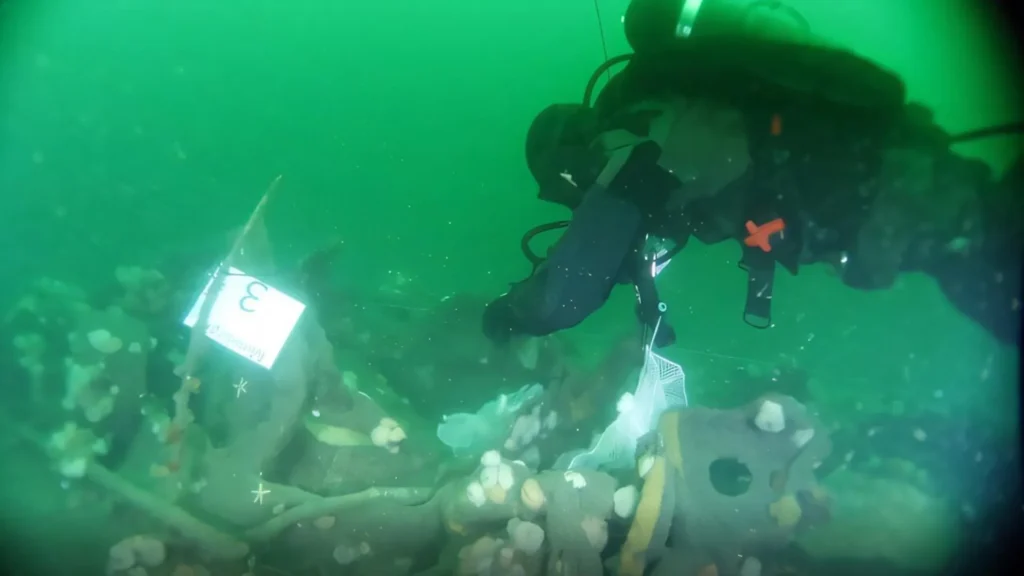
Katrine Juul Andresen, a professor at the Department of Geoscience at Aarhus University, led the investigation, which required a unique collaboration between scientists and the Danish Navy. Because civilian diving is strictly prohibited on the wreck site due to the inherent danger of the unexploded ordnance (UXO) and the sanctity of the grave site, the team relied on navy divers to act as their underwater eyes and hands.
"The divers received detailed instructions to collect sediment, water, and biological samples from various points on the submarine and the surrounding seabed," Andresen explains. "They also captured high-resolution video and photographs, which allowed us to perform a structural assessment of the hull and the state of the mines."
The findings were sobering. The team detected traces of TNT in the surrounding water column, the seabed sediment, and even in the local wildlife, including starfish and mussels. The evidence confirmed that the "containment" of these weapons had failed. As the steel hulls corrode, the chemical components of the explosives are slowly leaching into the marine environment, creating localized hotspots of chemical contamination.
The Strategic Battlefield: A Legacy of Iron and Explosives
To understand the scale of the current problem, one must understand the strategic imperatives of World War I. Control of the North Sea was the linchpin of the war effort for both the German Empire and the British Empire. Whoever dominated these waters controlled the flow of vital supplies, starving the opponent while keeping their own supply lines open.
Germany, lacking the sheer number of surface warships possessed by the British Royal Navy, turned to the submarine as a technological disruptor. The U-boat strategy was designed to strike from the shadows, effectively neutralizing superior enemy tonnage. Simultaneously, both nations engaged in a massive mining campaign, deploying an estimated 190,000 naval mines across the North Sea.
This was also the theater of the Battle of Jutland, the largest naval engagement of the war. Fought off the coast of Northern Jutland, the clash involved hundreds of ships and resulted in the loss of over 25 vessels and the deaths of nearly 10,000 sailors. These catastrophic events left the seabed littered with debris, hazardous materials, and thousands of tons of unstable, aging explosives.
Quantitative Risk: Over 10,000 Wrecks
The UC-30 is not an anomaly; it is a single data point in a vast, systemic problem. In 2024, Professor Andresen published a landmark report for the Danish Environmental Protection Agency (DEPA) that categorized the environmental risks posed by historical wrecks in Danish territorial waters.
The numbers are staggering. Andresen identified 10,127 wrecks in Danish waters alone. Approximately 15 percent of these date back to the two World War periods—1910–1920 and 1940–1945. These specific vessels are the most concerning, as they were the ones most likely to be carrying military-grade munitions that were not designed for long-term immersion in salt water.
The DEPA commissioned this report to ensure Denmark meets the stringent requirements of the EU Water Framework Directive, which mandates the protection and improvement of the aquatic environment. However, the report’s findings present a difficult policy dilemma: when does the potential harm of leaving a wreck undisturbed outweigh the environmental risk of attempting to remediate it?
The Paradox of Remediation
Cleaning up these underwater minefields is far from simple. While Germany has invested significant capital into retrieving and neutralizing munitions from the Baltic Sea—where post-WWII dumping of chemical and conventional weapons created a massive environmental hazard—the process is fraught with difficulty.
"The Germans are further ahead with this than we are in Denmark," Andresen notes. "They have established methods for retrieving explosives and neutralizing them, but the cost is astronomical."
Furthermore, there is the risk of "remediation harm." In many cases, the safest course of action may be to leave the munitions where they lie. If authorities choose to detonate the explosives underwater to clear them, the resulting shockwave can disperse contaminants further, potentially turning a localized issue into a widespread environmental catastrophe. Currents, seabed composition, and the structural integrity of the wreck must all be carefully analyzed before any action is taken.
Future Tech: Robotics and Sustainable Monitoring
To address the lack of safe intervention methods, researchers are turning to cutting-edge technology. Through the EU-funded REMARCO project, international teams are developing robotic solutions designed to operate in the hostile, high-pressure environments where these wrecks reside.
One promising avenue involves the use of autonomous underwater vehicles (AUVs) and robotic crawlers. These machines can map the seafloor with extreme precision, allowing scientists to monitor the rate of deterioration in real-time. In the future, these robots could perform delicate extraction work, removing individual munitions from a wreck without triggering a mass detonation.
"We are searching for the most gentle solutions," Andresen explains. "There is no ‘silver bullet’ for cleaning up the North Sea, but technology is closing the gap between observation and intervention."
Conclusion: A Delicate Balancing Act
The pollution emanating from wrecks like the UC-30 is undeniably a long-term environmental challenge, but it is not necessarily a sudden emergency. Research indicates that wrecks buried in sand and sediment are significantly less likely to leak contaminants into the water column. In these instances, the seabed itself acts as a natural containment vessel.
The path forward, according to experts, is a strategic, risk-based approach. By prioritizing wrecks that are leaking at high rates and those located in ecologically sensitive areas, authorities can direct limited resources where they are needed most.
As the world continues to grapple with the environmental impact of the 20th century’s industrial wars, the ghosts of the UC-30 and its fellow vessels serve as a stark reminder. Our technological reach, even a hundred years later, is still catching up to the destruction we left behind on the ocean floor. The battle for the North Sea may have ended in 1918, but for the scientists working to protect its fragile ecosystem, the cleanup has only just begun.



