

The fog that rolls over Mount Tamalpais in Northern California does not merely drift; it breathes. It clings to the serrated edges of redwood forests and softens the sharp, fragrant bay laurels, creating a landscape that feels less like geography and more like a sentient witness to history. For the late artist, poet, and philosopher Etel Adnan, this mountain was not simply a view; it was a compass, a constant, and a primary interlocutor in a dialogue that spanned over five decades.
In the new documentary Adnan Being and Time (2026), directed by Marie Valentine Regan, this majestic peak emerges as the film’s silent, towering protagonist. The documentary, which celebrated its U.S. debut at New York’s Rockaway Film Festival this month, serves as a poignant, intimate meditation on one of the 20th century’s most profound polymaths. Captured during the final five years of her life—Adnan passed away on November 14, 2021, at the age of 96—the film offers a rare, unfiltered window into the mind of an artist who spent her life translating the weight of exile into the lightness of color.
The Architecture of a Life: A Chronology of Flux and Stability
To understand Etel Adnan, one must understand the coordinates of her displacement. Born in Beirut in 1925 to a Syrian father and a Greek mother, Adnan grew up in a colonial environment that she would later describe as a “cultural crime.” Educated in French-run schools, she experienced the erasure of her own heritage, a wound that would define her early political and creative consciousness.
- The Formative Years (1925–1950s): Raised in the shadow of the Ottoman Empire’s collapse and the trauma of the 1922 burning of Smyrna—her mother’s home—Adnan moved to Paris and later to the United States to pursue philosophy at Harvard and UC Berkeley.
- The California Decades (1970s–2010s): Settling in Sausalito, at the base of Mount Tamalpais, Adnan found a sanctuary. It was here that she developed her signature abstract, color-saturated aesthetic, and it was here that she penned her seminal 1986 book, Journey to Mount Tamalpais.
- The Late-Career Renaissance (2012–2021): Despite a lifetime of prolific output, international acclaim arrived relatively late. Her participation in Documenta 13 at age 87 catalyzed a global reassessment of her work, leading to major exhibitions at the Serpentine, the Guggenheim, and the San Francisco Museum of Modern Art.
- The Final Act (2021): Adnan died in Paris, having been unable to return to her beloved California in her final years due to health restrictions regarding long-haul travel. Her ashes were eventually returned to the slopes of Mount Tamalpais, as per her wishes.
Philosophy of the Canvas: The Weight of "Being and Time"
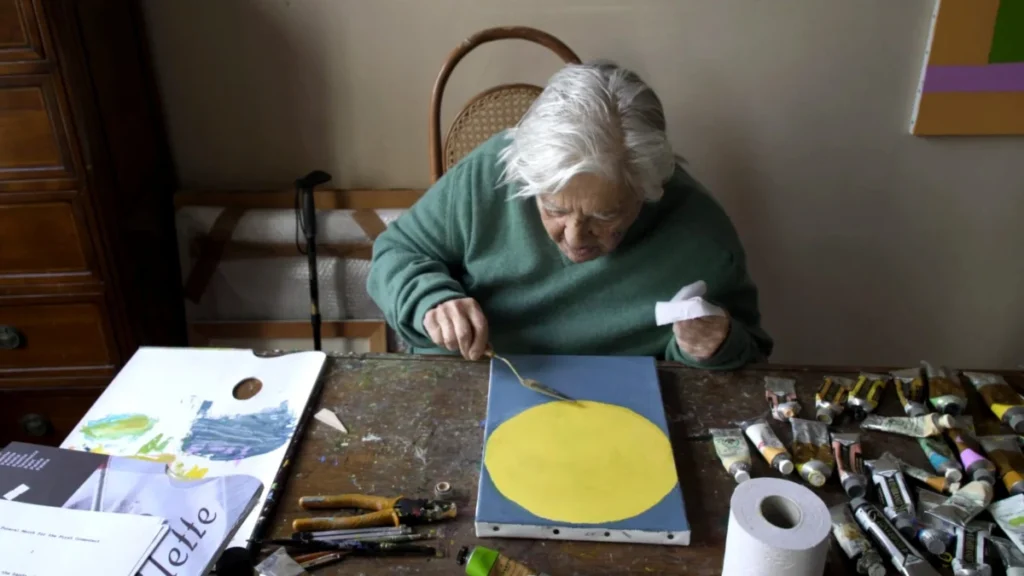
Regan’s film is not a traditional biography; it is a cinematic immersion into Adnan’s sensory world. The documentary tracks the artist through her Parisian apartment, observing her as she scrapes pigment onto canvas with a palette knife or marks paper with rhythmic, calligraphic ink strokes.
For Adnan, the act of making art was an antidote to the "apocalyptic" nature of political existence. She famously remarked, “My painting is the paradisiac side of the world, and my writing is the apocalyptic.” This duality was not a source of cognitive dissonance, but rather a functional equilibrium. In the film, she explains that her abstract painting, with its vibrant, minimalist shapes, served as a way to suspend "ordinary thinking."
She describes this process as "pre-thinking thinking"—a reliance on instinct that allows the artist to bypass the analytical mind. When she paints, she is not merely depicting a landscape; she is, as she wrote in Journey to Mount Tamalpais, "making" the mountain. By staring at it, walking it, and dreaming of it, she integrated the mountain into her own biological rhythm. Her assertion that “landscapes have their own time, the time it took to make them,” underscores her belief that art is a geological process—an accumulation of patience and observation.
Supporting Data: An Artistic Practice of Resistance
Adnan’s body of work is characterized by its visual audacity and its ethical stance. Following the Algerian War of Independence, Adnan made a radical choice: she stopped writing in French, the language of her colonizers, and began writing in English while focusing her visual practice on what she called “writing in Arabic.”
Her tapestries, ink drawings, and oil paintings act as a bridge between these identities. While the art world often categorized her primarily as a poet, the breadth of her contribution to contemporary abstraction is now considered monumental. Her color palette—often utilizing heavy, impasto blocks of orange, red, and blue—functions as a visual language that transcends borders. As she notes in the film, the compulsion to work is an existential necessity: "We can’t afford to ask ourselves too many questions; it stops us from working."
Official Perspectives and Critical Nuance
Director Marie Valentine Regan, a long-time friend of the artist, faced the formidable task of condensing a 96-year-long, multifaceted life into a 70-minute feature. The result is a work that feels remarkably light despite its thematic weight.
However, some critics have noted the film’s deliberate distance regarding Adnan’s private life, specifically her long-term partnership with the artist and publisher Simone Fattal. While Fattal appears throughout the documentary—hosting meals, attending book signings, and standing as a constant presence—the film offers little narrative exposition on the nature of their relationship.
When asked about this choice, Regan maintains that the documentary is designed to evoke rather than document. “What is a long relationship?” Regan posed in a recent communication. “It is so many things and part of the deep texture of their lives. I’ve tried to weave that into this film so it is there, evoked and felt, but at the same time part of this larger portrait of Adnan.” Indeed, the film’s quietest, most powerful inclusion of Fattal is the visual reference to her sculpture, The Meeting, and the final scene, which confirms that it was Fattal who ultimately carried out Adnan’s final wish to return to the California coast.
Implications for the Future of Art History
The legacy of Etel Adnan, as presented in Adnan Being and Time, serves as a challenge to contemporary artists and thinkers. In an era increasingly defined by digital fragmentation and the acceleration of time, Adnan’s work offers a different tempo—one tied to the slow evolution of a mountain and the persistence of memory.
The film serves as a vital pedagogical tool, urging the viewer to return to her texts and canvases with fresh eyes. By documenting the physical act of her creation—the way her hands moved across the paper, the way she spoke about the "thickness" of a landscape—Regan has preserved a methodology that is as much about spiritual endurance as it is about aesthetic production.
As we look at the trajectory of 20th-century art, Adnan stands out as a figure who refused to be contained by labels. She was an exile who found a home in a mountain; a philosopher who found logic in the irrationality of color; and an artist who, in her final years, taught us that the most important people we meet might not be people at all, but the natural entities that anchor our sense of self.
Adnan Being and Time does not just document a life; it documents a way of existing. It invites us to consider our own relationship with the spaces we inhabit and to ask, as Adnan did, if we are truly seeing the mountains—or the people—that surround us, or if we are merely waiting for them to pass. In the end, the film reminds us that while the artist is gone, the "inner movement" of her work remains, surging upward like the trees she loved to draw, indifferent to time, yet deeply rooted in the present.



