

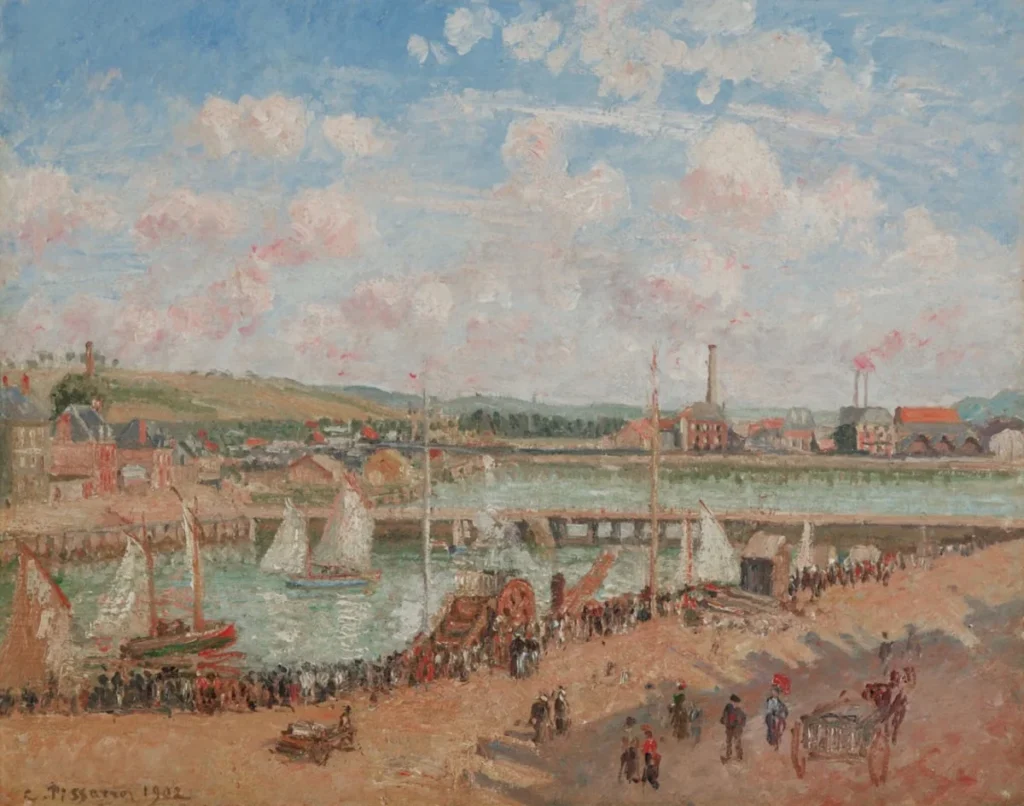
A high-stakes legal battle has erupted in a Paris courtroom, pitting seven heirs of the late Jewish banker Salomon Flavian against the global auction powerhouse Sotheby’s. At the heart of the dispute is the 2024 sale of a masterpiece by Camille Pissarro, Darse de pêche et bassin Duquesne, Dieppe, après-midi ensoleillée (1902). While Sotheby’s maintains that the £1.2 million ($1.5 million) transaction was a transparent settlement regarding the restitution of Nazi-looted art, the plaintiffs allege they were systematically sidelined, their inheritance compromised by unauthorized agreements, and their family legacy exploited.
The case, which centers on themes of historical justice, the ethics of art recovery, and the limits of international jurisdiction, is being closely watched by the art world. With a verdict expected on November 5, the proceedings have cast a shadow over the mechanisms used by auction houses to navigate the murky provenance of works seized during the Second World War.
The Painting and the Provenance: A History of Displacement
The work in question, a vibrant Impressionist canvas capturing the sun-drenched port of Dieppe, carries a provenance as turbulent as the era from which it was stolen. Records indicate that the painting was acquired by the renowned Paris dealer Paul Rosenberg by 1937, before passing into the hands of London-based dealer Edward Le Bas by 1939.
In the decades following the war, the painting enjoyed a prestigious exhibition history, gracing the walls of some of the world’s most venerable institutions, including the Tate in London, the Metropolitan Museum of Art in New York, and the Philadelphia Museum of Art. For years, its presence in these museums suggested a settled history. However, the shadow of 1941—the year the Nazi regime systematically seized the collection of Salomon Flavian in Paris—remained a persistent, albeit quiet, stain on the work’s pedigree.
Sotheby’s own research acknowledged that the painting had been registered in a 1947 French government repertory of looted art. This official classification creates a formidable hurdle for those attempting to argue that the work was not, in fact, the subject of spoliation.
Chronology of a Disputed Settlement
The timeline of the current legal entanglement is complex, marked by shifting allegiances and claims of procedural exclusion.
- 1941: The collection of Salomon Flavian is seized by Nazi forces in Paris.
- 1947: The French government officially registers Darse de pêche et bassin Duquesne, Dieppe, après-midi ensoleillée in its national repertory of looted art.
- 2024 (Early): Sotheby’s London prepares the painting for auction. Negotiations are initiated regarding the restitution claims, involving the current owner and Mondex Corporation, a firm specializing in recovering Nazi-looted assets.
- 2024 (Sale): The painting is sold at Sotheby’s London for £1.2 million. The auction house publicizes the sale as being "pursuant to a settlement between the current owner and heirs of Salomon Flavian."
- October 2024: Seven heirs, who were unaware of the negotiations, receive correspondence from Mondex revealing that their cooperation was "assumed" and that a portion of the sale proceeds had been allocated to them without their direct consent.
- September 18, 2024: The plaintiffs bring their case to a Paris court, challenging the legitimacy of the agreement signed by only two of the extended family members.
The Plaintiffs’ Allegations: Exclusion and Unauthorized Agency
The seven plaintiffs present a narrative of exclusion. They argue that the agreement brokered by Mondex—and subsequently executed by Sotheby’s—was fundamentally flawed because it failed to account for the entire body of Flavian’s living heirs.
According to the plaintiffs, only two family members, Gilles and Nicholas Flavian, were parties to the initial contract. The remaining seven plaintiffs argue they were neither consulted nor asked to sign any documents. The breach of trust was further exacerbated by the discovery that Mondex had accepted an 8% share of the net sale price on their behalf, ostensibly "in exchange for their cooperation," while the two signatories received a 16% commission.
The plaintiffs contend that this division of assets was arbitrary and that the use of their names in the settlement was a violation of their rights. More importantly, they challenge the assertion that the painting’s status as "looted" was ever truly resolved. They argue that while the Nazis kept meticulous lists of confiscated property, these records were frequently altered or purged by unscrupulous dealers or collaborators, meaning the absence of the Pissarro from a specific list does not serve as proof of legitimate ownership.
Official Responses and the Defense of Sotheby’s
Sotheby’s and their legal representatives have adopted a firm stance, emphasizing the legality of their procedures and the thoroughness of their due diligence. In an emailed statement, the auction house reiterated that the consignor employed a provenance researcher who concluded there was no definitive evidence of spoliation.
"The consignor retained a provenance researcher who concluded that there was no evidence that the painting was spoliated and negotiated on that basis with Mondex," the statement read. "Those discussions resulted in a settlement agreement between the consignor and Mondex, which was fully disclosed in our catalogue and pursuant to which the work was sold."
Melina Wolman, the attorney representing Mondex, adopted a more aggressive tone in court. She characterized the firm’s work as the "victim of a relentless harassment" and maintained that the painting was never officially classified as looted by the governing bodies, despite the 1947 registry. Furthermore, Sotheby’s legal team has mounted a jurisdictional defense, arguing that the Paris court has no authority over a transaction that occurred in London between parties with no established connection to France.
Implications: The Future of Restitution and Auction Ethics
The outcome of this case holds significant implications for the international art market. It highlights the growing tension between the desire for "finality" in art sales and the ethical mandate to address the lingering wounds of the Holocaust.
1. The Role of "Fixers"
The case puts a spotlight on firms like Mondex. While such companies play a vital role in identifying lost art, their practice of negotiating on behalf of entire families based on the signatures of a few raises significant ethical questions. Does a private company have the right to settle a historical grievance for heirs who have not provided informed consent?
2. The Burden of Proof
The plaintiffs’ argument that Nazi records were often manipulated challenges the traditional "due diligence" process. If an auction house relies solely on existing, potentially doctored, archives to clear a work for sale, they may be perpetuating the very crimes they claim to be resolving. This case could force a re-evaluation of what constitutes "sufficient evidence" in provenance research.
3. Jurisdictional Complexity
Sotheby’s reliance on the "London sale" defense serves as a reminder of the "forum shopping" that often occurs in international law. By moving assets across borders, stakeholders can sometimes insulate themselves from the more rigorous restitution laws of countries like France, which has historically been more proactive in protecting the rights of heirs of Holocaust victims.
4. The Moral Weight of History
Finally, this case underscores that for the descendants of Holocaust victims, the recovery of art is rarely just about the money. It is a matter of heritage and memory. When auction houses treat restitution as a mere "transactional settlement," they risk alienating the families whose lives were upended by the theft of their cultural property.
As the legal world waits for the verdict on November 5, the Pissarro at the center of this storm serves as a poignant symbol of a past that refuses to stay buried. Whether the court sides with the procedural rigor of the auction house or the moral claims of the heirs, the case of the Flavian family will undoubtedly remain a touchstone in the ongoing global conversation about justice, restitution, and the responsibility of those who trade in the world’s most precious cultural assets.



