

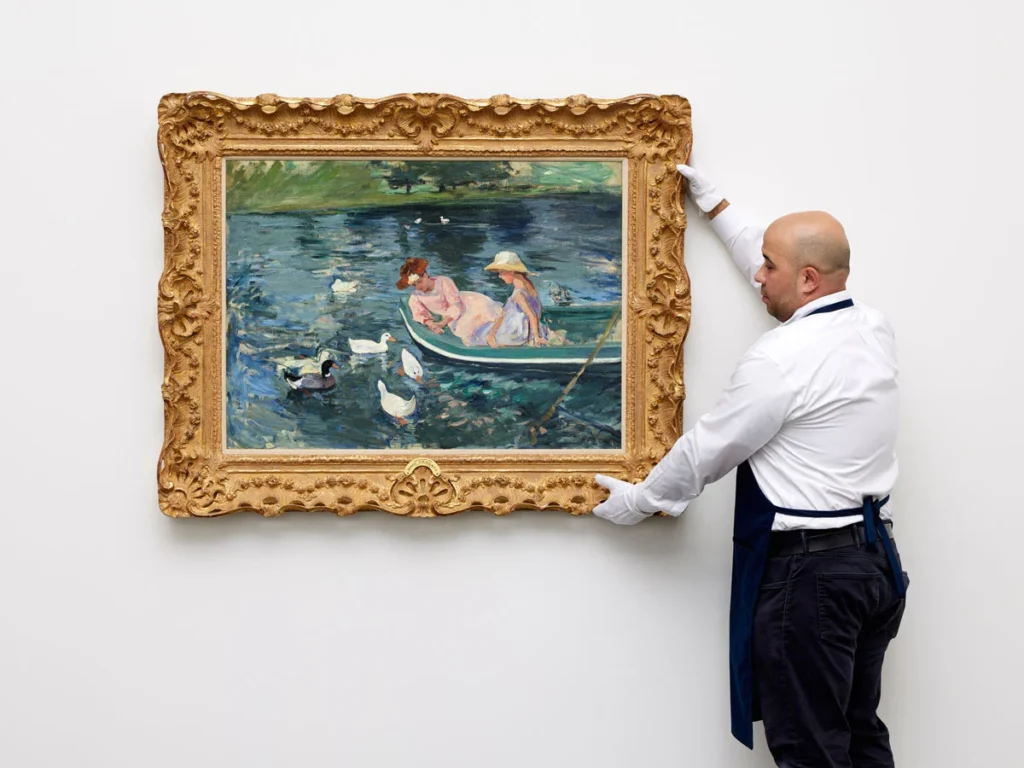
The international art market is entering a pivotal autumn season, marked by a convergence of blue-chip provenance, institutional leadership shifts, and the high-profile rediscovery of "lost" masters. At the center of this activity is the announcement that a significant cache of Impressionist and Modern masterpieces from the estate of the late oil tycoon and philanthropist Armand Hammer will head to the auction block at Sotheby’s. Simultaneously, the market is reacting to the meteoric rise of Alejandro Mario Yllanes, a Bolivian painter whose work—abandoned in a New York apartment decades ago—is now being acquired by the world’s most prestigious museums.
Main Facts: High Estimates and Philanthropic Goals
The most significant immediate financial development in the art market is the upcoming sale of twelve works once owned by Armand Hammer. Sotheby’s has announced that these works will be featured in its Modern Art Evening Sale this November in New York, a cornerstone of the global "marquee auction" calendar. The collection is expected to fetch between $25 million and $37 million.
Leading the Hammer cache is Edgar Degas’s Trois danseuses (Jupes jaunes) (ca. 1899), a quintessential example of the artist’s late-career fascination with the movement and color of the ballet. The painting carries a pre-sale estimate of $10 million to $15 million. Joining the Degas are several other heavyweight Impressionist and Modernist works:
- Mary Cassatt’s Summertime (1894–95): Estimated at $7 million to $10 million.
- Pierre-Auguste Renoir’s Antibes (1888): Estimated at $2.5 million to $3.5 million.
- Camille Pissarro’s Paysage à Osny, vue de la ferme (ca. 1883): Estimated at $2 million to $3 million.
While the financial figures are striking, the primary objective of the sale is philanthropic. The proceeds are earmarked for the Armand Hammer Foundation, specifically to fund grants for arts education and the support of cultural institutions. This move aligns with Hammer’s lifelong public persona as a patron of the arts and his desire to see private wealth recycled into public cultural benefits.
Chronology: A Season of Previews and Transitions
The timeline for these market-moving events spans from late September through the end of the calendar year, with some institutional appointments extending into early 2025 and award recognitions reaching into 2026.
September 2024: Previews and New Curatorial Directions
From September 23 to 25, Sotheby’s hosted a public viewing of the Hammer collection at its Los Angeles outpost. This West Coast preview was a strategic nod to Hammer’s deep ties to the city, where he founded the Hammer Museum and spent much of his later life.
In the same month, the Palm Springs Art Museum launched its latest curatorial initiative. César García-Alvarez, the founding executive and artistic director of The Mistake Room in Los Angeles, began his tenure as the Q+ Art Curator-at-Large. His inaugural exhibition, (Enter Pirates), opened last week in the Montgomery Gallery, signaling a two-year commitment to queer-focused programming.
November 2024: The New York Marquee Sales
The "Big Number" of $37 million will be tested in November during Sotheby’s Modern Art Evening Sale. This period represents the peak of the autumn art market, where global collectors descend on New York to compete for museum-quality works. Simultaneously, the National Gallery of Art in Washington, D.C., will welcome Virginia Anderson as the new Senior Curator of American Art and Head of the Art of the Americas.
2025–2026: Institutional Continuity and Recognition
Looking further ahead, Maria Arusoo will assume leadership of the Tallinn Art Hall in Estonia on January 1, 2025. Furthermore, the K21 Global Art Award has already looked toward 2026, naming the Chicago- and Berlin-based sculptor Julia Phillips as its next recipient. This award, which includes a €100,000 prize, highlights the long-term planning cycles currently dominating the institutional landscape.
Supporting Data: The Market of Rediscovery
While the Hammer sale represents the "establishment" market, the recent performance of works by Alejandro Mario Yllanes represents the "discovery" market—a sector increasingly fueled by academic research and gallery-led reclamation projects.
Ben Elwes Fine Art in London has spent the last several years rehabilitating Yllanes’s reputation. A student of the legendary Diego Rivera, Yllanes was a fierce advocate for the Indigenous people of Bolivia, using his canvases as political indictments of government maltreatment. Following his death in 1960, his work largely vanished from the public eye, with a significant portion left behind in an apartment on New York’s Upper West Side.
The data surrounding Yllanes’s market resurgence is staggering:
- Sales Volume: Since the gallery’s first exhibition of his work in late 2023, nearly two dozen pieces have been sold.
- Price Points: Works have commanded prices between $400,000 and $1.9 million.
- Institutional Buyers: The buyer list reads like a "who’s who" of the global museum world, including the Metropolitan Museum of Art (New York), the Museum of Latin American Art of Buenos Aires (MALBA), the Bowdoin College Museum of Art, and the Toledo Museum of Art. The latter acquired the seminal 1935 work Lake Titicaca in May 2024.
Official Responses and Perspectives
The responses from industry leaders emphasize the dual nature of these developments: the preservation of legacy and the necessity of growth.
Jacqueline Wachter, head of the Sotheby’s Los Angeles office, provided context for the Hammer sale, noting that the late tycoon’s impact on the city’s cultural fabric is "difficult to overstate." According to Wachter, Hammer viewed art collecting as a social contract, believing that "collecting art came with an obligation to share it." This sale is framed not as a liquidation of assets, but as a fulfillment of that mission by funding the next generation of arts education.
In the institutional sector, the appointment of Virginia Anderson to the National Gallery of Art is seen as a major win for the D.C. institution. Currently the head of American painting and sculpture at the Baltimore Museum of Art, Anderson’s move is viewed by peers as a strengthening of the "Art of the Americas" department at a time when national museums are re-evaluating their narratives of American history.
Regarding the K21 Global Art Award, the selection committee praised Julia Phillips for her "independent artistic vision." The €100,000 prize is intended to provide "new impetus for international contemporary art," reflecting a desire among European institutions to support artists who work across borders and media.
Implications: A Shifting Art World Paradigm
The convergence of these stories points toward several broader trends in the 2024–2025 art market:
1. The Rise of the "Philanthropic Deaccession"
The Hammer sale illustrates a growing trend where foundations and private estates sell high-value assets to pivot toward more liquid forms of philanthropy. Rather than holding onto a static collection, the Armand Hammer Foundation is converting aesthetic value into educational capital. This reflects a shift in how legacy is defined—less by what a foundation owns and more by what it does.
2. The Institutional Appetite for Social Justice Narratives
The rapid institutional acquisition of Alejandro Mario Yllanes’s work suggests that museums are hungry for historical narratives that challenge traditional Western art canons. Yllanes’s focus on Indigenous Bolivian struggles provides a perfect intersection of high-modernist technique (influenced by Rivera) and social-political relevance. His "rediscovery" serves as a blueprint for how galleries can create market value through rigorous historical research and institutional outreach.
3. A Resilient Blue-Chip Market
Despite global economic fluctuations, the $37 million estimate for the Hammer cache and the seven-figure prices for Yllanes indicate that the high end of the market remains robust. Collectors and institutions continue to seek "trophy" works—those with impeccable provenance (like Hammer) or significant historical discovery (like Yllanes).
4. Leadership Diversification
The series of industry moves—from the National Gallery of Art to the Palm Springs Art Museum—indicates a period of "musical chairs" among top-tier curators. The focus on "Art of the Americas" and "Q+ Art" suggests that the next decade of museum programming will be defined by specialists who can bridge the gap between traditional art history and contemporary identity politics.
In conclusion, the upcoming November auctions and the ongoing institutional shifts represent a healthy, if changing, ecosystem. Whether it is the $15 million Degas or the $1.9 million Yllanes, the market is currently rewarding works that carry both historical weight and a clear sense of purpose. As the Hammer collection goes under the hammer in New York, the art world will be watching to see if the market’s appetite for legacy remains as strong as its newfound passion for rediscovery.



