

Introduction: The Unseen Battle for Global Trade
The global economy is anchored by the maritime industry, a complex web of logistics that facilitates over 80% of world trade. Yet, beneath the calm surface of international shipping lanes, a persistent and evolving threat remains: maritime piracy and armed robbery. For over three decades, the International Chamber of Commerce (ICC) International Maritime Bureau’s (IMB) Piracy Reporting Centre (PRC) has served as the frontline defense for mariners, functioning as a global nerve center for incident reporting, threat mitigation, and strategic intelligence. As maritime corridors become increasingly congested and geopolitical tensions rise, the role of the PRC has never been more critical to ensuring the safety of crews and the continuity of global supply chains.
Main Facts: The PRC’s Mandate and Operational Framework
Established in 1991, the IMB Piracy Reporting Centre was created in direct response to a surge in violent piracy in Southeast Asia. Headquartered in London, the center operates as an independent, non-governmental agency that provides a 24-hour service to mariners, shipowners, and operators.
The mandate of the PRC is three-fold:
- Immediate Response: Acting as a primary point of contact for vessels under attack, the PRC coordinates with local and international authorities, including navies and coast guards, to ensure a rapid response to distress signals.
- Intelligence Dissemination: By issuing real-time warning broadcasts and email alerts, the PRC creates a "safety net" of information, allowing ships in the vicinity of a reported incident to adjust their routes or elevate their security postures.
- Data Stewardship: The center functions as the world’s most comprehensive repository of piracy and armed robbery data. By cataloging every incident—from boarding attempts to successful hijackings—the PRC provides the statistical evidence necessary for governments to allocate naval resources and for the shipping industry to refine its Best Management Practices (BMP).
A Chronology of Maritime Security
The evolution of the PRC mirrors the shifting landscape of maritime threats over the last 33 years.
The 1990s: The Genesis of Modern Reporting
When the PRC opened its doors in 1991, the focus was largely on the Malacca Strait and the surrounding waters of Southeast Asia. At the time, piracy was often viewed as a local nuisance rather than a systemic threat to global trade. The PRC’s establishment shifted this narrative, compelling international regulators to recognize that piracy was a crime that required a coordinated, international response.
The 2000s: The Rise of the Somali Crisis
The turn of the millennium brought a seismic shift. The collapse of civil order in Somalia created a "lawless zone" off the Horn of Africa. Between 2005 and 2012, the world witnessed an unprecedented escalation in piracy, with heavily armed gangs using mother ships to hijack tankers and container ships for millions of dollars in ransom. During this era, the PRC became the primary liaison between the shipping industry and the international naval task forces, including Operation Atalanta and the Combined Maritime Forces.
The 2010s to Present: Diversification and Regional Hotspots
Following the successful containment of the Somali threat, piracy did not disappear; it metastasized. The focus shifted toward the Gulf of Guinea, where kidnapping for ransom became a dominant business model, and the Singapore Strait, which remains a high-frequency zone for low-level armed robbery. Today, the PRC is grappling with the emergence of new technologies—such as drones and cyber-vulnerabilities—that modern pirates are beginning to incorporate into their operational repertoire.
Supporting Data: Understanding the Trends
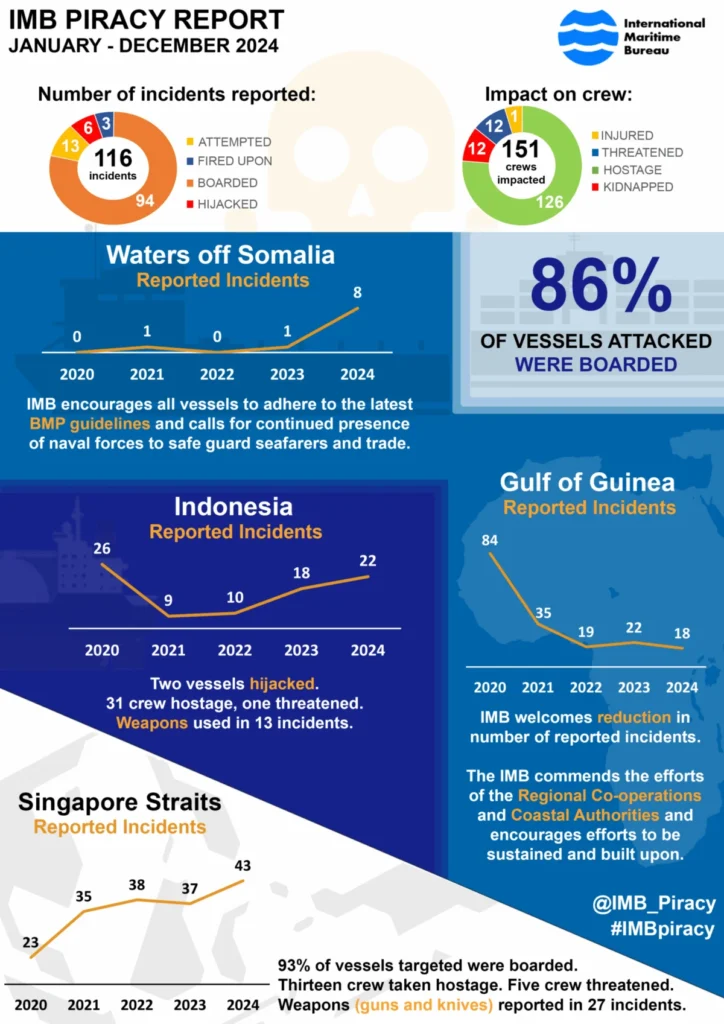
Data is the lifeblood of the PRC’s strategy. According to the latest figures, reporting remains the most effective tool for deterrence. The IMB maintains that while many incidents go unreported due to fear of insurance premium hikes or delays in port, consistent reporting is the only way to compel littoral states to take responsibility for their waters.
Key Statistics and Insights
- Report Frequency: The PRC processes hundreds of notifications annually. Every "attempted" incident is just as vital as a "successful" one, as it helps map the operational patterns of pirate syndicates.
- The "Dark" Numbers: Experts at the IMB estimate that for every reported incident, there may be several that go unrecorded. The PRC actively encourages shipmasters to break the silence, emphasizing that under-reporting leads to a false sense of security and a subsequent withdrawal of naval protection.
- Annual Reports: The Piracy and Armed Robbery Against Ships report, published annually by the IMB, serves as the industry’s "Gold Standard" for risk assessment. It categorizes incidents by severity, location, and method, allowing shipping companies to conduct accurate voyage risk assessments.
Official Responses and Strategic Collaboration
The IMB’s work does not happen in a vacuum. It relies on a delicate balance of cooperation between the private sector and sovereign authorities.
The Role of Advocacy
Director Michael Howlett of the ICC International Maritime Bureau has consistently emphasized that maritime security is a shared responsibility. "The PRC acts as a catalyst," Howlett explains. "By providing actionable, verified data to coastal states, we create a situation where those states are held accountable for the security of their waters. We aren’t just recording crime; we are pressuring the system to prevent it."
Navigating Jurisdictional Hurdles
One of the most significant challenges the PRC faces is the "jurisdictional void." Many piracy hotspots occur in the Exclusive Economic Zones (EEZs) of countries with limited naval capacity. The PRC bridges this gap by acting as an intermediary, relaying distress calls to the nearest competent authority—even when that authority is thousands of miles away or part of a multinational task force.
Implications for the Future of Shipping
As we look toward the mid-2020s, the implications of the PRC’s work are profound. The global shipping industry is moving toward greater automation and reduced crew sizes, which could potentially make vessels more vulnerable to boarding.
Technological Adaptation
The IMB is currently focusing on how the digital transformation of shipping interacts with piracy. The PRC is increasingly involved in discussions regarding the cybersecurity of navigation systems. If a pirate group can spoof a GPS signal to lure a vessel into a "trap" zone, the nature of piracy moves from physical boarding to digital coercion.
Policy and Regulation
The data provided by the PRC is foundational to the International Maritime Organization (IMO) and its regulatory frameworks. Without the center’s consistent, long-term data, global maritime policy would be based on anecdotes rather than evidence. The implications for the shipping industry are clear: companies that engage with the PRC and participate in its reporting structure are statistically safer, better prepared, and more resilient in the face of maritime threats.
Conclusion: A Call to Vigilance
The IMB Piracy Reporting Centre stands as a testament to the power of coordinated information. By transforming a decentralized industry into a cohesive network of eyes and ears on the water, the PRC has saved countless lives and protected billions of dollars in global commerce.
However, the safety of the high seas remains fragile. As maritime criminals adapt their tactics, the shipping industry must mirror this adaptability through increased transparency and active reporting. Shipmasters and owners are urged to treat every encounter—no matter how minor—as a data point in the larger struggle for maritime security.
For those navigating the complexities of modern trade, the IMB Piracy Reporting Centre remains the first line of defense. By maintaining a constant, 24-hour vigil, they ensure that when the call for help comes, the world is listening.
Resources and Contact Information
For shipmasters, owners, and maritime stakeholders, engagement with the PRC is a vital operational requirement.
- Reporting Incidents: All actual, attempted, and suspected incidents should be reported immediately to the PRC. This ensures that the bureau can coordinate with response agencies and issue timely warnings to other vessels in the region.
- Accessing Reports: To stay informed on current trends, stakeholders are encouraged to request a copy of the latest 2024 Piracy and Armed Robbery Against Ships report. Access is available via the ICC-CCS website.
- Media and Institutional Inquiries:
- Contact: Michael Howlett, Director, ICC International Maritime Bureau
- Tel: +44 207 423 6960
- Email: [email protected]
In the ongoing effort to secure our oceans, the data provided by the IMB is not merely a record of the past—it is the essential blueprint for a safer future.



