
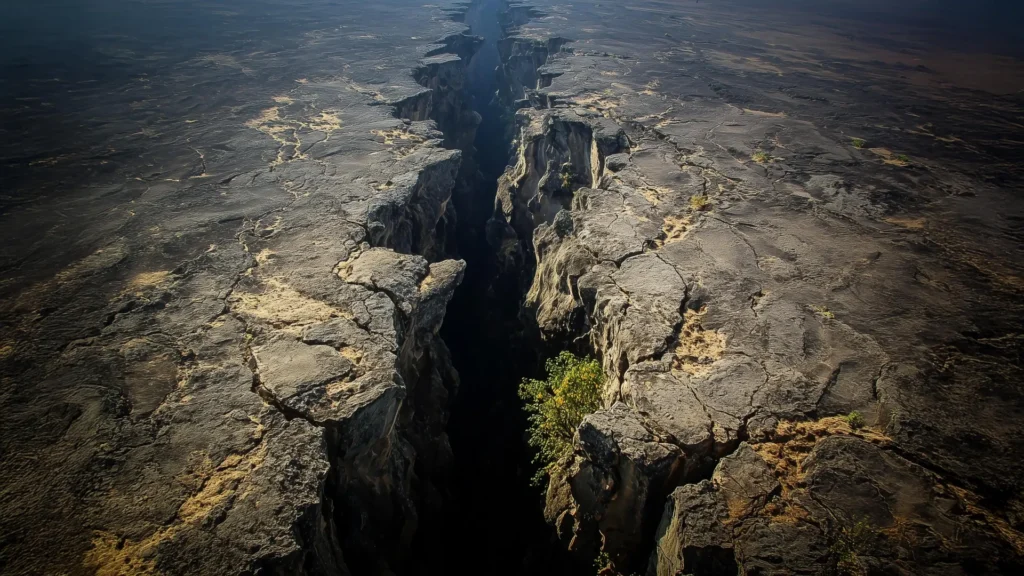
The East African Rift System (EARS) has long been regarded as the definitive laboratory for continental breakup. It is a gargantuan scar stretching thousands of kilometers, a place where the African continent is slowly tearing itself asunder. For decades, the conventional wisdom held that this process was driven primarily by shallow forces: the weight of the lithosphere itself and the gravitational pull of its high topography.
However, new research utilizing advanced 3D thermomechanical modeling has shattered this simplistic narrative. By reconciling over 12 years of high-precision GPS data with state-of-the-art computational simulations, an international team of researchers has identified a "hidden" driver of geological change. The culprit is the African Superplume—a colossal, upwelling column of hot mantle material rising from deep within the Earth’s interior. This subterranean engine is not merely a passive background feature; it is actively warping the surface, driving unusual, rift-parallel motions that have baffled geophysicists for years.
The Mechanics of a Breaking Continent
To understand the magnitude of this discovery, one must first grasp the paradoxical nature of the Earth’s lithosphere. The lithosphere—the rigid, outermost shell comprising the crust and the uppermost mantle—is remarkably fickle. Its behavior depends entirely on the tempo of the stress applied to it.
Geophysicist D. Sarah Stamps, an associate professor in the Department of Geosciences at Virginia Tech, provides a relatable analogy: Silly Putty. "If you hit Silly Putty with a hammer, it can actually crack and break," Stamps explains. "But if you slowly pull it apart, the Silly Putty stretches. So, on different time scales, Earth’s lithosphere behaves in different ways."
In the context of continental rifting, this duality is critical. Near the surface, where the crust is cooler and more brittle, the stretching of the Earth results in sudden, violent fractures—the source of earthquakes and rift-perpendicular faults. Deeper down, where temperatures soar and pressures mount, the rock becomes ductile, flowing gradually over geological time.
In most rift systems, the deformation is straightforward: the lithosphere pulls apart perpendicularly to the rift axis, much like pulling a piece of fabric until it tears. The EARS does exhibit this expected behavior, but it also displays something else—an anomalous motion running parallel to the rift. For years, this "rift-parallel" movement remained an enigma, a nagging data point that refused to fit into standard tectonic models.
A Chronology of Discovery: From GPS to Supercomputers
The journey to solve this mystery began more than a decade ago. Dr. Stamps, then a postdoctoral researcher, turned to the sky for answers. By deploying a dense network of GPS stations across East Africa, her team tapped into signals from over 30 satellites orbiting 25,000 kilometers above the planet. These stations were capable of detecting surface motion at the millimeter scale, revealing that the ground was not just moving apart; it was sliding in unexpected directions.
2021: The Initial Modeling Breakthrough
In a 2021 study published in Geophysical Research Letters, Stamps and her colleagues attempted to model the forces behind these observations. Using 3D computational simulations, they tested the two traditional drivers of rift deformation: lithospheric buoyancy and mantle traction.
Lithospheric buoyancy forces are driven by elevation and density variations within the crust—specifically the African Superswell, a region of unusually high topography. While these forces successfully accounted for the expected, perpendicular stretching of the rift, they utterly failed to explain the mysterious rift-parallel motion. The researchers were left with a scientific vacuum: if surface buoyancy couldn’t explain the movement, what could?
2024: The Superplume Connection
The answer arrived in a more recent study published in the Journal of Geophysical Research, led by Dr. Tahiry Rajaonarison, a former doctoral student of Stamps and current postdoctoral researcher at New Mexico Tech. By employing complex 3D thermomechanical modeling, Rajaonarison focused specifically on the "anomalous" rift-parallel data.
The simulations yielded a breakthrough: the northward flow of the African Superplume. This massive, deep-mantle upwelling begins deep beneath southwest Africa and extends northeastward. As it rises and travels north, it becomes progressively shallower, exerting a physical drag—or traction—on the underside of the African plate. This force, the models suggest, is the primary engine behind the rift-parallel deformation.
The Anatomy of the African Superplume
The African Superplume is one of the most significant geological features on the planet, yet it remains largely invisible to the human eye. It is an enormous "blob" of hot, buoyant material originating from the core-mantle boundary. As this material rises through the mantle, it creates a convective current that acts like a conveyor belt beneath the lithosphere.
The impact of this upwelling is twofold:
- Physical Traction: As the plume material moves northward, it drags the base of the lithosphere along with it, creating the rift-parallel motion observed by the GPS network.
- Seismic Anisotropy: The heat and movement of the plume alter the alignment of minerals within the mantle rocks. This creates "seismic anisotropy," where seismic waves generated by earthquakes travel faster in the direction of the flow than in other directions.
When researchers compared their model’s predicted flow direction with actual seismic data from the region, the match was near-perfect. The alignment of rocks below the rift mirrored the northward flow of the Superplume, providing independent, empirical evidence that the mantle is indeed "pushing" the surface in ways previously unmodeled.
Implications for Continental Evolution
The findings from the Geodesy and Tectonophysics Lab at Virginia Tech have profound implications for our understanding of how continents break apart. They suggest that the birth of a new ocean basin—the eventual fate of the East African Rift—is not a simple, two-dimensional process of pulling a plate apart. Instead, it is a complex, multi-layered interaction between the crust and the deep, flowing mantle.
Redefining the "Natural Laboratory"
For scientists, the East African Rift is the premier location to observe the transition from a stable continent to an ocean basin. By confirming that mantle traction plays a critical role, the research team has added a new layer of complexity to this "natural laboratory." It implies that the evolution of the rift is dictated not just by the forces at the surface, but by the deep-seated convective patterns of the Earth’s interior.
Addressing the Debate
For years, the geological community has been divided into camps: those who favor "bottom-up" forces (mantle plumes) and those who favor "top-down" forces (lithospheric buoyancy). This study effectively ends that binary debate by proving that both forces are at play.
"We are saying that the mantle flow is not driving the east-west, rift-perpendicular direction of some of the deformations, but that it may be causing the anomalous northward deformation parallel to the rift," Rajaonarison noted. "We confirmed previous ideas that lithospheric buoyancy forces are driving the rift, but we’re bringing new insight that anomalous deformation can happen in East Africa."
Future Directions: Beyond the Rift
The success of the 3D thermomechanical models in explaining the EARS phenomena has opened new doors for geophysics. If the African Superplume is influencing the motion of the African plate today, researchers must now ask to what extent similar deep-mantle processes have shaped other rifts throughout Earth’s history.
Dr. Stamps, reflecting on the significance of the work, emphasizes the collaborative nature of the discovery. "We’re excited about this result from Dr. Rajaonarison’s numerical modeling because it provides new information about the complex processes that shape the Earth’s surface through continental rifting," she said.
As the research progresses, the team plans to refine their models further, integrating even higher-resolution seismic data and potentially incorporating the influence of ancient, pre-existing structural weaknesses in the lithosphere. The study serves as a potent reminder that beneath the solid ground we walk upon, the Earth is in a state of constant, fluid motion—driven by deep, invisible currents that are slowly, inexorably, redrawing the map of the world.
Through the lens of this research, we see that the East African Rift is not just a place where the Earth is pulling apart; it is a point of intersection where the deepest reaches of the planet’s interior communicate with the surface, shaping the landscape in ways that will influence the geography of our planet for millions of years to come.