
In an era of hyper-globalization, the world economy relies on the silent, constant movement of goods across the high seas. Over 80% of global trade is transported by sea, making the maritime industry the lifeblood of international commerce. However, this vast, ungoverned expanse of blue water remains vulnerable to age-old threats. As modern piracy evolves from simple opportunistic boarding to sophisticated organized crime, the International Chamber of Commerce (ICC) International Maritime Bureau (IMB) Piracy Reporting Centre (PRC) stands as the preeminent guardian of maritime security.
Operating as a 24-hour, single point of contact, the IMB PRC serves as a vital nexus between vulnerable vessels and global law enforcement. By providing free support to mariners under duress and disseminating transparent, reliable data to governments and industry stakeholders, the Centre plays an indispensable role in maintaining the flow of global trade.
The Genesis and Evolution of the IMB Piracy Reporting Centre
The IMB Piracy Reporting Centre was established in 1992 in response to an alarming surge in pirate attacks against merchant vessels in the Southeast Asian corridor. What began as a localized initiative to track regional piracy has evolved into a global sentinel.
For decades, the PRC has functioned as a neutral, third-party observer. Unlike governmental bodies, which may be constrained by political boundaries or diplomatic sensitivities, the IMB PRC operates with a singular objective: the safety of the crew and the security of the vessel. By maintaining a constant watch, the Centre ensures that when a distress signal is sent, it does not disappear into the void of the ocean but is channeled immediately to the relevant authorities and regional coast guards.
Chronology of Maritime Threats: From Traditional Piracy to Modern Challenges
The landscape of maritime crime has shifted dramatically over the past thirty years. Understanding this trajectory is essential to understanding the value of the IMB PRC’s reporting mechanisms.
1990s: The Rise of Southeast Asian Piracy
The early years of the PRC were defined by attacks in the Malacca Strait and the South China Sea. These were largely characterized by "hit and run" tactics, where perpetrators would board vessels at anchor or while underway, steal ship’s stores and crew belongings, and flee before the authorities could respond. The IMB’s role was to map these "hotspots," allowing shipping companies to adjust their routes or increase their onboard security posture.
2000s: The Somali Crisis
The mid-2000s ushered in the most dangerous era for modern shipping: the Somali piracy crisis. Armed with AK-47s and rocket-propelled grenades, pirate skiffs hijacked massive oil tankers and container ships, holding crews hostage for millions of dollars in ransom. During this period, the IMB PRC became the primary coordination hub for international naval coalitions. The data collected by the Centre allowed for the establishment of the "Maritime Security Transit Corridor," effectively forcing a change in the way the industry operated.
2010s to Present: Diversification and Digital Threats
Today, the threat has shifted again. While the Gulf of Guinea has emerged as a high-risk area for kidnappings for ransom, the industry is also grappling with the rise of cyber-piracy, where digital systems are compromised to facilitate physical attacks. The IMB PRC has adapted, integrating new technologies into its reporting systems to ensure that data remains relevant in a technologically advanced maritime environment.
Supporting Data: Why Transparency Matters
The IMB PRC’s primary contribution to maritime security is its commitment to transparent, data-driven reporting. By collecting granular data—including time of attack, coordinates, type of vessel, method of boarding, and the use of weapons—the Centre provides a blueprint for risk assessment.
The Power of "Reporting Culture"
One of the greatest challenges in maritime security is the under-reporting of incidents. Many shipping companies fear that reporting a minor boarding will lead to higher insurance premiums or bureaucratic delays at the next port of call. The IMB PRC works to combat this by maintaining a strict policy of confidentiality and neutrality.
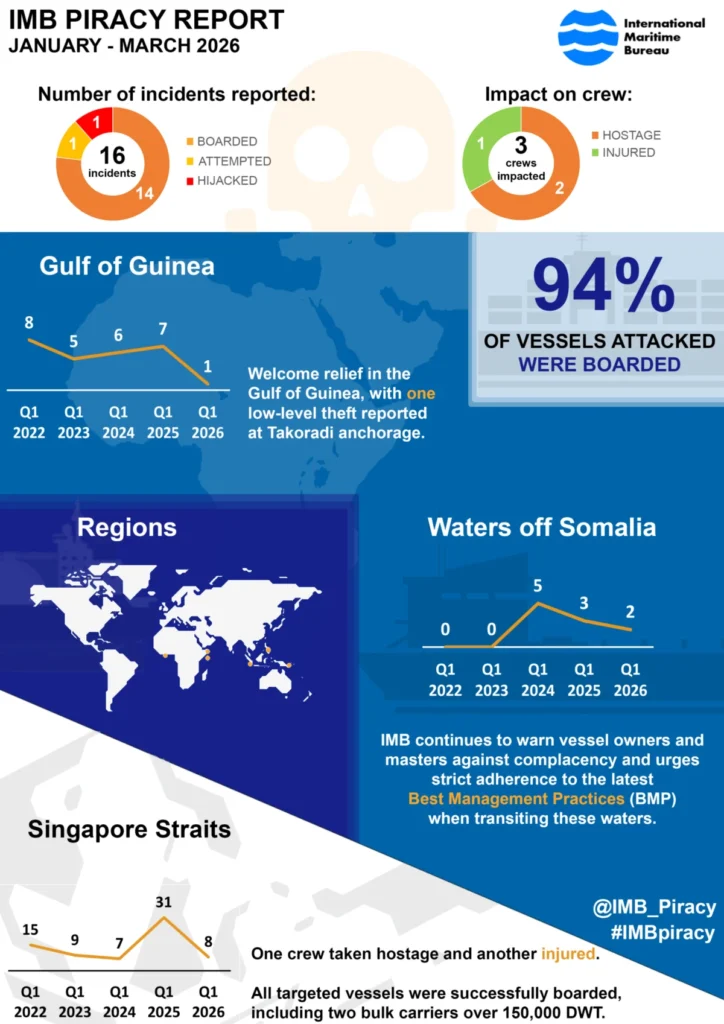
According to annual IMB reports, the correlation between high-quality reporting and the reduction in successful attacks is undeniable. When the Centre publishes a quarterly report, it isn’t just a list of statistics; it is a tactical document used by:
- Shipping Companies: To determine the need for Private Maritime Security Contractors (PMSCs) or the use of "citadels" (safe rooms).
- Governments: To justify the deployment of naval assets to specific regions.
- Insurance Underwriters: To accurately price risk, which in turn incentivizes better onboard security measures.
Official Perspectives and Operational Framework
At the helm of this operation is Michael Howlett, the Director of the ICC International Maritime Bureau. Under his guidance, the PRC has remained a steadfast resource, often acting as the first point of contact for a Master of a vessel experiencing a suspicious approach.
"The PRC is not just a repository of data; it is an active participant in the safety of mariners," says Howlett. "When a vessel calls our 24-hour hotline, we immediately trigger a response chain that alerts local authorities and ensures the incident is recorded and acted upon. Our neutrality is our strength; we provide the evidence that governments need to act, without the political baggage that often hinders international cooperation."
The International Chamber of Commerce (ICC) provides the necessary institutional backing for the PRC. As the institutional representative of over 45 million companies in 170 countries, the ICC ensures that the PRC’s findings reach the highest levels of global governance, including the International Maritime Organization (IMO).
Implications: The Macro-Economic Impact
The implications of the IMB PRC’s work extend far beyond the safety of a single vessel. The stability of the global supply chain is directly tied to the perceived security of the seas.
1. Insurance and Cost of Goods
Maritime insurance premiums are directly tied to the IMB’s piracy statistics. If a region is marked as a "High-Risk Area" by the IMB and other international bodies, insurance costs for vessels transiting that region skyrocket. These costs are ultimately passed down to the consumer, increasing the price of everything from consumer electronics to fuel.
2. The Human Element
The psychological toll on mariners cannot be overstated. A ship’s crew is the most valuable asset in the maritime industry. The knowledge that a 24-hour support structure exists provides a level of psychological security that is essential for crew retention in an industry that is already struggling with labor shortages.
3. Legal and Regulatory Standard Setting
The IMB PRC’s data is frequently used to lobby for changes in international maritime law. Whether it is advocating for the right of vessels to carry armed guards or pushing for more aggressive prosecution of pirates, the Centre provides the empirical evidence required to change policy. Their influence extends to the creation of "Best Management Practices" (BMP), which have become the industry standard for deterring piracy.
The Future of Maritime Security
As we look toward the future, the maritime industry faces an increasingly complex security environment. Climate change is opening new Arctic trade routes, which may present new, unforeseen security challenges. Simultaneously, the rise of autonomous and semi-autonomous vessels requires a total rethink of how piracy is countered.
The IMB Piracy Reporting Centre remains at the forefront of this evolution. By continuing to bridge the gap between private enterprise and state-led security, the Centre ensures that the "Blue Economy" remains resilient. The mandate of the ICC—to make business work for everyone, every day, everywhere—is nowhere more evident than in the work of the IMB PRC.
In a world where international relations are often fraught with tension, the IMB PRC serves as a rare example of global cooperation. By prioritizing the safety of the individual mariner and the reliability of the global supply chain, the Centre does more than just report on piracy—it actively preserves the stability of the global order.
For shipowners, governments, and international organizations, the IMB PRC is not merely a resource; it is a fundamental pillar of modern maritime infrastructure. As long as the seas remain a vital highway for the world’s goods, the IMB Piracy Reporting Centre will continue to stand as an unwavering watchman, ensuring that the light of safety and transparency never dims.
Contact Information for Assistance
For those involved in the maritime sector seeking information, reporting an incident, or requesting further analysis on regional security trends, the IMB Piracy Reporting Centre remains accessible 24 hours a day.
Michael Howlett
Director, ICC International Maritime Bureau
Tel: +44 207 423 6960
Email: [email protected]
The IMB invites all stakeholders to engage with their reporting platform, contributing to the global repository of knowledge that keeps our oceans secure. By working together—under the guidance of the ICC and the operational precision of the PRC—the maritime community can continue to navigate the challenges of the 21st century with confidence and resilience.