By Industry News Desk
Mining Americas Inc. [MAI-TSX; MAIFF-OTCQX], formerly known as Minera Alamos Inc., has reached a pivotal juncture in its corporate evolution. The company announced this week that the Mexican Federal Environmental Department (SEMARNAT) has officially granted the requisite land use change and environmental impact assessment approvals for its 100%-owned Cerro de Oro gold project. Situated in the northern reaches of Zacatecas State, this asset is poised to become a cornerstone of the company’s transition into a premier North American intermediate gold producer.
The market response to the announcement was immediate and bullish. Mining Americas shares surged 14.15%, or $0.80, closing at $6.45. This movement highlights investor confidence in the company’s de-risking strategy, as the stock continues to trade within a 52-week range of $3.45 to $7.50.
A Strategic Milestone: The Path to Cerro de Oro
The approval from SEMARNAT is not merely a bureaucratic hurdle cleared; it represents the final "green light" needed to transition Cerro de Oro from a development-stage asset to a potential construction project.
For Mining Americas, this success is the culmination of years of rigorous environmental due diligence and engineering studies. The project, which was initially acquired in September 2020, has undergone extensive drill programs and economic modeling to ensure it meets the company’s stringent return-on-investment criteria. With the environmental permits now secured, the company has successfully de-risked its primary pipeline of growth projects.
"With these permits now approved, we will start planning the advancement of Cerro de Oro towards a construction decision," stated Darren Blasutti, CEO of Mining Americas. "Cerro de Oro was shown to be a robust, open pit, heap leach gold project at a base case gold price of US$1,600 an ounce based on the 2023 Preliminary Economic Assessment (PEA). We are excited now to evaluate the project in the context of significantly higher gold prices and their potential positive impacts on the size and the economics of the project."
Chronology of Development
The journey to this week’s announcement has been characterized by a methodical, multi-year progression:
- September 2020: Mining Americas finalizes the acquisition of the Cerro de Oro project, identifying it as a high-potential, low-capital-intensity heap leach opportunity.
- 2021–2022: The company executes aggressive drilling campaigns to upgrade the geological confidence of the deposit, followed by comprehensive metallurgical testing and engineering studies.
- Late 2022: Mining Americas releases an updated mineral resource estimate and the results of a Preliminary Economic Assessment (PEA), confirming the project’s viability.
- 2023: The company integrates the PEA findings into its corporate strategy, positioning Cerro de Oro as a key driver of its intermediate producer transition.
- Q2 2024: SEMARNAT issues the final environmental and land-use approvals, providing the legal framework for construction commencement.
Supporting Data and Economic Outlook
The 2023 PEA provides a compelling look at the technical foundation of Cerro de Oro. Utilizing a gold price of US$1,700 per ounce, the resource estimate identified a pit-constrained, inferred resource of 67 million tonnes at an average grade of 0.37 g/t, totaling 790,000 ounces of gold.
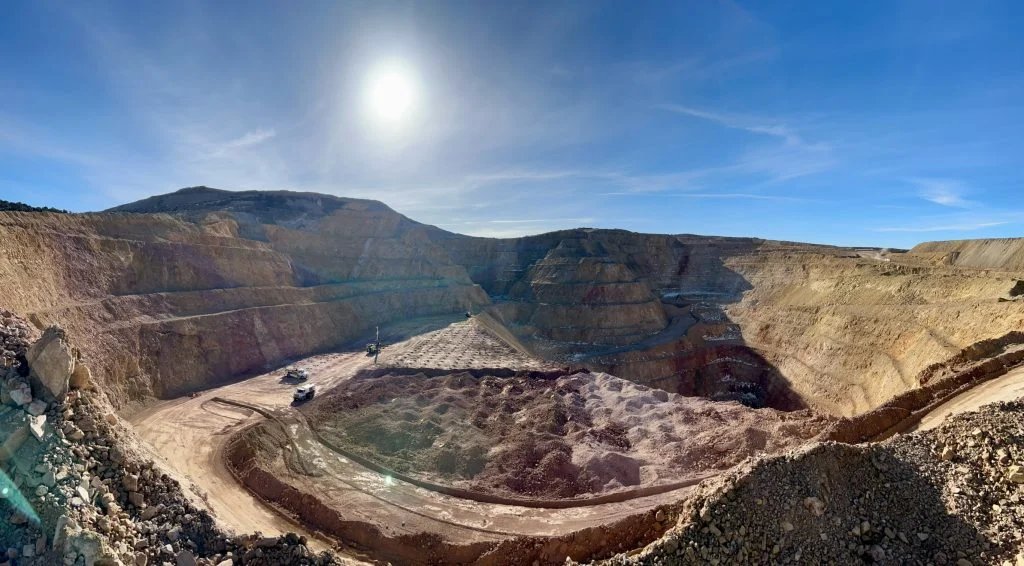
The operational model envisioned is a conventional, open-pit, heap-leach operation—a methodology favored by Mining Americas for its relative simplicity and lower capital expenditure requirements. The project’s key metrics, as outlined in the 2023 study, include:
- Initial Mine Life: 8.2 years.
- Strip Ratio: 0.3:1 (a highly favorable ratio indicating minimal waste movement).
- Total Gold Production: 477,000 ounces.
- Average Annual Production: 58,000 ounces (with a ramp-up to 65,000 ounces in the first four years).
- Initial Capital Costs: US$28 million.
These figures, while impressive at the time of the study, are now viewed by management as conservative. With the prevailing gold market exhibiting significantly higher price floors, the internal rate of return (IRR) and net present value (NPV) are expected to improve substantially when updated for current market realities.
A Portfolio Built for Scale
Mining Americas has carefully curated a portfolio that balances operational cash flow with high-upside development projects. The company’s growth strategy centers on three primary pillars:
1. The Pan Operating Complex (Nevada)
Located in White Pine County, Nevada, the Pan mine serves as the company’s anchor. It provides the necessary cash flow to fund corporate overhead and exploration activities. Adjacent to the Pan mine lies the Gold Rock project, which is fully permitted and represents a significant near-term production expansion opportunity.
2. Copperstone Project (Arizona)
The Copperstone underground gold project in La Paz County, Arizona, is currently in the construction stage. As a permitted, high-grade asset, Copperstone is a key component of the company’s pivot toward becoming a U.S.-focused intermediate producer.
3. Cerro de Oro (Mexico)
With the latest regulatory breakthrough, Cerro de Oro joins the ranks of permitted assets. By having three distinct, permitted growth projects (Copperstone, Gold Rock, and Cerro de Oro) in its portfolio, Mining Americas is significantly less reliant on the success of any single operation, effectively diversifying its operational risk across three different jurisdictions.
Implications: A Strategic Transition
The significance of the SEMARNAT approval cannot be overstated. In the current mining environment, permitting is often the most significant barrier to entry. Many junior and mid-tier companies struggle for years, or even decades, to secure the necessary social and environmental licenses to operate. By successfully navigating the Mexican regulatory landscape, Mining Americas has differentiated itself as an operator capable of executing complex development timelines.
CEO Darren Blasutti’s commentary highlights the broader strategic shift: "With Cerro de Oro permits approved, the company now has key permits in place for all of its cornerstone growth projects. We look forward to continuing to advance construction at Copperstone, making a construction decision for Gold Rock later this year, and progressing Cerro de Oro to a potential construction decision."
This "pipeline of permitted projects" is precisely what the market rewards in the current economic climate. As inflationary pressures impact the cost of labor and energy, having low-capital-intensity projects like Cerro de Oro—which requires only a modest US$28 million in initial outlay—is a major competitive advantage.
Investor Perspective and Forward-Looking Statements
For investors, the recent share price appreciation serves as a validation of the company’s long-term business model. By transitioning from a name change (Minera Alamos to Mining Americas) to a focus on execution, the company is signaling its readiness to scale operations.
However, as with all mining investments, caution remains prudent. Commodity markets are volatile, and the transition from a "permitted project" to a "producing mine" involves technical, logistical, and financial challenges. The company has stated that it will rely on its own internal cash flow and prudent capital allocation to advance these projects, but the execution phase will require disciplined management of construction timelines and budget controls.
The company maintains that it is committed to maximizing shareholder value by building a multi-asset platform. As Mining Americas moves toward the next phase of its corporate lifecycle, the integration of Cerro de Oro into its broader production portfolio will likely be the primary metric by which analysts measure its success in the coming quarters.
Disclaimer: Resource World Magazine Inc. has prepared this editorial for general information purposes only and should not be considered a solicitation to buy or sell securities in the companies discussed herein. The information provided has been derived from sources believed to be reliable but cannot be guaranteed. This editorial does not take into account the reader’s investment criteria, investment expertise, financial condition, or financial goals. Recipients should rely on their own due diligence and seek their own professional advice before investing.