As urban centers across Europe grow increasingly congested, the automotive landscape is undergoing a radical downsizing. The iconic, "yoghurt pot" microcars of the past, once the darlings of Italian and French city streets, are witnessing a demographic shift. In their place, a wave of affordable, tech-forward electric vehicles (EVs) from China has surged, capturing the market share once held by European legends. Even Smart, the brand that arguably defined the modern ultracompact segment, has pivoted its manufacturing base to China.
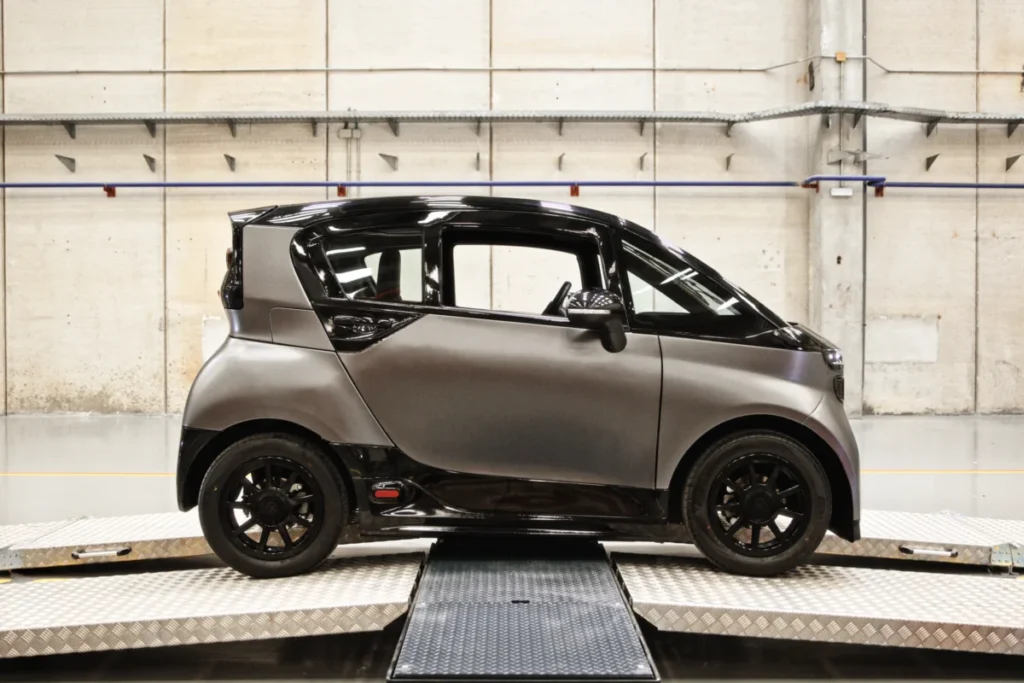
Yet, amidst this tide of imported mass production, a Spanish startup is attempting a defiant pivot. Liux, headquartered in Spain, believes it can challenge the status quo not just with size, but with a philosophy rooted in radical sustainability and circular design. Its flagship project, the "Liux Big," is a microcar that combines an ironic name with oversized industrial ambitions.
A New Vision for Urban Mobility
The name "Liux Big" is, by design, a joke. The vehicle is tiny—small enough to be parked at a right angle to a curb, reclaiming valuable city space. However, the moniker also serves as a manifesto for the startup’s leadership. Co-founders Antonio Espinosa de los Monteros and David Sancho are not content with merely building another commuter appliance; they are aiming to re-engineer the way cars are conceived, manufactured, and recycled.
"The idea of a ‘European car’ does not exist," Espinosa remarked during a recent interview. It is a striking admission from the CEO of a company currently making headlines for establishing the first new car manufacturing plant in Spain in over three decades. Yet, his skepticism highlights a pragmatic reality: in an era of globalized supply chains, true, 100% domestic sovereignty is an unattainable pipe dream. Instead, Liux is navigating the complexities of the modern automotive industry by prioritizing "circularity" and material integrity over nationalistic manufacturing claims.
Chronology: From Hypercars to Sustainable Micro-Mobility
The path to the Liux Big was neither linear nor conventional. It is a story of evolution, pivoting, and the synthesis of disparate automotive backgrounds.

The Foundation and the "Animal"
The journey began with the "Animal," a fully electric, five-seater SUV prototype unveiled in 2022. Constructed almost entirely from plant-based and recycled materials, the Animal was a proof-of-concept for the startup’s commitment to sustainable architecture. However, the founders quickly realized that bringing a full-sized SUV to mass production was a capital-intensive hurdle that might jeopardize the company’s long-term viability.
The Strategic Pivot
Recognizing that homologation—the process of getting a vehicle approved for road use—is significantly faster and more affordable for smaller, lighter vehicles, the team pivoted. They shifted their focus to the L7e category of micro-vehicles. This move was not a surrender; it was a tactical decision to secure market entry while perfecting their proprietary manufacturing techniques.
Reaching Homologation
By 2026, that strategy paid off. Liux successfully secured Europe-wide homologation for the Liux Big. With roughly 65 employees and three manufacturing facilities in Spain—including the flagship site in Azuqueca de Henares—the company is now preparing for a commercial launch slated for the first half of 2027.
Engineering for Circularity: The "Linen" Advantage
The most compelling aspect of the Liux Big is not its electric powertrain, but its body. Liux has pioneered the use of a novel, linen-based biocomposite. Unlike the standard plastics or steel used by competitors, this material is designed for total extraction and recycling at the end of the vehicle’s life.
"Recycling isn’t just a lab concept," explains Espinosa, who brings experience from his tenure as a co-founder of the B Corp firm Auara. "What makes something truly recyclable is how it’s built. When you manufacture, you must preserve the integrity of the materials so that a second life is actually possible."

This philosophy extends to the vehicle’s maintenance. Modern cars are often built with planned obsolescence in mind, utilizing integrated modules that are difficult to repair. Liux is designing the Big to be easily maintained, modular, and compatible with home-charging solutions—even those linked to residential solar arrays.
Supporting Data and Production Scalability
While the factory in Azuqueca de Henares may appear small, its operations are governed by the strict principles of "lean management." According to head of production Beatriz Belda González, a former BMW engineer, the facility is designed to handle the final, high-value stages of the assembly process.
- Production Capacity: Liux projects an output of 20,000 cars per year by 2030.
- Waiting List: Over 7,500 prospective customers have joined the company’s no-fee waiting list.
- Target Demographic: Analysis of the waiting list reveals that the primary interest comes from 55- to 60-year-old city dwellers, suggesting the Liux Big will likely serve as a household’s secondary, urban-commuter vehicle.
- Pricing: The company is aiming for a sub-€18,000 ($21,000) price tag before government subsidies, positioning it as a premium-accessible option in the microcar segment.
Official Perspectives: Safety and Performance
David Sancho, the technical lead at Liux, brings a background that is as far removed from microcars as one can imagine. Before co-founding Liux, he was instrumental in the development of the Bóreas, a high-performance hybrid supercar showcased at the 24 Hours of Le Mans.
Sancho’s influence is evident in the technical specifications of the Big. Despite the category’s lack of mandatory crash-test requirements, Liux has subjected the car to rigorous testing—slalom, braking, and structural integrity assessments—to ensure the vehicle feels like a "real" car.
"You don’t want a car that is only lightweight because its frame can’t withstand a crash," Sancho says. The goal is to provide the convenience of a two-wheeler with the psychological safety and stability of a four-wheeled vehicle. By maximizing the constraints of the L7e category, the engineering team has managed to integrate a 260-liter trunk, proving that size does not have to come at the expense of utility.

Implications for the European Market
The rise of Liux signals a potential shift in how European markets might compete with Chinese imports. By focusing on a "circularity-first" design, the company is attempting to build a brand identity that transcends price.
A New Retail Experience
Head of Brand Ana Terrado Leyva emphasizes that the sales experience will be just as important as the car itself. Showrooms are being curated to feel like design studios, utilizing textile screens and 3D modeling to explain the sustainable materials used in the vehicle. This aesthetic differentiation is a deliberate play to attract consumers who are conscious of their carbon footprint and who value European-led design.
Future Expansion and Partnerships
Liux is not banking on becoming a one-car brand. Plans are already in motion for a cargo variant of the Big, and the company is actively seeking partnerships with B2B fleet managers. The team is also keeping the door open for future integration of autonomous driving technologies, ensuring the platform remains relevant as the urban mobility landscape evolves.
With €16 million ($18.5 million) in funding secured, the startup is now moving from the prototype phase to the dealership floor. Whether it can compete with the deep pockets and manufacturing scale of global EV giants remains the defining question. However, by refusing to engage in a race to the bottom, Liux is offering an alternative: a car that is not just efficient, but intentionally built to exist in a circular, sustainable economy.
Perhaps, in the small frame of the Liux Big, there is a legitimate answer to the question of whether a "European car" can still exist in the 21st century. By focusing on design integrity and the long-term lifecycle of materials, Liux is betting that European consumers are ready to move past the era of disposable, mass-produced transport and into a future where "small" is the new "big."