VANCOUVER, B.C. – Oreterra Metals Corp. (TSXV: OTMC) (OTCQB: OTMCF) has reached a critical juncture in its 2024 exploration campaign at the Trek South prospect. Located within the heart of British Columbia’s prolific Golden Triangle, the company’s ongoing drilling program has yielded compelling evidence that it is nearing the central intrusive "engine" of a large-scale porphyry copper-gold system.
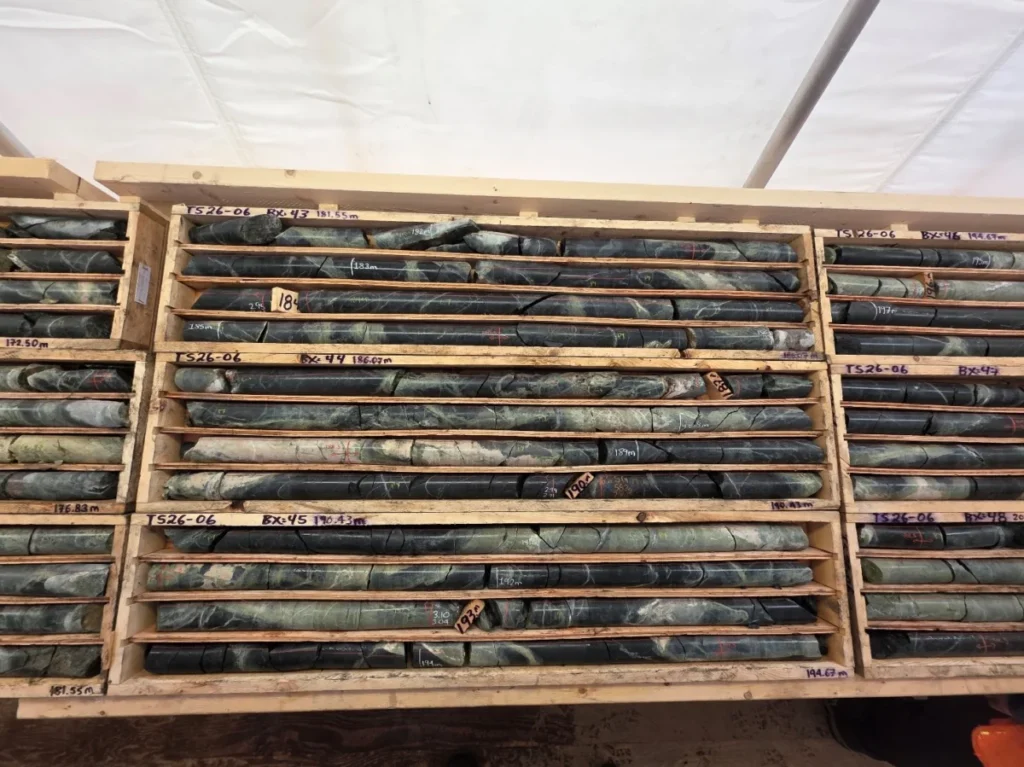
The identification of high-temperature indicator minerals—specifically bornite, chalcopyrite, and magnetite—within drill hole TS26-06 has energized the exploration team. These findings, coupled with intense alteration patterns, suggest that the company is homing in on the heat source and mineralizing center of a system that shares geological proximity to the world-class Galore Creek project held by Teck Resources and Newmont.
Main Facts: The Hunt for the Porphyry Core
Oreterra Metals is currently executing a 5,000-meter Phase 1 drilling program designed to test the limits of an 850-meter-long, highly altered bedrock corridor. The geological hypothesis, modeled on the University of British Columbia’s Mineral Deposit Research Unit (MDRU) criteria for BC-style alkalic porphyry deposits, posits that a carrot-shaped intrusion is responsible for the extensive alteration and mineralization observed at the surface.
The "bullseye" target—a magnetic high anomaly identified via geophysical surveys—is believed to represent the potassically altered, higher-grade core of the porphyry system. While initial drilling in the early stages of the program encountered propylitic alteration—a halo effect typically found on the periphery of these systems—recent holes have moved progressively toward the center of the magnetic anomaly. Hole TS26-06, which is currently targeting a depth of 600 meters, has intercepted significant bornite and garnet-magnetite assemblages, providing the strongest signal yet that the team is navigating toward the system’s primary source.
Chronological Progress of the 2024 Drill Campaign
The exploration strategy at Trek South has been systematic and iterative. The company’s technical team, led by VP of Exploration John Biczok, established a primary drill fence (Fence A-A’) across the length of the alteration zone to gauge the lateral extent of the mineralization.

- Initial Phase (Holes TS26-01 to TS26-03): Drilling began at the extremities of the alteration trend. These early holes confirmed the presence of propylitic alteration, characterized by pyrite, pyrrhotite, and minor amounts of chalcopyrite, molybdenite, and scheelite. While these minerals are indicative of a porphyry environment, their decreasing intensity downhole suggested the drills were positioned distal to the intrusive root.
- Vectoring Phase (Holes TS26-04 to TS26-05): With the initial data confirming the presence of a mineralizing system, the team adjusted their focus toward the central magnetic anomaly. Hole TS26-04, while encountering an Eocene granodiorite pluton, provided crucial data points that allowed the team to refine their targeting model.
- Current Status (Hole TS26-06 and Beyond): TS26-06 is currently the focus of the exploration efforts. Upon reaching the target depth of 600 meters, the company intends to pivot to hole TS26-07. A second drill rig has already been mobilized to the site, allowing for concurrent drilling of hole TS26-08, which will specifically target the most intense portion of the magnetic bullseye.
To date, approximately 2,020 meters of the planned 5,000-meter program have been completed. A significant operational victory was secured recently when the Tahltan Nation and the B.C. Ministry of Mining and Critical Minerals authorized the company to leave eight drill pads in place over the winter season, ensuring that exploration can resume with maximum efficiency in the coming cycle.
Supporting Data and Geological Context
The geological environment at Trek South is characterized by complex andesitic lapilli tuffs and breccias, which have been subjected to significant hydrothermal activity. The alteration assemblages observed in the core are consistent with the "MDRU model" for B.C. porphyry deposits.
The company has identified at least nine distinct styles of mineralized veins. These range from epidote-garnet-calcite-quartz veins carrying bornite and chalcopyrite to quartz-pyrite-molybdenite networks. The presence of bornite—a high-copper-content sulfide—is particularly noteworthy. In porphyry systems, the zonation of minerals is a key vectoring tool; the transition from peripheral propylitic alteration (chlorite/epidote) to proximal potassic-style alteration (magnetite/garnet/bornite) is the classic indicator that a drill is approaching the "hot" center of the deposit.
The geochemical signature is further supported by Induced Polarization (IP) surveys, which revealed a "wrap-around" chargeability high, signaling the presence of sulfide minerals at depth. The combination of magnetic highs (magnetite/pyrrhotite) and IP chargeability (disseminated sulfides) creates a robust target profile for a high-tonnage copper-gold deposit.
Official Response: CEO’s Perspective
Kevin Keough, CEO of Oreterra Metals, expressed significant optimism regarding the recent core samples. "There was real excitement in the core shack among all of us when bornite was first identified in core," Keough stated. "Seeing that, along with chalcopyrite, magnetite, and red garnet—some of the strongest alteration we’ve seen to date—confirms that we are in the right neighborhood. The source intrusion may be slightly deeper or lateral to where we are currently drilling, but we are undeniably close."

Keough highlighted that the decision to bring in a second drill rig reflects the company’s commitment to aggressively pursuing the discovery. "By moving the second drill to the adjacent pad for hole 7, and preparing a site 200 meters south for hole 8, we are effectively tightening the net around the magnetic anomaly. We have the permits, the equipment, and the geological evidence to continue our work well into September."
Implications for Investors and the Region
The Trek South project is strategically positioned in a region of B.C. that has historically hosted some of the world’s most significant copper-gold mines. The fact that the property was only recently revealed by retreating glacial ice adds a layer of "frontier" potential to the project; it is essentially a "greenfield" opportunity in a well-established mining district.
For shareholders, the implications are two-fold. First, the technical success in vectoring toward the source of the porphyry system reduces the inherent exploration risk associated with drilling in large, unproven areas. Second, the diversity of the company’s portfolio—which includes the Kinkaid and Scossa properties in Nevada, and the Lundmark-Akow Lake property in Ontario—provides a hedge against the outcomes at any single project.
However, as with any mineral exploration company, the path to discovery is fraught with uncertainty. The company has maintained a rigorous Quality Assurance/Quality Control (QA/QC) program, with independent lab analysis conducted via fire assay and ICP-MS to ensure that the reported grades are accurate. Oreterra’s commitment to transparency, evidenced by the regular disclosure of drill maps and geological models, is intended to provide investors with a clear view of the progress.
Looking Ahead
As drilling continues through September, the market will be looking for assay results from the current holes. These results will be the ultimate test of the geological model. If the grades align with the visual indicators of alteration, Trek South could emerge as one of the more significant recent copper-gold discoveries in British Columbia.

The combination of a supportive jurisdictional environment (the Golden Triangle), favorable indigenous partnerships (the Tahltan Nation), and a technically sound exploration strategy positions Oreterra Metals as a company to watch in the coming months. As the team continues to pierce the subsurface of the Trek South prospect, they are doing more than just moving dirt; they are decoding the architecture of a potential new copper-gold giant.
Disclaimer: This article is for informational purposes only and does not constitute financial advice. Investors are encouraged to conduct their own due diligence and consult with a qualified financial advisor before making any investment decisions.