By Marco Buti and Marcello Messori
August 25, 2026
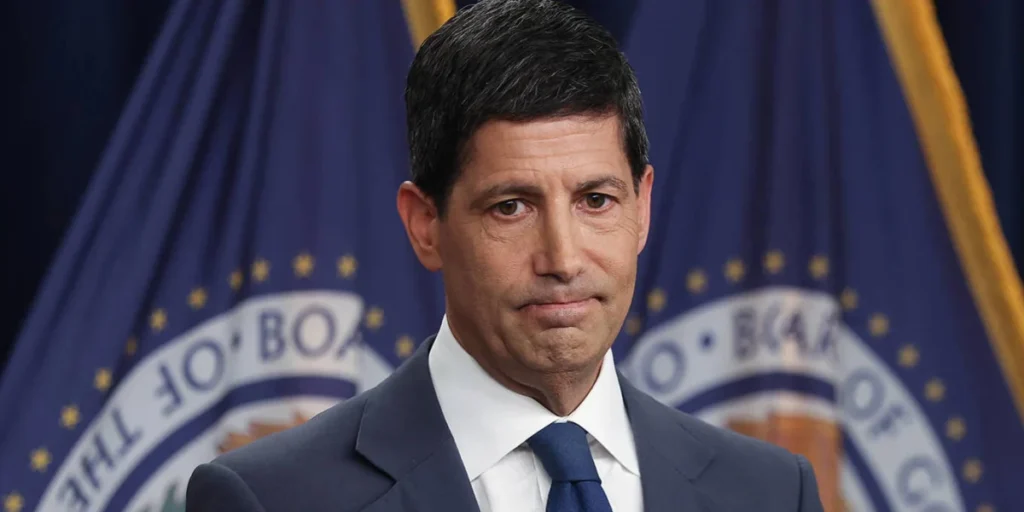
In the rarefied air of Jackson Hole, Wyoming, where the world’s most powerful central bankers gather annually to deliberate the fate of the global economy, the atmosphere this year is uncharacteristically thick with tension. Kevin Warsh, having assumed the mantle of Chair of the US Federal Reserve only months ago, finds himself at a critical juncture. His tenure, though brief, has been marked by a series of communications that have left market participants, institutional investors, and global policymakers in a state of profound disorientation.
As the symposium convenes, the question is not merely what the Federal Reserve will do next regarding interest rates, but whether it can restore the essential commodity of monetary policy: credibility.
The Main Facts: A Disjointed Tenure
The core of the current crisis lies in a disconnect between the Federal Reserve’s stated objectives and its tactical execution. Since taking office, Chair Warsh has oscillated between hawkish rhetoric regarding inflation suppression and dovish signaling concerning labor market stability. This volatility has translated into excessive market turbulence.
Market participants rely on the "Fed forward guidance" as a north star for long-term capital allocation. When that guidance shifts with the wind, the transmission mechanism of monetary policy breaks down. The primary fact facing observers today is that the Fed’s communication strategy has failed to anchor inflation expectations, leading instead to a "wait-and-see" paralysis among corporate capital spenders and a speculative fervor in equity markets that the Fed itself seems unable to explain.
Chronology of Confusion
To understand the urgency of this week’s address, one must look back at the trajectory of the last three months:
- Late May 2026: Kevin Warsh is confirmed as the new Fed Chair. His initial press conference emphasizes a "data-dependent" approach, which markets interpret as a standard, steady-handed continuation of the previous regime.
- Mid-June 2026: During a Senate testimony, Warsh surprises the markets by hinting at a "higher-for-longer" stance, citing unexpected resilience in consumer spending. The yield curve flattens aggressively in response.
- Early July 2026: In a sudden reversal during a regional Fed speech, Warsh acknowledges emerging "cracks in the labor market," suggesting that a preemptive rate cut might be necessary to avoid a recessionary "hard landing."
- Late July 2026: The Federal Open Market Committee (FOMC) meets, but the resulting statement is viewed as internally contradictory—maintaining a restrictive bias while simultaneously expressing concern over economic deceleration.
- August 2026: Markets enter the Jackson Hole period in a state of high volatility, with the CBOE Volatility Index (VIX) reaching levels not seen since the turbulence of 2023.
Supporting Data: The Volatility Metrics
The numbers paint a clear picture of the disorientation currently plaguing the markets. According to data tracked by the Federal Reserve Bank of St. Louis, the spread between 2-year and 10-year Treasury yields has undergone three distinct "regime shifts" in the last 90 days alone.
Furthermore, the "Fed Policy Uncertainty Index"—a measure derived from newspaper coverage of monetary policy and disagreement among forecasters—has surged by 42% since Warsh’s appointment. This is not merely a reaction to economic data, which has remained relatively stable; it is a direct reaction to the interpretation of the Fed Chair’s conflicting signals.
While the Consumer Price Index (CPI) has hovered within a manageable 2.8% to 3.1% range, the market’s implied volatility for the Fed Funds rate has spiked. Investors are pricing in a wider range of outcomes than at any point in the last five years, indicating that the market no longer possesses a "base case" for US monetary policy.
Official Responses and Institutional Disquiet
The confusion has not gone unnoticed by the international community. During the G7 finance ministers’ meeting held earlier this month, several European and Asian central bank governors expressed "private concern" regarding the lack of clarity emanating from Washington.
The International Monetary Fund (IMF) issued a cautious report last week noting that "the primary risk to global financial stability in the current quarter is the potential for miscommunication by major central banks." While the IMF did not name the Federal Reserve directly, the implication was unmistakable.
Inside the Fed, the silence is equally telling. Governors have been tight-lipped, but anonymous sources within the Board of Governors suggest a growing rift between the "inflation hawks" who support a more aggressive tightening cycle and those who believe the Fed has already overstepped. Warsh’s ability to build consensus within the FOMC is currently being tested; his address in Jackson Hole will be the first opportunity for the public to see if he has successfully consolidated his board.
Implications for the Global Economy
The implications of this institutional drift are profound. If the Fed remains unable to provide a clear, coherent strategy, the following risks emerge:
1. The Cost of Capital
If the market cannot predict the path of interest rates, the risk premium on long-term corporate debt rises. This increases the cost of capital for businesses, potentially throttling innovation and stalling long-term investments in technology and infrastructure.
2. Emerging Market Vulnerability
A confusing Federal Reserve is a global problem. Emerging markets, which rely on stable dollar-denominated capital flows, are particularly sensitive to sudden shifts in US interest rate expectations. A "surprising" move by the Fed could trigger capital flight from developing nations, leading to currency crises and debt defaults.
3. Erosion of Institutional Trust
Perhaps most significantly, the Federal Reserve’s greatest asset is its reputation. If the institution is perceived as "confused" or "reactive" rather than "proactive" and "deliberate," its ability to manage future crises—be they financial or inflationary—is severely compromised.
The Path Forward: What to Expect at Jackson Hole
"Dear participants, I would like to apologize for the uncertainty I have created."
If Chair Warsh were to begin his speech with these words, it would be a masterstroke of humility and a necessary reset. However, the expectations for Jackson Hole go beyond an apology. To restore confidence, the Chair must provide three things:
- A Clear Framework: He must move away from short-term reactions and articulate a clear, long-term framework for how the Fed intends to balance inflation targets with full employment.
- Internal Cohesion: He must demonstrate that the FOMC is speaking with one voice. This may involve signaling that the "dissenting voices" within the board are being managed effectively.
- Forward Guidance Reset: He must explicitly define the thresholds—data points or economic conditions—that will trigger specific policy shifts. By removing the guesswork, he can begin to lower the "uncertainty premium" currently embedded in the markets.
The symposium in Jackson Hole is historically the stage where central bankers announce shifts in paradigm. For Kevin Warsh, this is the defining moment of his early chairmanship. He can either lean into the confusion, risking further market instability and potential economic contraction, or he can provide the clarity that is so desperately needed.
The world is watching, and the markets are waiting for a signal that is, for the first time in months, unambiguous. Whether Warsh rises to the occasion or continues the trend of disorientation will determine the trajectory of the global economy for the remainder of 2026. The era of uncertainty must end at the base of the Teton Range; anything less would be a failure of leadership with consequences that would echo far beyond Wyoming.