
Introduction: The Unseen Battle for Global Trade
The global economy is anchored by the silent, relentless movement of merchant vessels traversing the world’s oceans. Over 80% of global trade is carried by sea, creating a complex, vulnerable web of supply chains that are essential to modern life. However, lurking in the shadows of the high seas is an age-old threat that has evolved with the digital age: maritime piracy and armed robbery.
Since its inception in 1991, the International Chamber of Commerce (ICC) International Maritime Bureau (IMB) Piracy Reporting Centre (PRC) has stood as the world’s foremost line of defense against these criminal activities. Operating as a 24-hour, 365-day nerve center, the PRC serves as the vital link between vulnerable vessels, naval task forces, and national law enforcement agencies. As piracy continues to shift from traditional hotspots like the Gulf of Guinea to emerging theaters of operation, the role of the PRC has never been more critical to the safety of seafarers and the integrity of global trade.
The Main Facts: A 24-Hour Shield
The IMB Piracy Reporting Centre was established during a period of rising instability in shipping lanes. Its mandate is clear: to provide a centralized platform for the reporting of piracy and armed robbery, to facilitate rapid response, and to disseminate life-saving intelligence to vessels operating in high-risk waters.
Operational Mandate
The PRC operates on three core pillars:
- Immediate Response: Acting as a primary point of contact for ships under attack, the Centre coordinates with response agencies to ensure that distress signals are received and that naval or coast guard assets are alerted to the incident location.
- Intelligence Dissemination: By issuing timely warning broadcasts and email alerts, the PRC provides shipmasters with the situational awareness required to deviate from dangerous routes or implement defensive measures, such as hardening the ship’s perimeter.
- Data Synthesis: The Centre maintains a comprehensive database of global incidents. This information is transformed into actionable intelligence, helping the shipping industry identify trends, hotspots, and the shifting tactics of maritime criminals.
A Chronology of Maritime Vigilance
To understand the significance of the PRC, one must look at the historical trajectory of maritime crime.
The 1990s: The Foundation
In the early 1990s, the rise of piracy in Southeast Asia necessitated a coordinated international response. The IMB launched the PRC in 1991 to bring order to a fragmented reporting landscape. For the first time, shipowners had a neutral, non-governmental entity to which they could report crimes without fear of bureaucratic delay or jurisdictional confusion.
The 2000s: The Somali Crisis
The mid-2000s marked a dark chapter in maritime history with the surge of Somali piracy. The PRC became a critical hub for gathering data on hijacking patterns, which informed the deployment of international naval coalitions like Combined Task Force 151. During this era, the PRC’s role shifted from a passive reporting agency to a proactive intelligence node.
The 2010s to Present: Diversification of Risk
While piracy off the coast of Somalia was largely contained through naval intervention and the widespread adoption of Best Management Practices (BMP), the threat shifted toward West Africa and later toward the Singapore Straits and the South American coast. Throughout these transitions, the PRC has remained the constant, providing the consistent data stream necessary to adapt security protocols to new geographic and tactical threats.
Supporting Data: The Quantitative Pulse of Piracy
The IMB’s annual reporting is considered the industry gold standard. The data is not merely a collection of statistics; it is a map of global vulnerability.
Analyzing the 2024 Trends
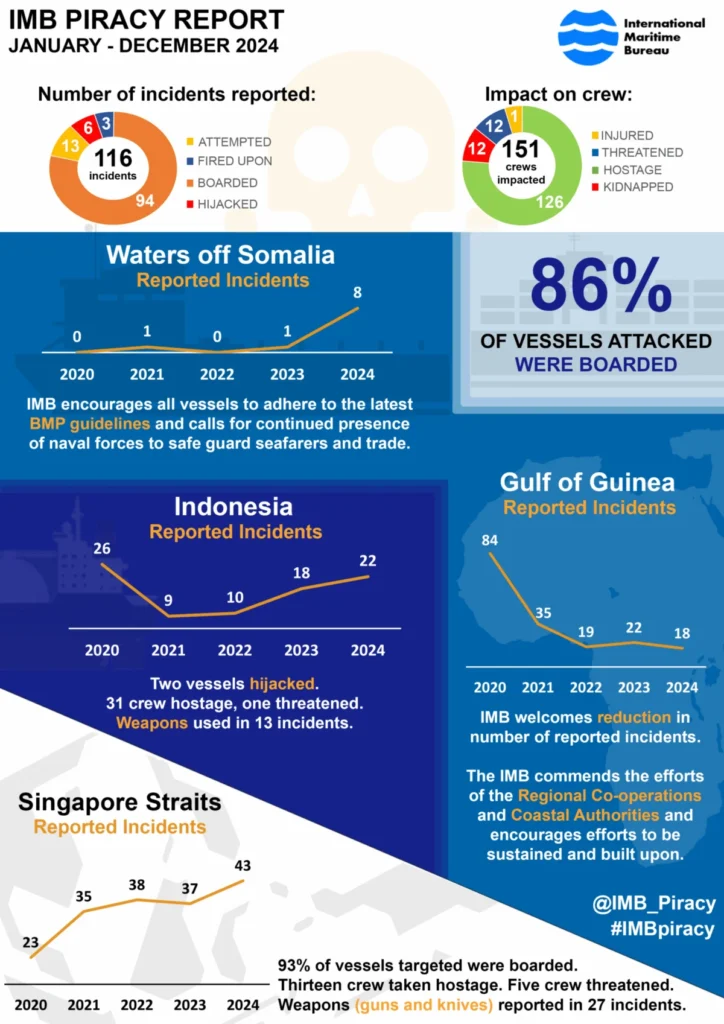
According to the latest insights provided by the IMB, piracy is no longer a monolithic threat. It is a spectrum ranging from opportunistic armed robbery—where perpetrators board vessels at anchor to steal cargo or ship stores—to sophisticated maritime kidnapping for ransom.
The data gathered by the Centre reveals several key insights:
- Location Density: Reports indicate a significant concentration of incidents in coastal anchorages, suggesting that port security remains a weak link in the global maritime chain.
- Tactical Shifts: Criminals have moved away from complex, long-range hijacking operations toward "hit-and-run" robberies, which are harder to detect but remain incredibly dangerous to crew members.
- Under-reporting: A major concern highlighted by the IMB is the tendency of some operators to suppress reports of attempted attacks. This silence hinders the PRC’s ability to build a complete picture of the threat landscape, ultimately leaving other ships at risk.
The 2024 Piracy and Armed Robbery Against Ships report offers a deep dive into these patterns, providing stakeholders with the empirical evidence needed to justify increased security budgets and lobbying efforts for more robust naval patrols.
Official Responses and Industry Engagement
The efficacy of the PRC relies heavily on the cooperation of the private sector. Michael Howlett, Director of the ICC International Maritime Bureau, has frequently emphasized that maritime security is a shared responsibility.
"The Piracy Reporting Centre is only as effective as the information it receives," Howlett notes. "When a shipmaster reports an attempted or suspected incident, they are not just protecting their own vessel; they are contributing to a collective intelligence pool that guards the entire global shipping community."
The Call to Action for Shipmasters
The IMB maintains an open invitation to all shipowners and masters: report everything. Whether it is an actual boarding, an attempted approach by a suspicious skiff, or a sighting of unidentified vessels in high-risk zones, these reports are the "vital first step" in ensuring that regional authorities allocate resources effectively. By documenting these incidents, the IMB can exert pressure on coastal states to improve their maritime law enforcement, effectively turning anecdotal accounts into diplomatic pressure.
Implications: The Future of Maritime Security
The implications of the IMB PRC’s work extend far beyond the deck of a container ship. They reach the dinner tables of consumers and the boardrooms of international corporations.
Economic Consequences
Maritime piracy acts as a "hidden tax" on global trade. When piracy rises, insurance premiums spike, security personnel must be hired, and ships must burn more fuel to avoid high-risk zones. The data provided by the IMB allows insurers and shipping companies to calculate risk accurately, ensuring that global supply chains remain economically viable.
Human Rights and Crew Welfare
At the heart of the piracy issue is the human element. Seafarers are often the victims of extreme violence and psychological trauma. The PRC’s focus on timely reporting and coordination helps ensure that if a crime occurs, the response is swift, potentially saving lives and shortening the duration of kidnappings.
Geopolitical Stability
Maritime crime often thrives in areas with weak governance or internal conflict. By highlighting these areas through consistent reporting, the IMB assists the international community in identifying regions where capacity-building and maritime security training are most urgently needed. It transforms the ocean from a lawless frontier into a regulated space governed by international maritime law.
Conclusion: A Call for Continued Vigilance
The maritime environment is inherently unpredictable, and the threat of piracy is a constant, shifting challenge. As criminal groups employ more sophisticated technology—from high-speed drones to encrypted communications—the role of the IMB Piracy Reporting Centre becomes increasingly vital.
The Centre remains a testament to the power of international cooperation. By bridging the gap between the ship at sea and the authority on land, the IMB ensures that the high seas remain open for trade and safe for the thousands of seafarers who dedicate their lives to moving the world’s goods.
For shipmasters, owners, and maritime stakeholders, the message is clear: engage with the IMB, share your data, and remain vigilant. The security of the global maritime domain depends on the strength of the network we build together.
For more information, or to report an incident, please contact:
Michael Howlett
Director, ICC International Maritime Bureau
Tel: +44 207 423 6960
Email: [email protected]
To access the latest insights and data, request a copy of the 2024 Piracy and Armed Robbery Against Ships report at the official IMB website.