For more than two decades, the scientific community has been locked in a quiet but intense debate over a mysterious circular scar buried 700 meters beneath the floor of the North Sea. Located roughly 80 miles off the coast of Yorkshire, England, the feature—known as the Silverpit Crater—has long defied simple classification. Was it the result of a cataclysmic extraterrestrial impact, or merely the byproduct of mundane geological shifting?
Now, a team of researchers led by Dr. Uisdean Nicholson of Heriot-Watt University in Edinburgh has effectively silenced the skeptics. By synthesizing high-resolution seismic imaging with the discovery of rare, "shocked" mineral crystals, the team has confirmed that Silverpit is indeed a hypervelocity impact crater, created by an asteroid strike between 43 and 46 million years ago. This discovery, published in Nature Communications, not only settles a long-standing geological argument but also provides a rare, pristine window into the violent mechanics of planetary collisions.
The Chronology of a Controversy: From Discovery to Proof
The story of Silverpit began in 2002, when petroleum geologists first identified the unusual structure during a routine seismic survey of the North Sea’s subsurface. The crater, measuring three kilometers in diameter and encircled by a vast, 20-kilometer-wide network of faults, bore a striking resemblance to known impact sites. It featured a distinct central peak—the telltale "rebound" structure that occurs when rock is compressed and then snaps upward, much like a splash in a pond.
However, the scientific community remained largely unconvinced. In the world of geology, "circular" does not always mean "asteroid." Throughout the 2000s, alternative theories gained significant traction. Some geologists argued that the structure was the result of "salt tectonics," where deep-seated salt deposits move, causing the overlying rock layers to collapse or deform. Others pointed to potential volcanic activity or localized seabed subsidence.
The debate reached a fever pitch in 2009, when Geoscientist magazine documented a formal vote among experts; the consensus at the time overwhelmingly rejected the impact hypothesis. For years, Silverpit sat in a purgatory of scientific ambiguity, labeled as a "possible" crater but lacking the definitive physical evidence required for widespread acceptance.
The tide began to turn with the advent of next-generation 3D seismic imaging. By applying these advanced techniques to existing data, Dr. Nicholson’s team was able to peer through the sediment with unprecedented clarity. But the "silver bullet," as collaborator Professor Gareth Collins of Imperial College London termed it, came from an unlikely source: an oil well drilled in the vicinity. Within rock cuttings recovered from the depth of the crater floor, researchers discovered microscopic crystals of quartz and feldspar that exhibited clear signs of "shocked" deformation.
The Smoking Gun: Microscopic Evidence and Seismic Imaging
The confirmation of the Silverpit impact hinges on the physical behavior of minerals under extreme stress. When an asteroid slams into the Earth at hypervelocity—typically several kilometers per second—it generates shock waves of such immense intensity that they fundamentally alter the crystal lattice of the surrounding rock.
"We were exceptionally lucky to find these—a real ‘needle-in-a-haystack’ effort," Dr. Nicholson remarked. "These prove the impact crater hypothesis beyond doubt, because they have a fabric that can only be created by extreme shock pressures."
Ordinary geological processes, such as volcanic eruption or the slow migration of salt deposits, cannot replicate the specific microscopic geometry found in shocked quartz. The presence of these minerals at the exact location of the crater floor serves as undeniable physical verification that the structure was birthed by a violent, high-energy impact rather than a gradual shift of the Earth’s crust.
Supporting this evidence is the sophisticated seismic data, which allowed the team to map the internal fracture patterns of the crater. The detailed imagery reveals a structure consistent with a shallow-angle impact, providing the researchers with enough data to run precise numerical simulations to reconstruct the event’s final seconds.
Reconstructing the Catastrophe: A 160-Meter Asteroid
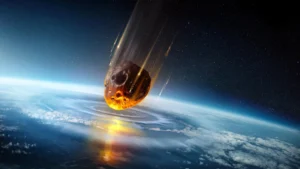
The numerical models utilized by the research team provide a vivid, if terrifying, picture of the events that unfolded in the North Sea some 45 million years ago. Simulations suggest an asteroid measuring approximately 160 meters in diameter approached from the west, striking the seabed at a shallow angle.
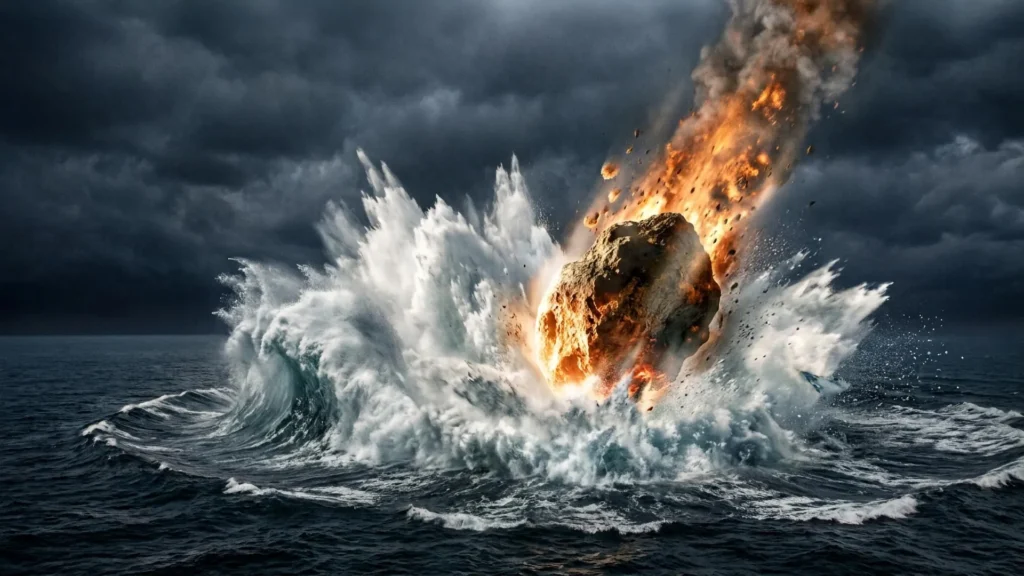
While this object was significantly smaller than the asteroid that triggered the K-Pg extinction event 66 million years ago, its kinetic energy was nonetheless staggering. The impact immediately pulverized the seabed, throwing a massive curtain of debris, rock, and seawater into the atmosphere. According to the team’s findings, this "curtain" rose to a height of 1.5 kilometers—nearly a mile into the air—before crashing back down.
The displacement of such a massive volume of water triggered a localized but devastating tsunami. Scientists estimate the initial wave height exceeded 100 meters, a wall of water taller than a 30-story building. Unlike wind-driven waves that dissipate relatively quickly, this tsunami would have been a high-energy, high-volume event capable of scouring the seafloor and reshaping the coastline of what is now Western Europe.
Official Responses and Scientific Significance
For those who have lived with the Silverpit debate for decades, the confirmation is a moment of profound vindication. Professor Gareth Collins, who contributed the numerical simulations to the new study, noted that the impact hypothesis was always the most logical explanation. "It is very rewarding to have finally found the silver bullet," he said. "We can now get on with the exciting job of using the amazing new data to learn more about how impacts shape planets below the surface."
The research is not merely an exercise in historical cleanup; it provides a vital case study for planetary science. Because the Earth is a dynamic, evolving planet, its surface is constantly being reworked by plate tectonics, erosion, and sedimentation. These forces act as a planetary "eraser," scrubbing away the evidence of ancient collisions. Consequently, only about 200 impact craters have been confirmed on land, and a mere 33 beneath the ocean.
"Silverpit is a rare and exceptionally preserved hypervelocity impact crater," Dr. Nicholson noted. By maintaining such a high level of structural integrity, the crater allows scientists to study the subsurface damage caused by impacts—a perspective that is often impossible to achieve on other, more weathered terrestrial sites or distant planets where subsurface data is limited.
Broader Implications: Understanding Earth’s Violent History
The resolution of the Silverpit mystery serves as a stark reminder of the volatile nature of our planet’s history. Cosmic collisions are not mere footnotes in the geologic record; they are recurring events that have shaped the Earth’s topography and, at times, its biological trajectory.
By placing Silverpit alongside other significant structures—such as the Chicxulub crater in Mexico and the recently discovered Nadir Crater off the coast of West Africa—scientists are building a more comprehensive catalog of Earth’s impact history. Each new discovery refines our understanding of how frequently these events occur and the scale of destruction they can unleash.
Furthermore, the methodologies employed in this study—combining deep-crustal seismic imaging with mineralogical analysis—provide a template for future research. As we seek to identify other "hidden" craters buried beneath the world’s oceans and ice sheets, the techniques pioneered by Dr. Nicholson and his team will prove invaluable.
Ultimately, the study of Silverpit is an exercise in both humility and preparedness. As we gain a deeper understanding of the craters that dot our seafloor, we gain a clearer picture of the risks posed by near-Earth objects. While the asteroid that formed the Silverpit crater struck millions of years ago, the geological record it left behind is a permanent testament to the power of the cosmos—a reminder that, in the grand timeline of the Earth, we live on a planet that has been, and continues to be, shaped by the stars.
The research was funded by the Natural Environment Research Council (NERC), a testament to the importance of institutional support in resolving the long-standing mysteries of our planet’s deep past.