
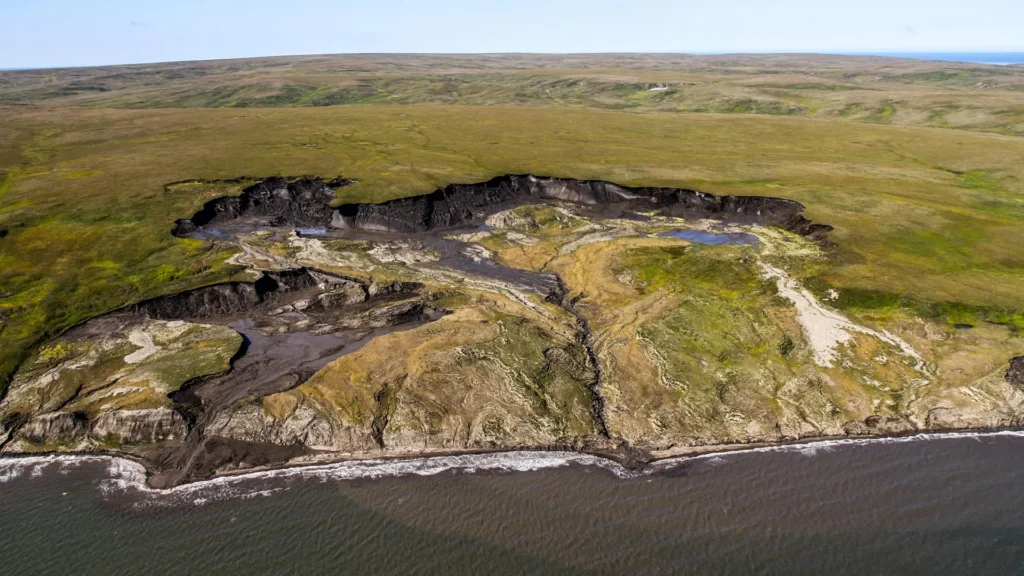
The Arctic is often described as a "sleeping giant" of the climate system—a vast, frozen repository of organic matter that, if thawed, could accelerate global warming to catastrophic levels. For decades, scientists have tracked the degradation of permafrost on land, monitoring the release of methane and carbon dioxide into the atmosphere. However, a significant portion of this organic material does not stay on land; it is swept into the Arctic Ocean by intensifying coastal erosion and river discharge.
A groundbreaking study published in Nature Geoscience by researchers from the Alfred Wegener Institute (AWI) and MARUM – Center for Marine Environmental Sciences at the University of Bremen has unveiled a surprising new chapter in this story. By analyzing sediment cores from the coast of Qikiqtaruk (Herschel Island) in Canada, the team discovered that the deep-sea environment may be acting as a more effective carbon vault than previously assumed. It appears that marine microorganisms are "picky eaters," favoring fresh, recent carbon over the ancient deposits unearthed by melting permafrost.
Main Facts: The Carbon Migration
The Arctic landscape sits atop an estimated 1,300 gigatonnes of organic carbon, largely comprised of prehistoric plant remains locked in frozen soil. An additional 400 gigatonnes are tucked away in subsea sediments and river deltas. As the Arctic warms at a rate nearly four times the global average, this structural foundation is destabilizing.
Current estimates suggest that approximately 0.02 gigatonnes of this organic carbon reach the Arctic Ocean annually through erosion and runoff. Projections indicate this outflow could surge by 70 to 150 percent by the year 2100. Until this study, the "fate" of this carbon—whether it remained buried in the seafloor or was metabolized by bacteria into greenhouse gases—was a significant "black box" in global climate modeling. The research findings offer the first high-precision evidence that the vast majority of this terrestrial carbon remains sequestered in the seabed, rather than returning to the atmosphere as a climate-forcing gas.
Chronology: Unlocking the Sediment Archives
The investigation, centered on the coastal waters of Herschel Island, utilized a multi-layered approach to reconstruct the history of carbon deposition.
1. Site Selection and Core Extraction
Researchers targeted the near-shore environment of Herschel Island, a region where coastal erosion is visibly rapid. By extracting sediment cores, the team accessed a vertical timeline of the seafloor, effectively reading the "geological history" of the region over the last 50 years. Each layer of sediment serves as a chronological record of what the ocean has swallowed and what has been left behind.
2. Isotopic Analysis
To distinguish between the various sources of carbon, the team employed sophisticated isotope geochemistry. By analyzing the ratios of carbon-13 ($^13C$) and carbon-14 ($^14C$), the scientists could pinpoint the biological origins and age of the organic matter. $^13C$ acted as a tracer to differentiate between land-derived and marine-derived carbon, while $^14C$ allowed the team to distinguish between "fresh" organic matter (such as recent algae) and "old" organic matter (permafrost thousands of years old).
3. Measuring Pore Water Dynamics
The researchers examined "pore water"—the thin film of water trapped between sediment particles. By measuring the concentration of dissolved inorganic carbon within these pores, the team could calculate the metabolic output of the microbial communities living within the seabed. This provided a direct metric of how much organic carbon was being "breathed out" as CO2 by deep-sea organisms.
Supporting Data: The "Gourmet" Bacterial Phenomenon
The study’s most compelling revelation is the selective behavior of deep-sea microorganisms. Despite the influx of vast quantities of terrestrial organic carbon, the microbes in the seafloor do not consume it with abandon.
"The sediment is home to ‘gourmet’ bacteria that apparently prefer fresh carbon stemming from, for example, more recent algal remains over the ‘old’ carbon from permafrost deposits," explains Prof. Gesine Mollenhauer, a geochemist at the AWI and co-spokesperson for the ‘The Ocean Floor – Earth’s Unexplored Interface’ Cluster of Excellence.
The data revealed that only about ten percent of the organic carbon deposited in the seafloor is converted into gases by these microbial communities. The rest remains buried, effectively removed from the active carbon cycle. This indicates that while the Arctic is losing its permafrost, the ocean floor is serving as a buffer, preventing a significant portion of that carbon from contributing to further atmospheric warming.
Official Responses and Expert Perspective
Dr. Manuel Ruben, the study’s lead author, emphasizes that these findings are a critical advancement for climate science, though he remains cautious about the broader implications.
"Our study shows, more precisely than ever before, how much carbon is safely stored in the seabed—and just how much of the decomposed material actually originates from the old permafrost," says Dr. Ruben. "However, how much of this is released back into the atmosphere as a greenhouse gas and how much is stored in the seabed has, until now, been largely unknown."
The researchers acknowledge a potential "blind spot" in the study: some of the permafrost carbon may be degraded by bacteria while it is still in transit through the water column, before it ever reaches the seabed. Therefore, the "ten percent" conversion rate is a baseline for the seafloor specifically, and further research is required to map the degradation pathways of carbon during its entire journey from the tundra to the deep ocean.
Implications: A Shifting Ecosystem
The implications of this carbon migration extend far beyond greenhouse gas levels. The transport of sediment from land to sea is fundamentally altering the physical environment of the Arctic Ocean.
1. The Light-Limiting Effect
Increased erosion introduces vast amounts of suspended sediment, creating turbid, "cloudy" waters. Simultaneously, dissolved organic carbon can darken the water column. This light-blocking effect is catastrophic for primary producers like phytoplankton and sea-ice algae, which rely on photosynthesis to fuel the base of the Arctic food web.
2. Biodiversity and Food Security
As primary production is stifled, the effects ripple upward. Crustaceans, fish, and seals—all of which rely on the health of the phytoplankton bloom—face potential declines in population. For local Indigenous communities in the Arctic, whose food security is tied to the health of marine mammals and fish stocks, these shifts in coastal chemistry represent an existential threat to traditional ways of life.
3. Refining Climate Models
The study provides a much-needed foundation for climate modeling. By quantifying the "retention" capacity of the seabed, modelers can now move away from "worst-case" scenarios that assumed all permafrost carbon would inevitably enter the atmosphere. This precision allows for more accurate predictions of the Arctic’s role in the global carbon budget.
Future Research: The ‘Arctic Pulse’ Campaign
To build on these findings, the scientific community is preparing for the ambitious 2027 ‘Arctic Pulse’ campaign. This international effort will leverage the capabilities of the German research icebreaker Polarstern, supported by specialized aircraft and land-based observation stations. The goal is to provide a comprehensive, systemic view of how the Arctic is being transformed.
By coordinating observations across the land-sea interface, researchers hope to better understand the temporal and spatial dynamics of carbon flux. The study of 2024 has opened a window into the "gourmet" habits of deep-sea bacteria, but the ‘Arctic Pulse’ will seek to understand the broader pulse of the entire region as it transitions from a frozen, static system to a dynamic and rapidly changing environment.
As the Arctic continues to heat, the interplay between land and sea will only intensify. Whether the seabed continues to act as a reliable vault or becomes a source of future emissions remains one of the most pressing questions in environmental science. For now, the evidence suggests that while the "sleeping giant" is waking up, the ocean floor is playing an unexpectedly robust role in keeping the climate crisis from spinning further out of control.