For over two decades, a silent, circular scar buried 700 meters beneath the floor of the North Sea has served as one of the most contentious subjects in modern geology. Known as the Silverpit Crater, this enigmatic structure—located roughly 80 miles off the Yorkshire coast—has long divided the scientific community. Was it a relic of a catastrophic extraterrestrial impact, or merely the byproduct of mundane geological shifting?
Today, that debate has been settled. In a landmark study published in the journal Nature Communications, an international research team led by Dr. Uisdean Nicholson of Heriot-Watt University has provided definitive proof that the Silverpit Crater is indeed a hypervelocity impact site. Created between 43 and 46 million years ago, the crater stands as a rare and vital record of a violent cosmic collision that forever altered the prehistoric seascape of the North Atlantic.
A Chronology of Controversy: From Discovery to Consensus
The story of the Silverpit Crater began in 2002, when seismic surveys conducted for the oil and gas industry first revealed a peculiar, ringed depression deep beneath the seabed. Measuring three kilometers in diameter and surrounded by a complex web of concentric faults spanning 20 kilometers, the structure bore a striking resemblance to known impact craters elsewhere on Earth.
The Initial Skepticism
While the "impact hypothesis" gained early traction, it was met with fierce resistance. Skeptics pointed to the unique geological context of the North Sea—a region defined by thick salt deposits and volcanic history. Some researchers argued that the "crater" was simply a collapse structure formed by the migration of subterranean salt layers (halokinesis), while others posited that it was the result of volcanic outgassing or seabed subsidence.
The 2009 "Verdict"
The disagreement reached a fever pitch in 2009, when the geological community held a formal, albeit informal, vote on the crater’s origin. During a debate documented in Geoscientist magazine, the majority of attendees dismissed the impact theory, favoring terrestrial explanations. For years, the scientific narrative remained stuck in a state of suspended animation, with the Silverpit relegated to the status of a geological curiosity rather than a confirmed impact site.
The Turning Point
The tide finally turned with the advent of high-resolution seismic imaging technology. Much like a clinical ultrasound, these advanced sensors allowed researchers to peer through 700 meters of sediment with unprecedented clarity. By integrating these new images with forensic microscopic analysis of rock samples—the "smoking gun" evidence—the team led by Dr. Nicholson was able to definitively dismantle the competing theories and validate the extraterrestrial origin of the site.
Supporting Data: The "Needle-in-a-Haystack" Discovery
The breakthrough that silenced the critics came in the form of mineralogy. When a team of geologists analyzed rock fragments retrieved from an oil exploration well drilled near the site, they found a rarity that only extreme cosmic violence can produce: "shocked" quartz and feldspar.
The Science of Shocked Minerals
"Shocked" minerals are the definitive fingerprint of an asteroid strike. These crystals undergo a structural transformation—a process known as planar deformation features—that can only occur under the instantaneous, colossal pressures generated by an object slamming into the Earth at several miles per second.
"We were exceptionally lucky to find these—a real ‘needle-in-a-haystack’ effort," noted Dr. Nicholson. "These minerals prove the impact crater hypothesis beyond doubt, because they possess a fabric that cannot be created by normal geological activity like salt shifting or volcanic collapse."
Numerical Modeling and Simulations
Supporting the physical evidence, Professor Gareth Collins of Imperial College London utilized sophisticated numerical modeling to simulate the impact event. By feeding the crater’s dimensions and the local geological conditions into computer models, the team was able to recreate the collision with startling accuracy. The simulations matched the observed circular shape, the central uplift, and the unique fault patterns of the Silverpit structure, leaving no room for alternative interpretations.
The Event: A 160-Meter Asteroid and the Resulting Mega-Tsunami
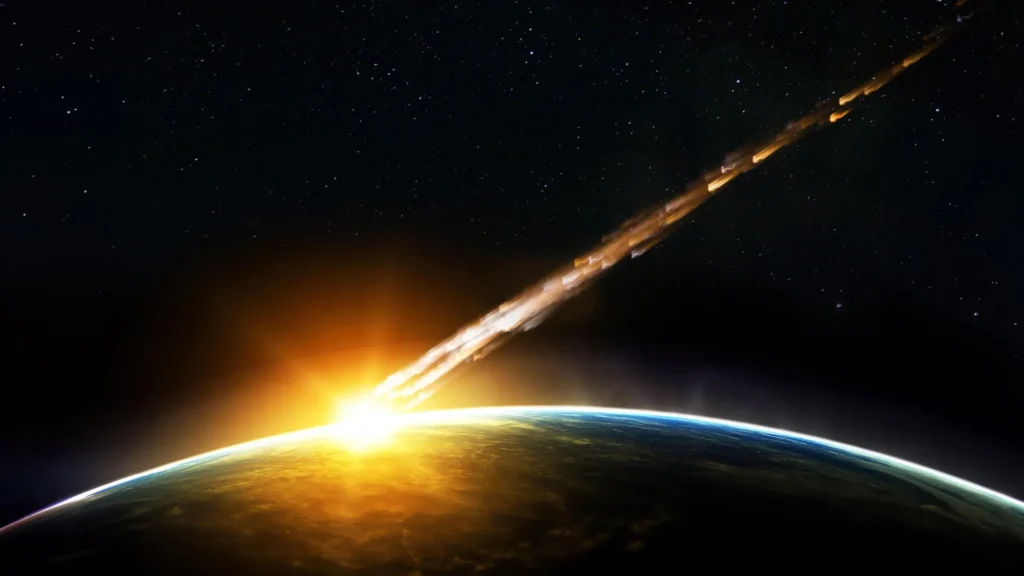
According to the team’s reconstruction, the object that struck the region roughly 45 million years ago was an asteroid approximately 160 meters (525 feet) in diameter. Approaching from the west at a shallow angle, the projectile hit the seabed with such force that it triggered an instantaneous geological catastrophe.
The Curtain of Destruction
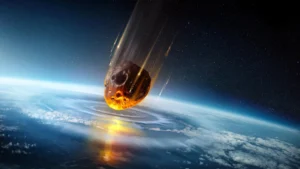
The impact excavated the seafloor, sending a 1.5-kilometer-high "curtain" of pulverized rock, sediment, and boiling seawater into the atmosphere. As this massive plume collapsed back into the ocean, it generated a tsunami of epic proportions—estimated to have been over 100 meters (330 feet) high. For context, such a wave would have towered over the tallest skyscrapers of the modern era. The surrounding coastline, had it been populated by complex civilizations, would have been wiped clean in a matter of minutes.
Official Responses and Scientific Significance
The confirmation of the Silverpit Crater is being hailed as a triumph of modern analytical geology. For Professor Gareth Collins, who stood on the side of the impact hypothesis during the 2009 debates, the validation is immensely satisfying.
"I always thought that the impact hypothesis was the simplest explanation and the most consistent with the observations," Collins said. "It is very rewarding to have finally found the ‘silver bullet.’ We can now move on to the exciting job of using this amazing new data to learn more about how impacts shape planetary surfaces—a process that is often obscured on Earth but is visible on other bodies in our solar system."
The research, funded by the Natural Environment Research Council (NERC), highlights the value of ongoing investment in marine geological surveys. By turning the North Sea into a "natural laboratory," scientists hope to gain a deeper understanding of the frequency and mechanics of asteroid impacts.
Implications: Understanding Earth’s Dynamic History
Why, if Earth is constantly being bombarded by space rocks, are impact craters like Silverpit so exceptionally rare? The answer lies in the very nature of our planet.
The Erasure of History
Earth is a dynamic, living world. Unlike the Moon or Mars, which are geologically "dead" and preserve impact craters for billions of years, Earth is constantly reshaping its surface. Plate tectonics, volcanic activity, and relentless erosion act as a cosmic eraser, scrubbing away the evidence of past collisions.
"Silverpit is an exceptionally preserved hypervelocity impact crater," Dr. Nicholson explained. "Because our planet is so dynamic, we only have about 200 confirmed impact craters on land and a mere 33 identified beneath the ocean floor."
Protecting the Future
The study of Silverpit is not merely an academic exercise in looking backward; it is a critical component of planetary defense. By understanding how an asteroid of this size affects the Earth’s crust and surrounding environment, scientists can better model the risks posed by near-Earth objects.
The confirmation of the Silverpit Crater places it in an elite category alongside the famous Chicxulub Crater in Mexico—the site of the K-Pg extinction event—and the recently discovered Nadir Crater off the coast of West Africa. These sites collectively offer a window into the violent, chaotic history of our solar system.
As the scientific community moves forward, the Silverpit Crater will serve as a vital reference point. It stands as a reminder of the Earth’s vulnerability to the heavens and a testament to the persistent curiosity of the researchers who spent decades hunting for the truth hidden beneath the waves. With the mystery of the North Sea’s circular scar finally put to rest, the focus shifts to what these ancient wounds can teach us about our planet’s past—and how we might prepare for the impacts of the future.