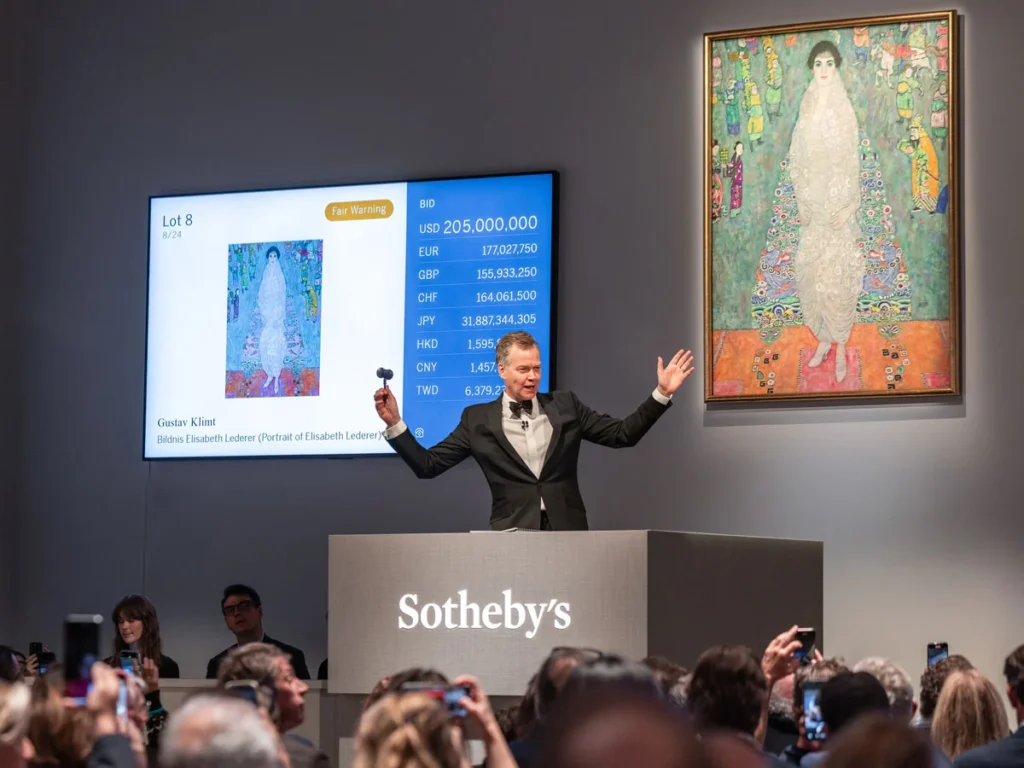
The names read like a mid-century social register: Paul Allen, S.I. Newhouse, Robert Mnuchin, Marian Goodman, Leonard Lauder, and Barbara Gladstone. For decades, these titans of industry and culture sat atop the art world’s pyramid, amassing collections that rivaled those of minor nation-states. Today, however, these names are appearing in a different context: the high-gloss auction catalogs of Christie’s and Sotheby’s.
As the global art market navigates a complex post-pandemic landscape, a singular force has emerged as its primary engine: the estate sale. Driven by the inevitability of mortality and the onset of the "Great Wealth Transfer," the liquidation of legendary private collections is currently propping up a market that might otherwise be faltering under the weight of high interest rates and geopolitical uncertainty.
Main Facts: The Estate-Driven Recovery
The first half of 2024 has revealed a striking bifurcation in the art market. While the middle and lower tiers of the market have seen a cooling of enthusiasm, the top end—specifically material sourced from prestigious estates—is booming.
According to recent financial reports, Christie’s posted $4.5 billion in total sales for the first six months of the year, marking its strongest performance in half a decade. Sotheby’s followed closely with $4.4 billion, a record-breaking figure for the house. On the surface, these numbers suggest a market in robust health. However, market analysts and industry insiders point out that these totals are not necessarily a sign of broad-based buyer confidence, but rather the result of a sudden influx of "fresh-to-market" masterpieces that have been locked away for decades.
Mari-Claudia Jiménez, a partner and head of Withers Art and Advisory and a former Sotheby’s executive, notes that the current recovery is "entirely being driven by these collections." The reason is a fundamental supply problem. In the art world, high-quality works by "blue-chip" artists like Mark Rothko, Francis Bacon, or Gerhard Richter are finite. Once a work enters a museum collection, it is effectively removed from the market forever. When it enters a private collection, it may disappear for forty or fifty years.
Estates represent the only moment when a "plethora of fresh masterpiece trophy-level material" suddenly becomes available. For the world’s ultra-high-net-worth individuals, the opportunity to acquire a work with "impeccable provenance"—the history of ownership that adds prestige and value—is often more enticing than the art itself.
Chronology: From "Estates in Waiting" to the Billion-Dollar Gavel
The current surge in estate activity was predicted years ago but has only recently reached its crescendo.
- 2020: The Forecast. Industry publications, including ARTnews, began identifying "Estates in Waiting"—collections belonging to aging billionaires like Paul Allen and Ronald Lauder that were expected to hit the market within the decade. At the time, the market was grappling with the initial shock of the COVID-19 pandemic.
- 2022: The Billion-Dollar Milestone. The death of Microsoft co-founder Paul Allen led to a watershed moment in auction history. His collection, sold at Christie’s, became the first single-owner sale to exceed $1 billion. This event proved that even in a volatile economy, there is an insatiable appetite for "trophy" works.
- 2023: The Correction. As interest rates rose and the "frothy" post-Covid speculative buying cooled, the market entered a correction phase. High-end sales began to rely more heavily on the "Three Ds": Death, Debt, and Divorce.
- 2024: The Great Wealth Transfer Begins. The first half of the year saw the market stabilized by the estates of Leonard Lauder and others. Analysts now recognize that we are in the early stages of a decade-long shift where trillions of dollars in assets will pass from the Silent Generation and Baby Boomers to their heirs.
Supporting Data: The Trillion-Dollar Handover
The scale of the upcoming shift is staggering. According to the Deloitte Private and ArtTactic Art & Finance Report, approximately $1 trillion worth of art is expected to change hands through inheritance over the next ten years.
While some heirs may choose to keep their parents’ Pierre Bonnards or Cy Twomblys, a significant portion of Gen X, Millennial, and Gen Z beneficiaries are opting for liquidity. The motivations are varied: some heirs lack the space to house massive collections, others do not share their parents’ aesthetic tastes, and many simply prefer the capital to fund their own ventures or lifestyles.
Data from Sotheby’s highlights a shift in the buyer demographic as well. A decade ago, buyers under the age of 40 represented less than 10% of the house’s clientele. Today, that number has doubled to 20%. This younger cohort is increasingly the one competing for the works released by the estates of the previous generation.
Official Responses and Expert Insights: The Auction House Pitch
Auction houses have transformed their business models to cater specifically to executors and heirs. The competition between Christie’s and Sotheby’s to win a major estate is often described as a "blood sport," involving years of relationship-building.
The Turnkey Solution
Mitchell Zuckerman, co-founder of Art Market Advisors and a former Sotheby’s executive, explains that auction houses offer a "turnkey" service that galleries cannot match. "An executor may have a deadline and hundreds of objects to dispose of," Zuckerman says. "An auction house can sell the $50 million painting, the $10,000 furniture, the jewelry, and the coins, all while guaranteeing a minimum return."
Fiduciary Obligations
For executors, the decision to sell at auction is often driven by legal necessity. Mari-Claudia Jiménez points out that executors have fiduciary obligations to beneficiaries. They are legally required to maximize the value of the estate. Because auction houses can offer financial "guarantees"—where the house or a third party agrees to buy the work if it doesn’t reach a certain price—they provide a level of certainty that protects the executor from market fluctuations.
The Marketing of Immortality
Madeline Lissner, executive vice president for Sotheby’s global fine art division, emphasizes the "halo effect" created by marketing a single-owner collection. Auction houses don’t just sell objects; they sell the story of the collector. Through glossy catalogs, international touring exhibitions, and cinematic promotional videos, the collector is transformed into a visionary figure. This "hagiography" adds a premium to every item in the sale, from the masterpieces to the desk ornaments.
Implications: A Changing of the Guard
The reliance on estates to fuel the market carries several long-term implications for the art world.
1. The Professionalization of Provenance
As the market becomes more reliant on "storytelling," the provenance of a work is becoming as important as the work itself. A mediocre painting from the Paul Allen estate may sell for more than a superior painting from an anonymous source. This creates a market where "celebrity ownership" acts as a hedge against economic downturns.
2. The Museum Squeeze
As prices for "trophy" works are driven into the stratosphere by estate sales, public museums are increasingly priced out of the market. Unless a collector chooses to donate their works—a trend that is declining as heirs seek cash—the world’s most important cultural artifacts are increasingly circulating only among the ultra-wealthy.
3. The Taste Gap
The most significant question facing the market is whether the next generation of collectors will continue to value the same artists as their predecessors. While the current "Great Wealth Transfer" is providing a windfall of Impressionist and Post-War masterpieces, younger buyers often gravitate toward contemporary, digital, or "ultra-contemporary" artists. If the heirs of the future don’t want to buy the "Old Masters" of the 20th century, the current price levels may eventually prove unsustainable.
4. The Inevitability of Supply
Despite these concerns, the industry remains optimistic about the volume of material. Mitchell Zuckerman, who has observed the market since the 1970s, offers a pragmatic view: "There’s an unending supply of art-owning estates."
As the sun sets on the era of the great 20th-century collectors, the auction houses are waiting in the wings, ready to transform private lives into public spectacles. The "Great Wealth Transfer" is no longer a theoretical future event—it is the current reality of the art market, ensuring that while collectors may pass away, their assets will continue to circulate in a multi-billion dollar cycle of legacy and liquidation.