PARKER, ARIZONA – Corcel Exploration Inc. (CSE: CRCL | OTCQB: CRLEF | FSE: Y67) has announced the completion of its maiden Phase I drill program at the Yuma King Project, a move that the company claims has significantly recalibrated its understanding of the district’s geological architecture. Located in the heart of Arizona’s prolific Ellsworth Mining District, the Yuma King project has long been recognized for its historical output of copper, gold, and silver. However, recent drilling results suggest that the past-producing mine is merely the surface expression of a much more expansive and deeper-seated mineralized system.
The Phase I campaign, which comprised 1,087 meters of drilling across six strategic holes, successfully intersected copper and gold mineralization in every instance. For investors and geological stakeholders, these results represent more than just a confirmation of known deposits; they provide the strongest evidence to date that Yuma King may host a large-scale, concealed porphyry system.
The Evolution of the Yuma King Project: A Chronology of Discovery
The Yuma King Project, which spans a massive 3,200-hectare land package, has been a focus of strategic acquisition and exploration by Corcel. Between 1940 and 1963, the Yuma King Mine was a steady producer of copper, lead, gold, and silver, but the modern exploration era has shifted the focus from high-grade veins to the broader porphyry potential of the region.
Early 2026: Setting the Stage
The year began with intensive geological mapping and the execution of an Induced Polarization (IP) geophysical survey. This survey identified several high-priority chargeability and resistivity anomalies, which served as the blueprint for the current drill campaign.
Mid-2026: Executing Phase I
The drilling program was designed to test the depth and lateral continuity of known skarn horizons while probing the structural controls that influence mineralization.

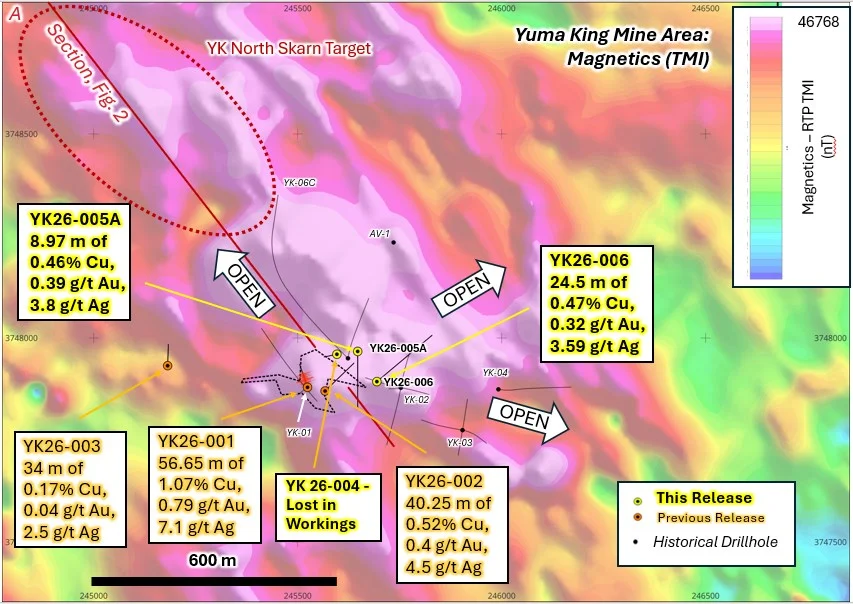
- Hole YK26-004: Initially intended to test the area beneath historical mine workings, this hole faced a technical challenge. It encountered a void—likely an unmapped historical underground working—forcing the termination of the hole. However, assay data from the final 10 meters provided a promising glimpse, yielding grades up to 0.63% Cu, 0.27 g/t Au, and 5.4 g/t Ag.
- Hole YK26-005A: Located 160 meters northeast of the initial drill site, this hole intersected 8.97 meters of 0.46% Cu, 0.39 g/t Au, and 3.8 g/t Ag. Most significantly, it highlighted a mineralized zone "sandwiched" between altered monzonite porphyry and feldspar porphyry, confirming the presence of a complex, multi-stage hydrothermal system.
- Hole YK26-006: Serving as the flagship hole of the campaign, YK26-006 targeted an IP anomaly. It returned a dual-zone discovery: an upper oxide zone and a deeper, substantial sulfide zone returning 24.5 meters of 0.46% Cu, 0.32 g/t Au, and 3.9 g/t Ag. The intervening monzonite porphyry returned anomalous copper, gold, and molybdenum values over a 150.7-meter interval, providing a "smoking gun" for a larger, underlying porphyry system.
Decoding the Data: Geological Significance
The technical data derived from the Phase I program offers a clear roadmap for future exploration. The intersection of strongly anomalous copper, molybdenum, and gold within porphyritic intrusions—specifically the monzonite porphyry—is a classic indicator of a porphyry copper-gold system.
Structural Repetition and Skarn Footprint
One of the most critical observations from Hole YK26-006 is the structural repetition of the skarn horizon. Geologists believe that folding or faulting may have doubled the prospective host rock, effectively expanding the potential footprint of the target area. This discovery suggests that the mineralized system is not only more robust than previously anticipated but also geometrically more complex, providing multiple horizons for future discovery.
The "Porphyry Vector"
The correlation between the mineralized skarn and the highly altered porphyritic intrusions is paramount. The presence of sheeted quartz veins and the specific alteration signatures (propylitic, quartz-sericite-pyrite) are consistent with the "halo" of a large porphyry system. Corcel’s technical team, led by Qualified Person Dr. Roy Greig, believes that the primary source of this mineralization lies to the north, northwest, or northeast, likely hidden under younger cover.
Official Commentary: CEO Perspectives
Jon Ward, CEO of Corcel Exploration, expressed optimism regarding the implications of these findings. "Phase I has significantly advanced our understanding of Yuma King and highlighted the potential for a much larger copper-gold system," Ward stated.
He further emphasized the strategic value of the data: "We have demonstrated the continuity of copper-gold skarn mineralization and intersected additional mineralized skarn at depth. By encountering strongly anomalous copper, gold, and molybdenum within the associated porphyritic intrusions, we have obtained compelling vectors toward a potentially concealed porphyry system."

Ward noted that the company is already looking toward the next stage of development. "With mineralization remaining open under cover to the north and northwest toward the North Skarn target, and with additional untested targets at Yuma King West and Three Musketeers, Phase I has provided us with several compelling targets to advance and test during a Phase II exploration program."
Implications for Future Exploration
The completion of Phase I marks a pivot point for Corcel. The company is no longer simply exploring the historical mine site; it is now actively targeting a district-scale porphyry system.
Phase II Strategy
The upcoming Phase II program is expected to focus on:
- Step-out drilling to the north and northwest to intercept the main porphyry body.
- Testing the Three Musketeers target, an area that remains largely untouched by modern drilling but shares similar geophysical signatures to the primary Yuma King zones.
- Refining the structural model to better understand the folding and faulting that has repeated the skarn horizons.
For the mining sector, the results at Yuma King arrive at a time when the demand for copper, essential for the global energy transition, is at a record high. Identifying new, high-potential copper-gold porphyries in stable, mining-friendly jurisdictions like Arizona remains a top priority for mid-tier and major mining firms, potentially positioning Corcel as an attractive prospect for future partnerships or acquisition.
Rigor and Integrity: Quality Assurance and Control
To ensure the validity of these results, Corcel maintained a rigorous Quality Assurance and Quality Control (QA/QC) program. All drill core was processed at a secure facility near Parker, Arizona, before being transported to Agat Laboratories in Calgary, Alberta.

The analytical process involved:
- Sample Preparation: Crushing to 80% less than 2mm, followed by rigorous splitting and pulverization.
- Multi-element Analysis: A 48-element suite using four-acid digestion and ICP-OES/MS analysis, ensuring accurate detection of copper, silver, and molybdenum.
- Gold Analysis: Fire assay on a 50-gram aliquot with an AAS finish.
- Internal Controls: The inclusion of field and lab duplicates, certified reference materials (standards), and blanks ensured that the data met the high standards required for NI 43-101 technical disclosure.
Conclusion
The successful completion of the Phase I drill program at the Yuma King Project serves as a resounding success for Corcel Exploration. By moving beyond the limits of historical underground workings and proving the presence of a broader, deeper, and more complex mineralized system, the company has effectively "derisked" the project while simultaneously increasing its upside potential. As Corcel prepares for the next phase of exploration, the focus will remain on the north and northwest, where the key to a major porphyry discovery is believed to lie.
Investors and stakeholders will be closely watching the development of the Phase II plan, as it represents the next critical step in determining whether Yuma King will reclaim its status as a significant contributor to the Arizona copper belt.
Disclaimer: This article is for informational purposes only and does not constitute financial advice. Investors should consult with a qualified professional and perform their own due diligence before making any investment decisions. For further information, visit the official Corcel Exploration website at https://corcelexploration.com/.