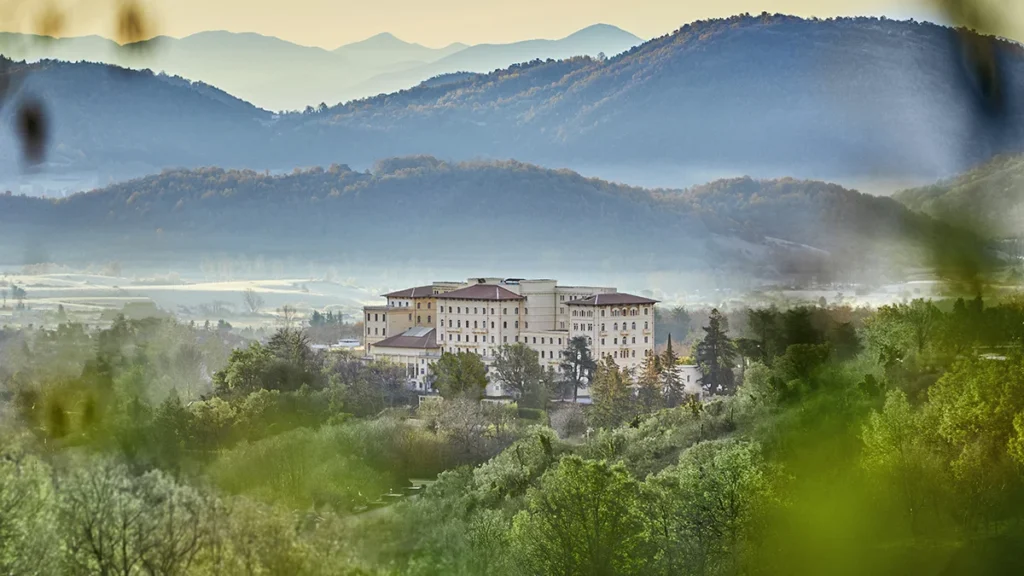
In the verdant, rolling hills located an hour outside of Rome, there exists a sanctuary where the gilded era of Italian aristocracy meets the cutting edge of 21st-century medical science. Palazzo Fiuggi, a sprawling, historic villa in the medieval spa town of Fiuggi, has evolved from a grand hotel into a global destination for those seeking the ultimate luxury: the extension of one’s own health span.
For many, the prospect of a medical wellness retreat triggers a visceral reaction of apprehension. Will the schedule be too stifling? Is the isolation a recipe for loneliness? Will the “prescriptive” dining leave one feeling deprived? Yet, as one ascends the winding, cedar-lined drive—passing through gates that seem to guard a world untouched by the frantic pace of modern life—the anxiety is quickly eclipsed by a profound sense of anticipation. Here, in a facility that balances the grandeur of a bygone era with a $35 million medical infrastructure, the pursuit of longevity is not just a goal; it is a meticulously engineered experience.
The Foundation: A Fusion of History and Science
Originally established in 1913 as a premier destination for those seeking the healing properties of Fiuggi’s world-renowned mineral spring water, the property underwent a radical metamorphosis, reopening in 2021. Today, it stands as a 102-room, five-star monument to preventative medicine.
The physical environment is designed to facilitate healing. Guests wander through frescoed halls and manicured gardens, often—in a juxtaposition that soon becomes second nature—clad in plush white bathrobes. The estate features a sophisticated ecosystem of indoor and outdoor pools, a sprawling library, a cinema, and a state-of-the-art gym housed in what was once the villa’s grand ballroom. However, the true heartbeat of the facility is the medical wing, where the Dr. Barbara Sturm spa meets clinical diagnostics.

Chronology of a Transformation
The journey begins not with leisure, but with data. Upon arrival, the guest is subjected to a comprehensive health assessment, a "deep dive" into their physiological state. The initial itinerary includes EKGs, ECGs, skin analysis, and a rigorous cardiology consultation. This is not a standard physical; it is an interrogation of the body’s current state of performance.
Over the course of a multi-day stay, the routine is rhythmic and precise. The programming is divided into eight distinct pathways—ranging from longevity and weight loss to bespoke protocols tailored to individual pathologies. Each day is a sequence of medical evaluations: blood work, genetic screening, ultrasounds, and the highly anticipated DEXA body-composition scan.
The brilliance of the model lies in its immediacy. In a typical medical system, waiting for results and subsequent consultations can take weeks. At Palazzo Fiuggi, every diagnostic finding is explained in real-time, translated by physicians into actionable, daily lifestyle adjustments. By the third day, the initial disorientation of the “clinical” schedule fades, replaced by a sense of empowerment. The treatments themselves—from the laughter-inducing hydrotherapy sessions to the meditative, restorative effects of binaural sound therapy—serve as a bridge between the clinical and the ethereal.
The Culinary Revolution: Food as Medicine
Perhaps the most startling discovery for the uninitiated is the food. The "Food as Medicine" philosophy, curated by three-star Michelin chef Heinz Beck in collaboration with the resort’s medical team, challenges the pervasive notion that health-conscious eating is synonymous with deprivation.

The menu, typically capped at 1,800 calories, is a revelation. Dishes are served in the frescoed Sala 4 Continenti beneath opulent Murano-glass chandeliers. Here, the service is white-glove, yet the plates are carefully calculated for longevity. Veal becomes a highlight, rice cakes are transformed through culinary ingenuity, and edible flowers turn simple greens into a vibrant sensory experience.
The absence of alcohol and coffee—staples of the modern diet—is initially felt, but by the third day, the body resets. During a behind-the-scenes kitchen tour, the level of precision becomes evident: walls are lined with photographic blueprints for plating, ensuring consistency across every meal. When a guest expresses a fondness for dark chocolate, a bespoke, healthy version from Chef Beck appears in their room. This is hospitality that cares for the guest’s long-term vitality, not just their immediate satisfaction.
Biomechanical Clarity: The High-Performance Method
While blood panels provide a snapshot of internal health, the High Performance Method focuses on external movement—the biomechanics of daily life. During this assessment, guests are placed on a treadmill equipped with advanced sensors and high-speed cameras.
The results are often humbling. The analysis reveals the hidden stories our bodies tell: why the lower back aches, why the gait feels uneven, and how the core fails to engage during simple tasks. Identifying that one exerts too much pressure on the heels or possesses weak ankles provides a "blueprint for movement" that offers more value than any temporary treatment. For many, this specific, personalized data serves as the most important takeaway of the entire experience.

The Social Fabric: A Global Community
The residency at Palazzo Fiuggi is a shared experience. As the days pass, the dining room becomes a hub for an eclectic, international cohort—CEOs from the U.S., social-media influencers from the Middle East, and families from across Europe. Conversations shift from the mundane to the profound: comparing test results, sharing the struggles of habit change, and discussing the common pursuit of a "reset." Whether they arrived via a recommendation from an AI chatbot or a prize won on national television, the common thread is a shared commitment to investing in one’s biological future.
Implications: The Hard Truths of Data
The true impact of a stay at the resort often manifests after the initial exhilaration of the experience. For the author, the reality check came in the form of a detailed, hardbound book containing every clinical result.
Discovering a minor heart-valve leak or a thyroid spot can be sobering, yet the clarity provided is invaluable. The most significant revelation, however, was the body-composition scan. Even for those with a healthy B.M.I., the ratio of visceral fat to muscle can be a hidden marker of metabolic decline. Such findings do more than inform; they motivate. Since returning home, the transition from the resort’s environment to the "real world" has been marked by a new, heightened awareness. Processed sugars, alcohol, and the chaotic consumption patterns of modern life have been significantly curtailed, replaced by the habits formed within the villa’s walls.
The Verdict: The Luxury of Clarity
For a facility that promises "a longer life, better lived," the ultimate luxury provided by Palazzo Fiuggi is not found in the swimming pools or the fine dining. It is found in the removal of ambiguity.

In a world saturated with contradictory health advice, the ability to see one’s health with clinical precision is a rare privilege. The resort offers a roadmap that is as scientific as it is sustainable. As the medical industry continues to pivot toward preventative care, the Palazzo Fiuggi model—marrying the rigor of a diagnostic clinic with the restorative power of a world-class resort—sets a new standard for the industry. For those willing to invest the time and the significant cost—starting at approximately $8,400 for a seven-night program—the return is a rare, life-altering perspective on one’s own physical potential.
The experience confirms that while we cannot stop the clock, we can certainly choose to listen to what our bodies are trying to tell us before it is too late.