The global art landscape is currently witnessing a rare convergence of institutional evolution, record-breaking market momentum, and unprecedented diplomatic cooperation. From the curatorial halls of the San Francisco Museum of Modern Art (SFMOMA) to the high-stakes auction rooms of Manhattan and the historic galleries of the British Museum, the industry is entering a definitive new chapter.
This week’s developments—the appointment of Anna Katz to a pivotal leadership role at SFMOMA, the announcement of the $450 million Blaquier collection sale at Sotheby’s, and the extraordinary loan of the Bayeux Tapestry to London—signal a robust recalibration of how art is managed, valued, and shared across borders.
Main Facts: A Triad of Industry-Shaping Developments
The current news cycle is dominated by three major pillars that reflect the diverse facets of the art trade: institutional leadership, the high-end secondary market, and cultural heritage diplomacy.
1. SFMOMA Appoints Anna Katz
The San Francisco Museum of Modern Art has officially named Anna Katz as its new Senior Curator and Head of Painting and Sculpture. Katz, a distinguished scholar and curator formerly of the Museum of Contemporary Art (MOCA), Los Angeles, steps into a role that is central to SFMOMA’s identity. Her appointment is seen as a strategic move to revitalize the museum’s core department following a period of administrative transition and a broader push within the industry for more inclusive, research-driven programming.
2. The $450 Million Blaquier Consignment at Sotheby’s
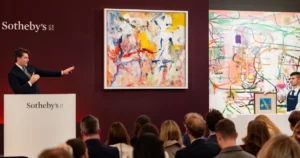
Sotheby’s has secured one of the most significant single-owner collections to hit the market in years: the estate of Nelly Arrieta de Blaquier and Carlos Pedro Blaquier. With a combined estimate exceeding $450 million, the collection is anchored by a late-period Vincent van Gogh masterpiece and a seminal Paul Cézanne. This consignment is expected to be the primary engine of the November auction season in New York, testing the depth of the ultra-high-net-worth market.
3. The Bayeux Tapestry Crosses the Channel
In a move that has stunned historians and conservators alike, the 900-year-old Bayeux Tapestry has arrived in the United Kingdom for a landmark exhibition at the British Museum. This 220-foot-long embroidery, which chronicles the 1066 Norman Conquest, has been the subject of decades of failed loan negotiations. Its arrival in London marks a triumph of modern conservation engineering and high-level political maneuvering between France and Britain.
Chronology: The Road to the Current Moment
The Evolution of SFMOMA’s Curatorial Vision
The path to Anna Katz’s appointment began several years ago as SFMOMA sought to stabilize its leadership after the departure of long-term staff. Over the last 24 months, the museum has focused on diversifying its board and its exhibition schedule. Katz’s track record at MOCA—specifically her 2019 exhibition With Pleasure: Pattern and Decoration in American Art—marked her as a leading voice in rethinking the Western canon. Her hire follows a rigorous international search intended to bridge the gap between traditional modernism and contemporary social relevance.
The Blaquier Legacy and the Auction Timeline
The Blaquier collection was built over decades by the Argentine industrialist Carlos Pedro Blaquier and his wife Nelly, who was a prominent socialite and philanthropist. The couple were fixtures of the international art circuit, acquiring Impressionist and Post-Impressionist works when the market was less saturated by speculative buyers. Following Carlos Pedro Blaquier’s passing in early 2023, rumors circulated regarding the fate of the collection. Sotheby’s successfully won the consignment in mid-2024, setting the stage for a global touring schedule that will culminate in the November sales.
Decades of "Non": The Tapestry’s Diplomatic Journey
For nearly a century, the French state maintained a policy of refusal regarding the Bayeux Tapestry.
- 1953: A request for the coronation of Queen Elizabeth II was denied due to the work’s extreme fragility.
- 1966: A request for the 900th anniversary of the Battle of Hastings was similarly rejected.
- 2018: French President Emmanuel Macron surprised the diplomatic world by suggesting a loan was possible during a summit with then-Prime Minister Theresa May.
- 2023-2024: Extensive scientific testing was conducted in Bayeux to determine if the textile could withstand transport. The final "oui" was granted only after specialized climate-controlled transport systems were perfected.
Supporting Data: Numbers Defining the Market and History
The Blaquier Auction Estimates
The financial weight of the Blaquier collection rests on several blue-chip pillars:
- Vincent van Gogh, Châtaignier en fleurs roses et blanches (1890): Estimated at $150M – $200M. Painted in Auvers-sur-Oise just weeks before the artist’s death, it is considered one of the last great Van Goghs in private hands.
- Paul Cézanne, Harlequin series: Estimated at $120M+. Cézanne’s Harlequins are among his most sought-after figurative works, with similar examples held by the National Gallery of Art in Washington.
- Impressionist Staples: Works by Degas, Pissarro, and Renoir within the collection are individually projected to clear the $25 million mark, providing a "safety net" of value for the overall sale.
The Bayeux Tapestry by the Numbers
- Age: Approximately 950 years.
- Length: 68.3 meters (approx. 224 feet).
- Content: 58 scenes containing 626 human figures, 190 horses, and over 500 other animals/creatures.
- Logistics: The loan required a custom-built, vibration-dampening crate and a dedicated team of 12 conservators for the unrolling process.
Official Responses and Expert Perspectives
On Anna Katz and SFMOMA
Christopher Bedford, Director of SFMOMA, expressed enthusiasm for Katz’s arrival, noting that her "intellectual rigor and commitment to expanding the narrative of art history" align perfectly with the museum’s future. Independent curators have praised the move, suggesting that Katz will bring a "Los Angeles sensibility"—one that is less beholden to New York-centric traditions—to the Bay Area’s most prominent institution.
On the Blaquier Sale
Sotheby’s Chairman for the Americas, Mari-Claudia Jiménez, characterized the Blaquier collection as "the kind of consignment that defines a decade." Market analysts suggest that because many of these works have been off the market for 40 to 50 years, they possess a "freshness" that usually triggers aggressive bidding from sovereign wealth funds and private museums in Asia and the Middle East.
On the Bayeux Tapestry Loan
Alex Marshall of the New York Times reported that the loan is viewed by the French Ministry of Culture as a "gesture of profound cultural brotherhood" in the post-Brexit era. However, some French conservationists remain wary. Pierre Lebrun, a textile specialist, noted, "The risk is never zero when moving a thousand-year-old linen. This is a political victory as much as a cultural one."
Implications: What This Means for the Art World
The Shift in Curatorial Power
Anna Katz’s move to SFMOMA signifies a broader trend: the "MOCA-fication" of major museums. Curators who cut their teeth at smaller or more experimental institutions are being tapped to lead "encyclopedic" modern museums. This suggests that the coming years at SFMOMA will see a departure from "blockbuster modernism" in favor of exhibitions that highlight the intersections of craft, politics, and overlooked regional movements.
Market Resilience at the Top
The $450 million estimate for the Blaquier collection serves as a litmus test for the global economy. While the mid-tier art market has seen some cooling due to interest rate fluctuations, the "masterpiece" level remains insulated. If the Van Gogh and Cézanne meet or exceed their estimates, it will confirm that high-end art remains the preferred alternative asset class for the world’s billionaire class.
Cultural Diplomacy as Soft Power
The Bayeux Tapestry loan demonstrates that art remains one of the most effective tools of "soft power." By allowing its greatest national treasure to travel to London, France is signaling a desire for continued intellectual and cultural exchange despite political friction. This sets a precedent for other "un-movable" objects, potentially opening the door for more ambitious international loans of fragile heritage items.
Conclusion
As the British Museum prepares for its sold-out crowds and Sotheby’s readies its auction hammer, the art world finds itself in a state of high-velocity change. Whether through the fresh eyes of a new curator in San Francisco or the centuries-old threads of a Norman embroidery, the narrative of art continues to be one of movement—of objects, of people, and of immense capital. The results of this November’s sales and the success of the Tapestry’s exhibition will likely dictate the industry’s tone for the remainder of the decade.