Deep beneath the Pacific Ocean, roughly 2,200 kilometers below the crust, a silent, titanic shift has occurred. For years, the scientific consensus held that the liquid iron in Earth’s outer core followed a relatively stable, westward-flowing pattern. However, data synthesized from a quarter-century of satellite observations has revealed a dramatic, unexplained reversal: in 2010, a massive volume of molten material beneath the Pacific suddenly surged eastward.
This discovery, detailed in a recent study published in the Journal of Studies of Earth’s Deep Interior, challenges our fundamental understanding of the planet’s geodynamo—the complex process of circulating liquid metal that generates our protective magnetic field. As researchers parse this new data, they are forced to confront a reality where Earth’s deep interior is far more turbulent and variable than previously imagined.
The Mechanics of the Geodynamo
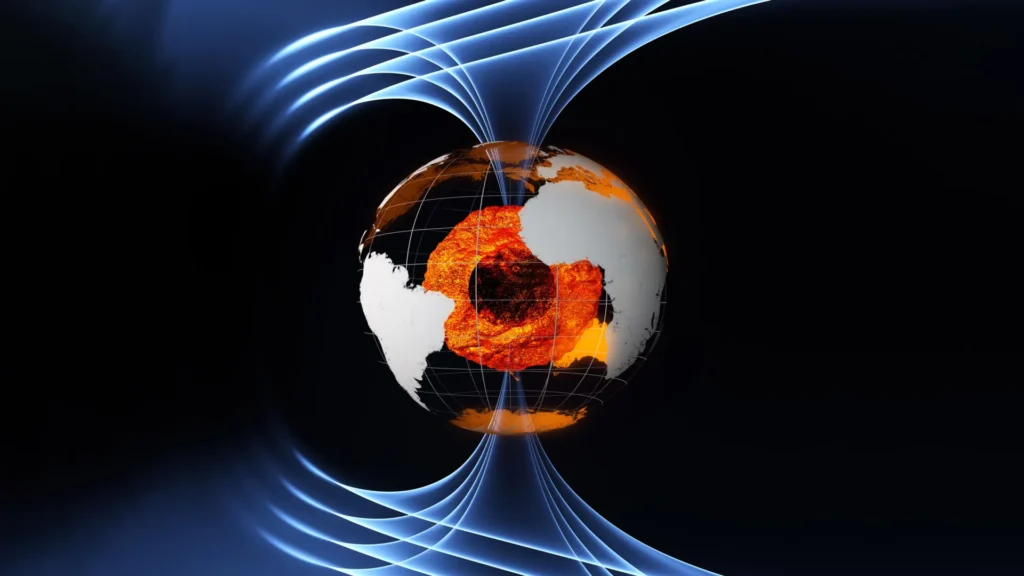
To understand the significance of this reversal, one must first look at the engine room of our planet. Earth’s outer core is a turbulent, electrically conducting ocean of molten iron and nickel. As this metal circulates, driven by convection and the planet’s rotation, it generates the geomagnetic field—an invisible shield that deflects lethal solar radiation and cosmic rays.
For decades, geophysicists believed the flow of this liquid iron was largely predictable, dominated by a steady westward drift. This "steady state" view allowed scientists to create models that accurately predicted magnetic variations over time. However, the 2010 event has disrupted this paradigm, suggesting that the core is capable of rapid, localized fluctuations that defy long-standing models.
A Chronology of Discovery
The timeline of this phenomenon spans nearly three decades, requiring a synthesis of legacy data and cutting-edge orbital technology.
1997–2009: The Era of Westward Stability
Prior to 2010, observational data from missions such as Germany’s CHAMP and the Ørsted satellite, combined with ground-based magnetic observatories, depicted a consistent pattern. The flow of molten iron in the outer core was characterized by a broad, weak westward motion. During this period, the geodynamo appeared to be in a stable, predictable equilibrium.
2010: The Great Reversal
The stability was shattered in 2010. Satellite-derived models show that a massive, equatorial region of molten iron beneath the Pacific Ocean underwent a structural transition. The flow did not merely slow down; it reversed direction entirely, shifting into a strong, sustained eastward current. This event, which caught the global geophysical community off-guard, served as the primary catalyst for the recent study.
2010–2020: The Period of Intense Flow
For a decade, the eastward flow remained the dominant feature of the Pacific deep-core region. During this time, the European Space Agency (ESA) launched the Swarm mission (2013), which provided unprecedented precision in measuring the magnetic field. These instruments confirmed that the reversal was not a data anomaly but a real, physical movement of fluid deep within the planet.
2020–Present: The Stabilization and Weakening
As of 2025, the latest models indicate that the aggressive eastward flow is beginning to wane. This leads researchers to wonder: was the 2010 reversal a singular anomaly, or is it part of a long-term, natural oscillation that we are only now capable of observing?
Supporting Data: The Role of ESA Satellites
The success of this research is inextricably linked to the evolution of satellite magnetometry. By utilizing a multi-mission approach—combining data from Ørsted, CHAMP, CryoSat, and the trio of Swarm satellites—researchers were able to perform a "magnetic autopsy" of the Earth’s core.
Decoupling the Signals
One of the primary challenges in studying the core is that the magnetic signal is "polluted" by the crust, the oceans, and the ionosphere. The Swarm satellites, however, utilize a constellation of sensors in coordinated orbits. This allows scientists to isolate the specific magnetic signature of the geodynamo from the noise of surface-level phenomena.
High-Precision Reconstructions
The Swarm mission has been particularly vital. Since its launch in 2013, it has provided a continuous stream of high-resolution data. This allowed the research team to correlate the 2010 reversal with the 2017 "geomagnetic jerk"—a sudden, sharp change in the rate of change of the magnetic field. By mapping these two events, scientists have gained a clearer picture of how core-mantle interactions influence the magnetic environment at the surface.
Official Perspectives: The Scientific Consensus
The study’s lead author, Frederik Dahl Madsen of the University of Edinburgh’s School of Geosciences, emphasizes the magnitude of these findings. "The large-scale flow reversal beneath the Pacific raises new questions about the behavior of Earth’s deep interior," Madsen noted. "We are now tasked with determining if this represents a short-lived fluctuation, a repeating oscillation, or a shift to a new stable equilibrium."
Madsen’s team has proposed a compelling hypothesis: the reversal might be linked to the inner core. "The rise of the strong eastward flow in the Pacific is contemporary with a change in behavior in the inner core, as inferred from geodesy and seismology," he explained. This suggests that the outer core is not an isolated system but is in constant, dynamic communication with the solid inner core and the lower mantle.
Anja Stromme, ESA’s Swarm Mission Manager, highlights the importance of the long-term record. "Although Swarm was launched after the reversal event of 2010, it provided the high-precision data needed to understand the aftermath," she said. "This mission allows us to track how core dynamics evolve in near-real-time, rather than relying on the slow, sporadic updates of ground-based observatories."
Implications: Why the Core Matters
While the movement of iron thousands of kilometers below our feet may seem removed from daily life, the implications are profound.
The Shield of Life
The geodynamo is our planet’s primary line of defense against solar wind. If the flow patterns in the outer core change, the morphology of our magnetic field changes with it. While there is no immediate danger to the public, significant shifts in the magnetic field can impact satellite operations, power grid stability, and the accuracy of global navigation systems.
A Deeper Connectivity
Perhaps the most exciting implication is the potential for "deep-earth meteorology." If the outer core can be shown to interact with the inner core and the mantle, scientists may eventually be able to create predictive models for core activity. This would be analogous to how we monitor the weather in the atmosphere, providing a new layer of insight into the geological history and future of our planet.
Elisabetta Iorfida, ESA’s Swarm Mission Scientist, frames the discovery as a turning point in geophysics. "This study proves that regional changes can emerge rapidly within just a decade," she said. "It challenges the old idea of a static, stable core and points toward a more complex, volatile system. Every piece of data we collect brings us closer to understanding the boundary between the core and the mantle—the most critical and least understood region of our planet."
Future Outlook
As we look toward the remainder of the 2020s, the focus will remain on continuous monitoring. The weakening of the eastward flow observed since 2020 provides a unique opportunity to study the "resetting" phase of a core event.
The scientific community is now entering a new era of "Earth-interior monitoring." With the continued operation of the Swarm satellites and the integration of new seismic data, the mystery of the Pacific reversal is likely to yield further secrets. Whether this event is a precursor to a larger shift in the geomagnetic field or merely a localized eddy in the depths of our world, one thing is clear: Earth’s center is alive with movement, and for the first time in human history, we have the eyes to watch it change.