By Fashion Editorial Staff
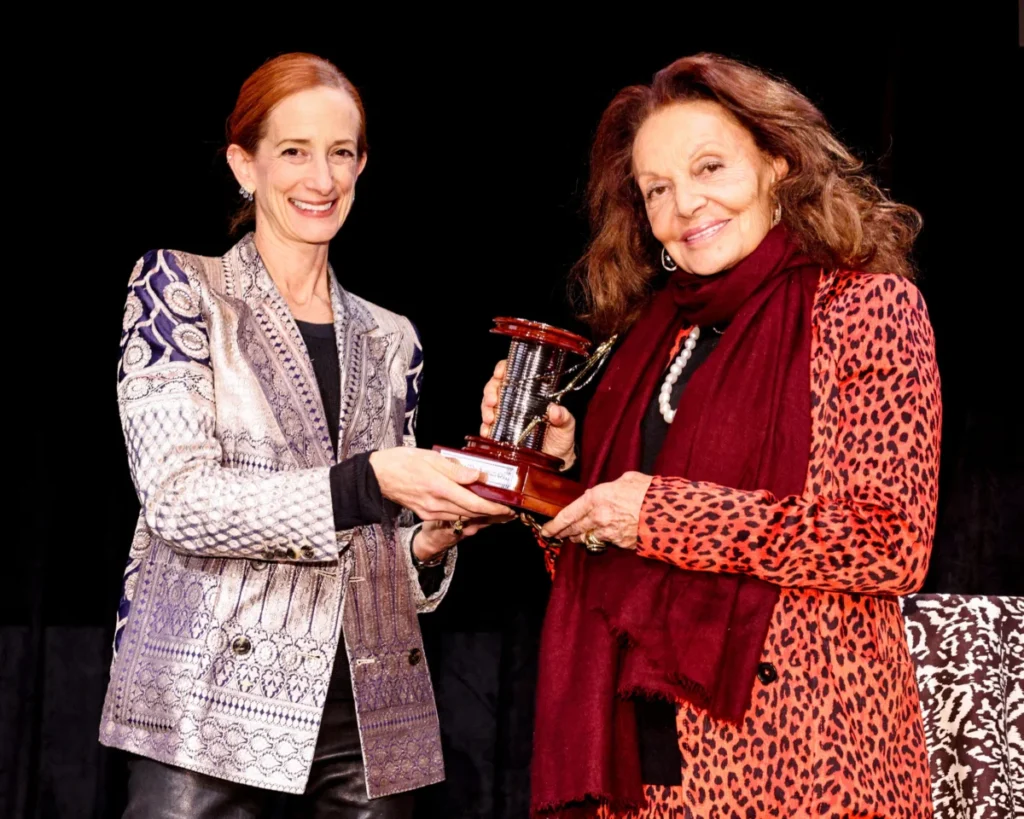
In the hallowed, storied halls of New York City’s Gotham Hall, the fashion industry gathered on Thursday afternoon to pay tribute to a woman whose name has become synonymous with liberation, entrepreneurial grit, and the transformative power of design. Diane von Furstenberg, the indomitable visionary who redefined the female wardrobe in the 1970s and has remained a titan of the industry for over half a century, was officially presented with the 2026 Couture Council Award from the Museum at the Fashion Institute of Technology (FIT).
The event was more than a celebratory luncheon; it was a testament to a career defined by perpetual reinvention and an unwavering commitment to uplifting women. As the room swelled with industry luminaries—including Martha Stewart, Linda Fargo, Narciso Rodriguez, and CFDA legend Fern Mallis—it became clear that von Furstenberg’s influence transcends the mere silhouette of a dress; it is etched into the very fabric of American culture.

A Legacy Built on Architects and Ideals
The afternoon’s festivities were opened by Henry Zankov, the artistic director of the Diane von Furstenberg (DVF) brand and a designer in his own right. Zankov’s presence was particularly poignant; a proud alumnus of FIT, he described the occasion as a true "full-circle moment."
"For those of you who may not know, I’m a graduate of FIT," Zankov noted, reflecting on the institution that provided the bedrock of his career. He drew a profound parallel between the legendary honoree and the structural discipline required of a great designer. "Diane has always said that designers are like architects. We have to understand not only how something is made, but also how to experience it, how it moves, and how it will make you feel."
Zankov, who recently garnered acclaim for his debut collection for DVF at the High Line, emphasized that von Furstenberg’s philosophy—combining manual craftsmanship with intellectual rigor—remains the gold standard. "I have always been surrounded by and inspired by strong women—women who lead with conviction, who challenge convention, and who understand that true influence comes from having the courage to be entirely yourself. Diane embodies all of that and so much more. She is a force, an icon, and a reminder of what is possible."

A Moment of Reflection: Addressing the FIT Community
The atmosphere shifted toward a more somber, grounded reality when Jason S. Schupbach, the newly appointed president of FIT, took the stage. Acknowledging that the campus and the broader community had been reeling from a recent, deeply painful tragedy involving a student, Schupbach used the platform to address the importance of institutional solidarity.
"While I hope you have read my official statement, let me be clear: FIT is a strong and safe community," Schupbach asserted, referencing a recent federal indictment concerning the tragic death of a student. "Part of being a strong and safe community means that as a community, we support each other through difficult times. We want justice to be served, and we will always condemn harm towards women and anyone in our community."
Despite the gravity of the moment, Schupbach pivoted to the importance of the work being celebrated. He noted that von Furstenberg’s career is the ultimate example of the "support and lifting up" of young creators that FIT strives to instill in its students. To honor this connection, the tables were adorned with runners featuring a signature DVF print, a pattern that has remained a symbol of the brand’s enduring relevance for over thirty years.

In a gesture of future-facing optimism, Schupbach presented the Museum at FIT Student Award to Chloe LaBel, a Class of 2027 student specializing in art history and museum professions. LaBel’s acceptance speech provided a youthful counterpoint to the day’s veteran speakers, remarking, "To me, museums are a place where we can step outside of ourselves and experience worlds different from our own. Through art, I’ve managed to better understand myself and to constantly question how I look at the world around me."
The "Force of Nature": A Tribute by Vanessa Friedman
The centerpiece of the event was the formal presentation of the award by Vanessa Friedman, the New York Times fashion director and chief fashion critic. In a warm and incisive tribute, Friedman dismantled the difficulty of capturing the totality of von Furstenberg’s impact in a single title.
"We call her designer, entrepreneur, feminist, activist, philanthropist, mother, grandmother, daughter, friend, mentor, hiker, icon, pioneer," Friedman listed. "But the term I actually prefer is ‘force of nature,’ which I know is three words, but that’s the point. It is impossible to reduce her to just one."

Friedman painted a vivid portrait of a woman who, statistically speaking, "wasn’t supposed to exist." Born to a Holocaust survivor who had been told she could not bear children, von Furstenberg defied early expectations to build a global empire without formal design training. Her ascent to the cover of Newsweek at age 29 was not merely a professional milestone; it was a cultural shift that signaled the rise of the modern, working woman.
"A woman who reinvented that business not just once, but three times," Friedman reminded the audience. She highlighted von Furstenberg’s civic contributions, including her stewardship of the High Line and Little Island via the Diller-von Furstenberg Family Foundation, her leadership at the CFDA, and even her historical role in the preservation of the Statue of Liberty.
Perhaps most resonant was Friedman’s observation regarding the honoree’s vulnerability. "I can’t think of another founder who would have told me on the record when her business was being restructured in the pandemic, ‘There’s no shame in admitting you are in trouble,’" she noted, highlighting the rare transparency that defines von Furstenberg’s leadership.

The Journey: From Belgium to the Global Stage
When von Furstenberg finally took the stage to accept the honor, the room fell into a respectful silence. She eschewed a formal speech in favor of a narrative journey, tracing her life from her youth in Belgium and schooling in Europe to the serendipitous path that led her to New York.
She spoke of her early days working for a printing factory in Como, Italy, utilizing knitting machines to create the jersey separates that would eventually become the foundation of her iconic wrap dress. She recounted the hustle of early New York—the hotel showrooms, the cold-call advertising in WWD, and the meteoric rise that led to national recognition in The Wall Street Journal.
In a moment of characteristic humor, she shared an anecdote about a flight to Pittsburgh. A man, sitting next to her and reading the same paper, began to flirt with her, asking why a woman like her would be interested in a business publication. "I said nothing," she recalled, noting that the silence—and the satisfaction of knowing the story inside the paper was about her—was one of the most triumphant moments of her life.

Implications for the Future of Fashion
The 2026 Couture Council Award event was a reminder that fashion is not merely about aesthetic trends; it is about the stories of the people behind the clothes. As von Furstenberg approaches her 80th birthday, her shift in focus toward global conservation—specifically her new project aimed at saving Venice—suggests that she is far from finished.
The event served as an important bridge between the past and the future. By honoring an icon while simultaneously recognizing the potential of students like Chloe LaBel, the Museum at FIT highlighted the cyclical nature of the industry. The legacy of Diane von Furstenberg is not contained in a museum archive or a single successful garment; it is found in the next generation of designers who, like Henry Zankov, understand that fashion is an architectural feat—one that must move, breathe, and, above all, empower the person wearing it.
As the guests departed Gotham Hall, the sentiment was clear: in a world that is constantly changing, the "force of nature" that is Diane von Furstenberg remains an essential anchor, a beacon of what is possible when one chooses to lead with authenticity, courage, and an unyielding commitment to the future.