
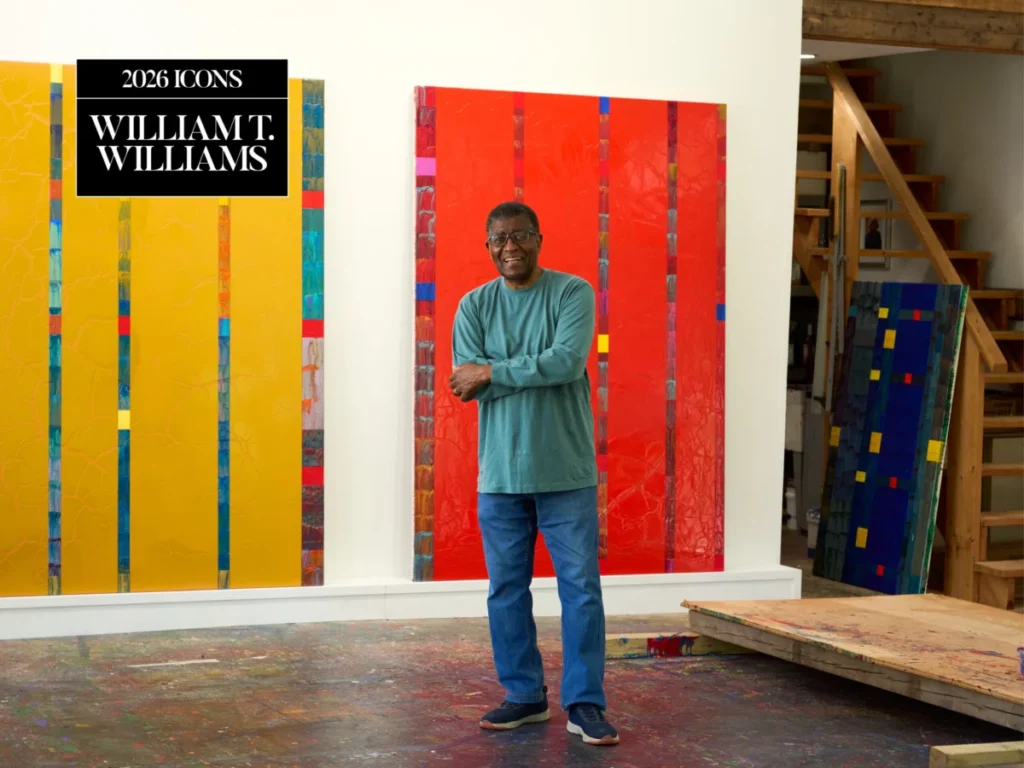
In the sun-drenched sanctuary of his Connecticut studio, William T. Williams stands before a canvas that has occupied his attention for months. The air is thick with the scent of acrylic medium and the quiet intensity of a master at work. For Williams, one of the most significant abstract painters of the 20th and 21st centuries, the act of painting is not merely an aesthetic pursuit; it is a rigorous, ongoing interrogation of history, materiality, and the self.
“There’s something to learn every time I go in the studio,” Williams reflected this past spring. “Anything that I did yesterday I have to forget, and I have to enter the studio and enter the paintings as if it’s the first time that I’ve had engagement.”
This philosophy—an openness to the unknown tempered by a disciplined, multi-step strategy—has defined a career that spans over six decades. From his early, iconic “Diamond in a Box” series to his current, layered, and texturally complex abstractions, Williams has remained an iconoclast, persistently pushing the boundaries of what formalist art can represent and how it can function within the social sphere.

The Evolution of a Master: A Chronological Journey
Early Formative Years
Born in 1942 in Cross Creek, North Carolina, Williams moved to Queens, New York, at age four. His early exposure to the arts was fostered by community mentors and teachers who recognized his potential. By the time he reached the School of Industrial Art, he was immersed in the transformative power of visual creation. His path led him through New York Community College to the Pratt Institute in 1962, where he transitioned from graphic design to painting—a shift catalyzed by the influence of his instructor Richard Bové.
It was Bové who directed him toward the work of Hans Hofmann, an encounter that fundamentally altered Williams’s relationship with paint. He began to view paint not as a tool for representation, but as a material with its own inherent life and physicality.
The Skowhegan Catalyst and Professional Recognition
In 1965, during his junior year at Pratt, Williams was selected for the Skowhegan School of Painting & Sculpture in Maine. As the only student working in abstraction, he found himself grappling with the shadow of Abstract Expressionism while simultaneously engaging in critical dialogue with artists like Alfred Leslie. His subsequent receipt of the Leonard Bocour Award, named after the legendary paint manufacturer, proved to be a defining moment. Bocour became a patron, mentor, and technical advisor, helping Williams resolve complex issues regarding paint consistency and drying times—knowledge that would eventually underpin his signature, cracked-surface techniques.

The "Diamond" and Beyond
After graduate school at Yale, Williams began his “Diamond in a Box” series. Influenced by the geometry found in the quilts of his grandmother and the design motifs of his mother’s phonograph, these works introduced a structured rhythm to his abstraction. He later moved through the “Shimmer Series,” which explored light’s movement over water, and the “Roller” series (1978–82), a radical departure that utilized industrial rollers to apply multiple layers of paint, creating an almost anti-art, highly textured surface.
The Architecture of the Studio: Light and Materiality
Williams’s practice is inherently linked to his physical workspace. For 15 years, he has split his time between New York and Connecticut. His Connecticut studio, characterized by windows on three walls, provides a stark contrast to his New York studio, which he famously boarded up to maintain a controlled, artificial light.
“We decided to open the studio up, and that has influenced the paintings because of the angle of light and the geometry that the light brings in the afternoon,” he noted. This shift has prompted his work to become more vertical, as he experiments with light passing through the canvas.

His process is a testament to patience. A single painting can take six months to years to complete. He utilizes plastic cups for paint mixtures rather than a traditional palette, allowing for precise, repeatable applications. He deliberately leaves gaps between layers to reveal the history of the painting’s construction, a visual archaeology that he calls “the building up of the layers.”
The Pedagogical Legacy
Williams’s influence extends far beyond his own canvases. His tenure as an educator at the School of Visual Arts and Brooklyn College, spanning nearly four decades until his retirement in 2008, shaped generations of artists. Among his notable students is Nari Ward, who recalls Williams’s ability to balance technical instruction with profound philosophical guidance.
“I saw him negotiating both this sense of control over the medium and at the same time allowing a way to let go of that control to make the material teach him what needs to happen,” Ward said.

Williams’s role as an institutional architect is perhaps best exemplified by his 1968 proposal for an artist residency program. Recognizing the lack of support for minority artists, he envisioned an ecosystem comprising studio space, patrons, scholars, and institutional venues. His proposal was instrumental in the founding of the Studio Museum in Harlem, which has since become a global powerhouse for contemporary art, launching the careers of artists like Kerry James Marshall, David Hammons, and Julie Mehretu.
Social Empowerment through Abstraction: The Smokehouse Associates
Between 1968 and 1970, Williams collaborated with Melvin Edwards, Guy Ciarcia, and Billy Rose to form the Smokehouse Associates. Together, they created nine public murals in Harlem. This project challenged the prevailing notion that abstraction was a detached, elitist pursuit.
By engaging community members—church groups, block associations, and children—in the creation of these murals, the collective proved that abstract art could be a tool for social empowerment. Curator Eric Booker notes that the project was less about the final images and more about the process of decentralizing art, making the act of creation a public, communal experience.

Official Perspectives and Critical Reception
The reception of Williams’s work has evolved alongside his long career. In the late 1960s, the art world was often bewildered by his commitment to abstraction, which some critics felt did not align with the narrative expectations of the Black Arts Movement.
Thelma Golden, director and chief curator of the Studio Museum in Harlem, highlights the profound nature of his career. “There is a constant sense where you see him asking and answering questions in the space of the work, and he has done that for decades,” Golden observed. “What we then have is the legacy of not only this incredible practice but also the legacy of this incredible person who has been so committed to creating art, creating space, creating meaning.”
Williams himself has long argued against the need for narrative prompts. He views the act of looking as an experiential encounter—a direct, unmediated relationship between the viewer and the work. His titles, such as Sister of Neckbone, are not descriptions but references to shared cultural experiences, meant to invite the viewer into an immediate state of being rather than a literary analysis.

Implications: A Continued Dialogue
Today, William T. Williams stands as a bridge between the mid-century pioneers of abstraction and the contemporary generation. His studio contains a poignant memorial: a collection of dried-out brushes used on the days his dear friends—such as Sam Gilliam, Jack Whitten, and Melvin Edwards—passed away.
This memorial is emblematic of his entire career. It is a record of time, a physical manifestation of loss, and a testament to the endurance of creative relationships. Even in their absence, the dialogue continues.
As the art world continues to re-evaluate the history of 20th-century American art, Williams’s contribution remains vital. He has proven that the "formal" can be "political," and that the "abstract" can be deeply "human." By refusing to be categorized by any single movement and by maintaining a steady, rigorous, and joyous dedication to the act of painting, William T. Williams has not only shaped the art world’s infrastructure but has redefined the possibilities of what it means to be an artist.

His work is a reminder that painting is not just a reflection of the world—it is an active, demanding, and ultimately poetic way of living within it. As Williams continues to work, adjusting the tone of a blue or the placement of a square, he remains engaged in the same fundamental question he started with: How can art be as "irritable" and alive as possible? For Williams, the answer is found in the next layer, the next brushstroke, and the next moment of discovery in the studio.