
By Stephen Holmes
September 14, 2026
At first glance, the MAGA movement’s profound fear of immigrants and the broader American public’s growing anxiety regarding the proliferation of data centers appear to be separate, unrelated phenomena. Yet, both reflect deep-seated insecurities about one’s place in a rapidly shifting global economy. While the former is rooted in a nativist assertion that the native population’s cultural and social position is being usurped, the latter is driven by the chilling realization that, in an AI-driven future, the traditional value of human labor and local resources may soon be rendered obsolete.
The common thread is displacement: one, a perceived demographic replacement; the other, an existential displacement by the silicon infrastructure of the future.
The Great Replacement: A Global Ideological Migration
Few political concepts have traveled as far or as destructively as the "Great Replacement." Coined by the French writer Renaud Camus, the theory posits that native populations are being deliberately supplanted by immigrants—a narrative that has evolved from a fringe intellectual provocation into a potent engine of nationalist mobilization.
This theory has furnished the core grammar for the rise of right-wing populism across the West. In France, it has underpinned the electoral gains of Marine Le Pen’s National Rally. In Hungary, it has served as the ideological bedrock for Viktor Orbán’s long-standing grip on power. In Germany, the Alternative für Deutschland (AfD) has utilized the rhetoric of "remigration" to challenge the postwar consensus. In the United States, it has transitioned from the dark corners of the internet to the mainstream platform of Donald Trump, forming the moral and political justification for his proposed mass-deportation programs.
The tragedy of this ideology is not merely its political success, but its lethal real-world consequences. The "Great Replacement" has been cited in manifestos by mass murderers in Christchurch, New Zealand; El Paso, Texas; Hanau, Germany; and Buffalo, New York. It has transformed abstract demographic anxiety into a justification for preemptive violence.
Chronology of a Resurgent Nativism
To understand the current political climate, one must map the trajectory of how demographic anxiety moved from the margins to the centers of power:
- 2011: Renaud Camus publishes Le Grand Remplacement, formalizing the theory that white, Western populations are being replaced by non-European migrants.
- 2015-2016: The European migrant crisis provides fertile ground for the theory, with right-wing parties in Germany and Hungary gaining significant parliamentary seats by campaigning on "identity preservation."
- 2017: The "Unite the Right" rally in Charlottesville, Virginia, sees demonstrators chanting "You will not replace us," signaling the arrival of replacement theory in American street politics.
- 2019: The Christchurch mosque shootings occur. The shooter’s manifesto, titled "The Great Replacement," marks a turning point where the theory becomes inextricably linked to international terrorism.
- 2022-2024: The theory finds a home in mainstream American conservative media. Political figures begin explicitly linking immigration policy to the existential survival of the "native" voter.
- 2026: The current moment. The intersection of economic stagnation and the rapid deployment of AI-driven data centers creates a new, parallel anxiety about the worth of the American worker.
Supporting Data: The Convergence of Anxieties
The "Great Replacement" thrives in environments where economic stability is perceived as fragile. When citizens feel they are losing their grip on the "American Dream," they become susceptible to narratives that provide a clear—albeit scapegoated—villain.
Current sociological data suggests a striking correlation between regions experiencing industrial decline and high support for nativist policies. In the "Rust Belt," where traditional manufacturing jobs have been hollowed out, the fear of the "other" is often a proxy for the fear of irrelevance.
Simultaneously, the rise of the data center industry has introduced a new tension. Data centers—massive, windowless warehouses of servers that house the cloud and power artificial intelligence—are being built in rural and semi-rural areas across the U.S. These facilities consume vast amounts of electricity and water but offer very few local jobs.
While the immigrant is blamed for "taking" the job, the data center is seen as a physical manifestation of an economy that doesn’t need the local resident at all. The former suggests that the native is being pushed aside; the latter suggests the native is being discarded.
Official Responses and Political Calculations
The response from the political establishment has been, at best, fractured.
In Europe, mainstream center-right parties have attempted to co-opt the language of the far-right to prevent the loss of their voter base. By adopting stricter border controls and rhetoric regarding "cultural heritage," these parties have inadvertently legitimized the core tenets of replacement theory, often with limited success in curbing the growth of parties like the National Rally.
In the United States, the Biden-Harris administration and their successors have struggled to balance border security with humanitarian obligations. The current administration’s rhetoric has focused on the "orderly management" of the border, but this has failed to satisfy a base that is increasingly convinced that the demographic makeup of the country is being fundamentally and irreversibly altered.
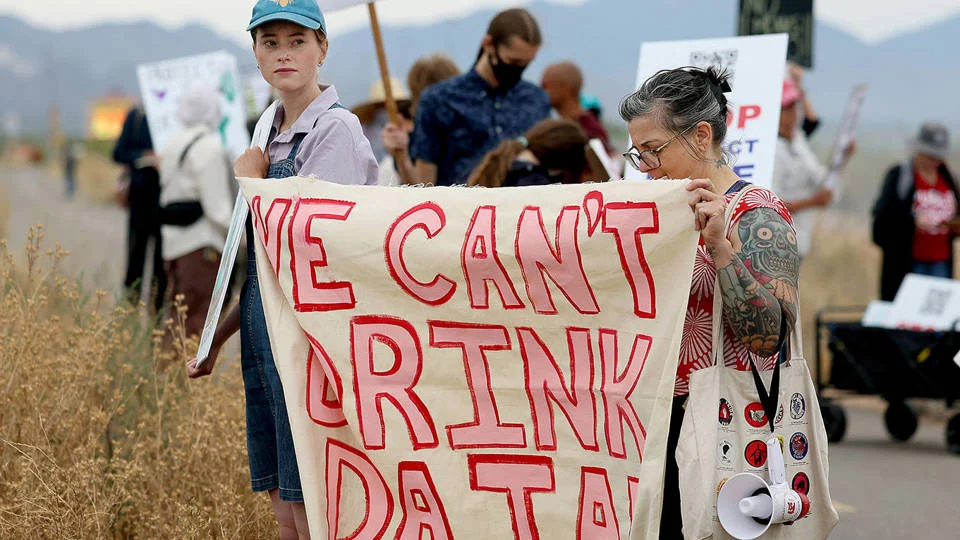
Regarding the data center crisis, responses are only now beginning to materialize at the local municipal level. Several counties in Virginia and Iowa have recently voted to place moratoriums on data center construction, citing concerns over power grid stability and water usage. These local battles serve as a microcosm of the broader struggle: the fight to ensure that the infrastructure of the future does not come at the expense of the communities it is built upon.
The Implications: A New Social Contract?
The implications of this dual anxiety are profound. If a significant portion of the population believes they are being "replaced" by immigrants, the social contract—the idea that the government exists to protect the interests of its citizens—is severed. When those same citizens feel that the technological elite (the owners of the data centers) are building a future that excludes them, the resulting alienation creates a vacuum that is easily filled by populism.
The Myth of Value
The fundamental difference between the fear of the immigrant and the fear of the data center lies in the perceived value of the native. The "Great Replacement" ideology tells the native population that their culture and presence are inherently valuable and therefore worth "defending." It provides a sense of self-importance and a mission.
Conversely, the rise of AI and automation tells the average worker that they are becoming obsolete. There is no "defending" one’s position against an algorithm that is faster, cheaper, and more efficient. This is a much darker anxiety, as it offers no path to victory—only the quiet realization of redundancy.
The Path Forward
To move past this era of anxiety, policymakers must address the economic insecurity that makes these theories so seductive. This requires:
- Economic Reinvestment: Moving beyond the "service economy" model to invest in infrastructure that creates high-value jobs for local populations, rather than just hosting the server racks that power Silicon Valley.
- Transparent Migration Policy: Moving the conversation on immigration away from conspiracy theories toward a fact-based discussion about labor needs and integration, acknowledging the anxieties of native-born citizens without validating the xenophobic tropes of the far-right.
- Technological Governance: Establishing clear regulations for the tech industry that prioritize local community health and economic benefit over the unbridled expansion of energy-intensive data centers.
The fear of displacement is the defining political emotion of our time. Whether it is a fear of the person arriving at the border or the server being installed in the town square, the root cause remains the same: a profound lack of agency in the face of globalized, uncontrollable forces. Until the state can prove that it is working to preserve the dignity and utility of its citizens, the politics of replacement will continue to dominate the discourse, driving us further into a cycle of suspicion and decay.
We are witnessing a shift in the tectonic plates of Western democracy. The "Great Replacement" is no longer just a conspiracy theory; it is a symptom of a society that has lost faith in its own future. Rebuilding that faith will require more than rhetoric—it will require a fundamental restructuring of how we value the human element in an increasingly automated, globalized world.