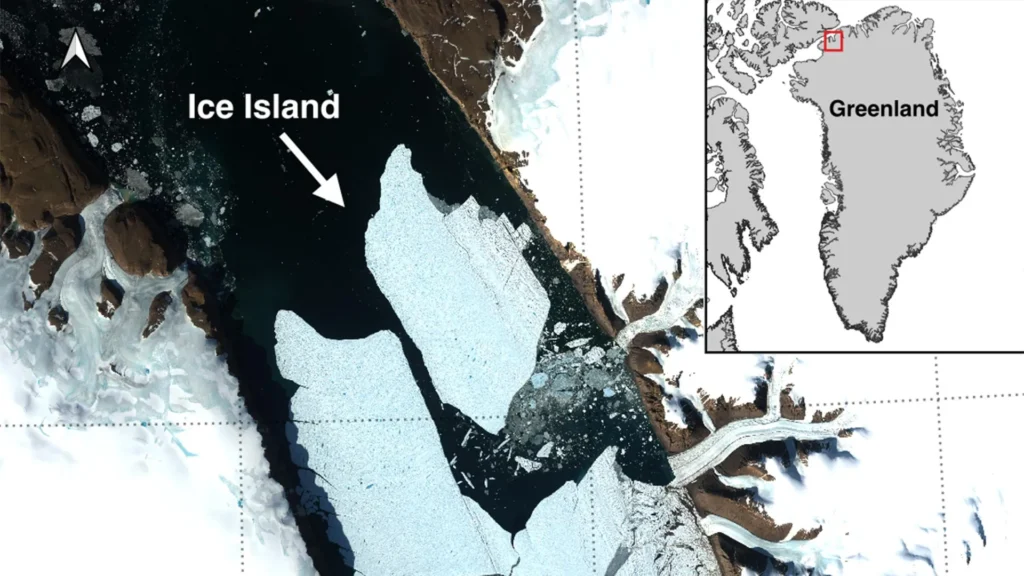
In a striking demonstration of the accelerating shifts within the Earth’s cryosphere, a massive section of Greenland’s Petermann Glacier has detached, shedding an ice island roughly the size of Manhattan. This event, which occurred on August 4, 2026, marks the most significant calving of floating ice in the Arctic since 2020 and the largest loss for Petermann Glacier itself since 2012.
The separation of the 76.4-square-kilometer ice island, which may reach thicknesses of up to 150 meters, serves as a poignant, physical reminder of the vulnerability of the Arctic’s remaining ice tongues. Led by a multi-institutional research team—including the University of Ottawa, the University of Stirling, Environment and Climate Change Canada, Lancaster University, and the University of Leeds—scientists are now racing to document the evolution of this massive fragment as it drifts into the open ocean.
Chronology of a Fracture: From Satellite Surveillance to Separation
The collapse did not come as a surprise to the scientific community. For years, the Petermann Glacier, one of Greenland’s most prominent ice tongues, has been under the watchful gaze of international researchers. Using high-resolution satellite imagery, particularly from the European Space Agency’s (ESA) Sentinel-1 mission, the team had been monitoring the structural integrity of the glacier since 2019.
The Buildup
For years, glaciologists observed a creeping instability in the ice tongue. Satellite data revealed the steady expansion of fractures—deep, yawning fissures that snaked across the glacier’s surface, signaling that the structural tension was reaching a breaking point.
The Final Days
By August 3, 2026, the data had become alarming. Sentinel-1 imagery displayed unmistakable signs of deterioration along the centerline of the ice tongue. The internal stress of the ice, combined with the warming temperatures of the surrounding fjord, pushed the glacier to its limit.
The final detachment occurred on August 4. By 20:00 UTC, the massive tabular iceberg had fully severed from the glacier’s eastern flank. The separation was clean but catastrophic in scale, instantly transforming a stable extension of the glacier into a free-floating island of ice.
The Science of Arctic Ice Islands
While tabular icebergs are a frequent occurrence in the Southern Ocean surrounding Antarctica, they remain a rarity in the Arctic. This difference in frequency makes the Petermann event a goldmine for glaciologists.
"While large, tabular icebergs are relatively common in the Southern Ocean that surrounds the Antarctic Ice Sheet, Arctic ice islands are far rarer," explains Dr. Anna Crawford of the University of Stirling. "By studying Arctic ice islands, we will gain knowledge that can be transferred across Polar regions."
Why Size and Longevity Matter
The newly formed island is not merely a transient block of ice. Because of its massive scale and thickness, it has the potential to remain intact for years, slowly moving through the ocean currents and gradually fragmenting into smaller, more hazardous icebergs.
This longevity provides researchers with a unique "laboratory" to study how colossal Arctic ice masses develop, move, and disintegrate. By observing the life cycle of this specific ice island, scientists hope to refine their models regarding glacier retreat and the influence of changing ocean temperatures on ice shelf stability.
A Precarious Future for Petermann
The August 4 event is likely only the beginning of a larger process of disintegration. According to the research team, the glacier is currently experiencing a "domino effect" of instability.
The Looming Losses
Analysis of the remaining floating ice tongue indicates that two additional major sections are primed to break away. Projections suggest these forthcoming ice islands will measure approximately 94 km² and 84 km² respectively. Should these sections detach as anticipated, the combined loss would strip roughly 254 km² from the Petermann Glacier’s ice tongue, effectively reducing its total area by 22 percent in a very short timeframe.
This rapid loss is indicative of a broader trend of Arctic retreat, where the feedback loops between warming air, warming ocean waters, and structural fatigue in glaciers are creating an environment of permanent instability.
Official Responses and Marine Implications
The discovery of the calving event was spearheaded by Adam Garbo, a PhD student in glaciology at the University of Ottawa’s Department of Geography, Environment and Geomatics. For Garbo, the event is the culmination of years of meticulous observation. "Petermann Glacier has long been one of Greenland’s largest remaining ice tongues," Garbo states. "We’ve anticipated this break for years, and seeing it finally happen is remarkable."
Navigational Hazards
Beyond the scientific curiosity, the Canadian government is treating the situation with caution. Environment and Climate Change Canada, through the Canadian Ice Service, is currently tracking the ice island to assess the potential threats to marine traffic and offshore infrastructure.
Dr. Abigail Dalton of the Canadian Ice Service emphasizes the severity of the threat: "These are thick blocks of ice that can drift for years. Over time, they fracture into smaller, harder-to-track pieces that pose hazards to vessels and resource operations."
As the ice island drifts, it complicates maritime logistics in the Arctic. Shipping routes that once felt secure can suddenly become littered with massive, radar-deflecting ice masses. The collaboration between the University of Ottawa and the Canadian government ensures that real-time data is being relayed to mariners and stakeholders in the region to minimize the risk of accidents.
Implications for Global Climate Research
The calving of the Petermann Glacier is a microcosm of the global climate crisis. While the direct sea-level rise caused by this single event is negligible, the process of calving is a vital indicator of the health of the Greenland Ice Sheet.
Understanding the Mechanisms
The research team is employing a multi-faceted approach to understand the "why" behind the calving. By combining satellite monitoring, aerial drone surveillance, and oceanographic data, the team is attempting to map the relationship between oceanic heat intrusion at the base of the glacier and the resulting surface fractures.
This research is critical for global climate policy. If we can better predict when and how large ice shelves will collapse, we can better predict the timeline of sea-level rise and the transformation of the Arctic ecosystem.
A Collaborative Effort
The ongoing work—led by the University of Ottawa—highlights the necessity of international cooperation in polar science. With partners across the UK and Canada, the project is a testament to the fact that no single nation can monitor the rapid changes occurring at the poles alone.
Conclusion: Watching the Horizon
As of late 2026, the 76.4 km² ice island continues to drift, its jagged edges a stark contrast to the dark, churning waters of the Arctic. For Adam Garbo and his colleagues, the work is far from over. The team intends to continue their intensive monitoring program, utilizing every available sensor to track the island’s trajectory.
"Our work is part of a broader effort to better understand the processes responsible for the calving and retreat of Arctic ice shelves," Garbo notes.
The Petermann Glacier event is more than a news headline; it is a sentinel. It signals that the Arctic is entering a phase of increased volatility. As researchers document the slow, grinding death of this ice tongue, they are also writing the history of a changing planet—a history defined by melting ice, shifting oceans, and the urgent need for a deeper understanding of the forces shaping our world.
The eyes of the scientific community remain fixed on the North, waiting to see which piece of the Petermann Glacier will be the next to vanish into the sea.