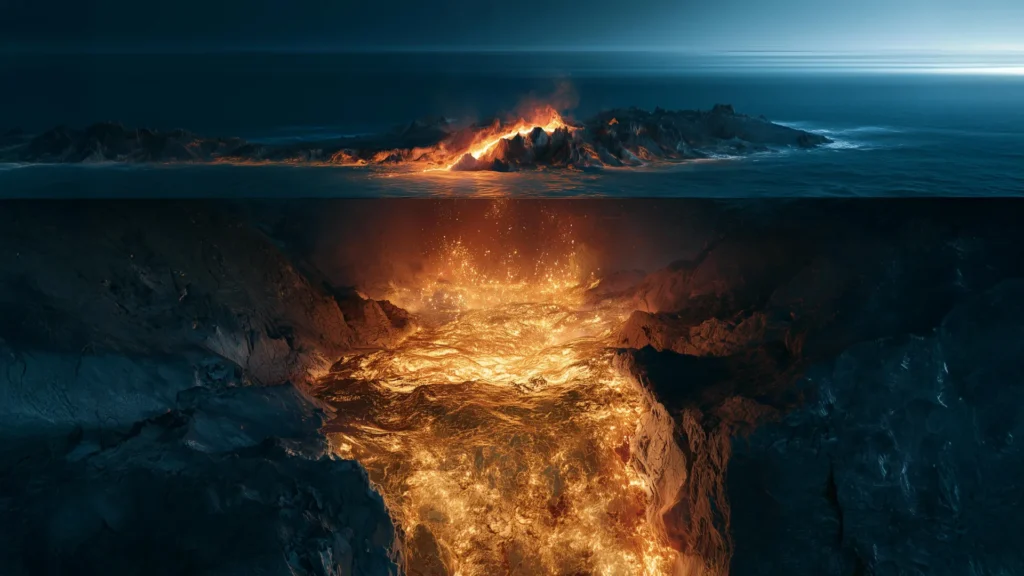
Deep beneath the rolling waves of the South Pacific, thousands of meters below the surface where light cannot penetrate, a profound geological process is unfolding. It is a slow-motion alchemy that has captivated scientists for decades: the creation of Earth’s "gold kitchens." Island arcs—chains of volcanic islands that sprout above subduction zones where one tectonic plate dives beneath another—are notoriously rich in precious metals. For years, the scientific community has grappled with a singular question: why are these specific regions of the Earth’s crust so disproportionately enriched with gold compared to the rest of the planet’s mantle?
A groundbreaking study led by Dr. Christian Timm, a marine geologist at the GEOMAR Helmholtz Centre for Ocean Research Kiel, has finally begun to peel back the layers of this mystery. By analyzing the chemical signatures locked within ancient volcanic glass, researchers have identified a multi-stage melting process that acts as a global concentrate for noble metals. This discovery not only refines our understanding of planetary geology but also illuminates the "first step" in the life cycle of the gold that eventually finds its way into human hands.
The Chronology of a Geological Discovery
The quest to understand the mantle’s gold enrichment began long before the recent publication of these findings. For years, geologists observed that hydrothermal sulfide deposits—mineral-rich chimneys that vent superheated water into the ocean—were significantly more auriferous in subduction zones than at mid-ocean ridges.
The investigative timeline for this specific project involved:
- Field Expedition: Scientists targeted the Kermadec island arc and the adjacent Havre Trough, north of New Zealand. This region is a hotbed of tectonic activity, characterized by the Pacific Plate sliding beneath the Indo-Australian Plate.
- Sample Collection: The team collected 66 samples of volcanic glass from the seafloor. These samples are essentially "time capsules"; when underwater lava erupts, the extreme pressure and temperature of the deep ocean cause it to quench—or cool—almost instantaneously. This rapid transition prevents the magma from crystallizing, thereby trapping the chemical composition of the melt exactly as it existed deep beneath the crust.
- Laboratory Analysis: Back at the laboratory, researchers isolated "primitive" glasses. These samples represent the "unadulterated" magma, untouched by the geochemical shifts that occur as magma cools and differentiates into various rock types.
- Comparative Data Modeling: The team compared the gold concentrations in the Kermadec samples against known baselines from mid-ocean ridge basalts. The disparity was stark: the island arc magmas contained gold levels significantly higher than their mid-ocean counterparts, triggering a rigorous investigation into the mechanisms of this enrichment.
Supporting Data: Decoding the Mantle’s Chemistry
To understand why gold behaves differently in subduction zones, the researchers focused on chalcophile elements—"sulfur-loving" elements like silver, copper, selenium, and platinum. Because these elements exhibit similar chemical behaviors during melting, they serve as proxies for the mantle’s history.
The Melting Threshold
The data revealed that the mantle beneath the Kermadec arc undergoes melting at relatively high temperatures—specifically, temperatures that exceed the "sulfide liquidus." In geological terms, this is a critical threshold. Gold is typically sequestered within sulfide minerals in the mantle. Under standard conditions, these minerals remain stable, trapping the gold within their molecular structure.
However, when the mantle reaches a sufficiently high degree of melting in the presence of water, these sulfide minerals break down entirely. This destruction of the mineral host allows the "trapped" gold to be released directly into the rising melt.
Quantitative Findings
The analysis yielded startling numbers: the primitive glasses from the Kermadec arc contained gold concentrations of up to six nanograms per gram of rock. While six nanograms may sound negligible to a commercial miner—who would require concentrations several orders of magnitude higher to justify an extraction operation—in the context of planetary mantle chemistry, this is an extraordinarily high value. Furthermore, the gold-to-copper ratios observed were far above those found in fertile mantle rocks, suggesting that a simple, single-stage melting event could not account for such high concentrations.
The Role of Water: A Catalyst, Not a Controller
One of the most significant revelations of Dr. Timm’s study concerns the role of water in subduction zones. Previous scientific consensus often posited that water released from the descending oceanic plate acted as a "carrier" or direct chemical control for gold, essentially "scrubbing" the metal from the slab and pulling it into the magma.
The new data suggests a far more nuanced reality. "We initially assumed that water released from the subduction zone directly controlled gold enrichment," says Dr. Timm. "However, our data show that water mainly facilitates mantle melting. The key factor for high gold concentrations is the high—and in part repeated—degree of melting."
Essentially, water acts as a geological "accelerant." By lowering the melting point of the mantle, it allows for more intense, higher-degree melting events. It is this intensity that destroys the sulfide minerals holding the gold. The research demonstrates that the mantle beneath the Kermadec arc is likely a "recycled" source—a region that has already been depleted by an earlier melting event and subsequently underwent a second, high-degree melt. This multi-stage process acts as a refinery, progressively concentrating the gold into the magma that eventually fuels the volcanic arc.
Official Responses and Expert Perspective
The implications of this study are being felt across the fields of geochemistry and economic geology. Dr. Timm emphasizes that while the rocks themselves are not "gold mines" in the traditional sense, they provide the "starting conditions" for the gold deposits that humans do eventually mine.
"Our results demonstrate that gold enrichment is not the result of a single melting event, but of multiple stages," Dr. Timm notes. "Only repeated melting allows gold to become strongly concentrated in the magma."
This perspective shifts the focus from surface-level hydrothermal processes to deep-mantle pre-concentration. While the mineral deposits we see at the seafloor are formed by hot fluids circulating through volcanic vents, the "source material" for these deposits is already enriched before the magma ever reaches the surface. This suggests that the geological "luck" of a specific location depends heavily on the chemical history of the mantle beneath it.
Broader Implications: The Life Cycle of Gold
The findings offer a new framework for understanding the global distribution of gold deposits. If the "gold kitchen" model is correct, then regions with a history of repeated, water-assisted mantle melting are far more likely to host large-scale hydrothermal sulfide deposits.
Why This Matters for Science
- Exploration Targeting: By understanding the geochemical "fingerprint" of a gold-rich mantle, geologists may be able to better predict which subduction zones are most likely to contain valuable hydrothermal mineral deposits.
- Planetary Evolution: This research highlights the complexity of the Earth’s interior. It suggests that the mantle is not a static pool of magma, but a dynamic, multi-stage processing system that continually recycles and concentrates rare elements.
- Connecting the Dots: The study bridges the gap between deep-earth processes and seafloor hydrothermal systems. It suggests that the "alchemy" of gold begins deep in the subduction zone, long before the magma reaches the surface or the hydrothermal vents begin their work.
Future Research Directions
Dr. Timm and his team acknowledge that while the mechanism is identified, there is still much to learn. "The mechanism we identify could contribute to the elevated gold contents observed in hydrothermal systems in subduction zones," Timm explains. "However, this link still needs to be investigated further." Future studies will likely focus on mapping other island arcs around the world to determine if this multi-stage melting process is a universal constant in subduction-related volcanism or if it varies based on the age and composition of the subducting plate.
Conclusion: The First Step in the Journey
The study of the Kermadec arc reminds us that the gold in our jewelry and electronics has a history that stretches back millions of years and hundreds of kilometers into the Earth’s interior. It is a story of destruction and rebirth—of minerals being broken down in the intense heat of the mantle, only to be forged into new configurations within the rising magma.
"We are effectively looking at the first step in the life cycle of gold," says Dr. Timm. "It begins with the transfer of gold from the mantle into a melt that eventually forms volcanoes. The alchemy starts long before the metal reaches the surface." As we continue to probe the deep ocean floor, we are not just discovering minerals; we are uncovering the intricate, deep-earth mechanisms that have shaped the chemical composition of our planet since its formation. The "gold kitchen" is operating, and for the first time, we are beginning to understand the recipe.