Executive Summary: A Complex Picture of Maritime Safety
The global maritime security landscape underwent a notable transformation during the first nine months of 2024. According to the latest data released by the International Maritime Bureau (IMB), traditional piracy hotspots such as the Gulf of Guinea have seen a historic decline in reported incidents. However, this statistical improvement masks a persistent and grave reality: the continued threat to crew welfare, the re-emergence of high-stakes hijackings in the Indian Ocean, and the persistent danger posed by opportunistic boarding in the critical choke points of the Singapore Straits.
As of the third quarter of 2024, the maritime industry finds itself at a crossroads. While the downward trend in total incident volume is a testament to improved naval cooperation and enhanced onboard security measures, the human cost remains high. Stakeholders are now grappling with how to sustain these gains while addressing the evolving tactics of criminal syndicates that operate across these volatile maritime corridors.
The Chronology of Risk: Q1 to Q3 2024
To understand the current state of maritime security, one must examine the progression of incidents over the nine-month reporting period.
First Quarter (January–March): The Resurgence of Somali Piracy
The year began with a troubling uptick in activity off the coast of Somalia and the Gulf of Aden. After years of relative dormancy, the resurgence of hijackings signaled that the maritime security architecture in the region might be fraying. By the end of March, industry monitors had already flagged several vessels that were fired upon or seized, marking the most significant surge in this region in nearly a decade.
Second Quarter (April–June): Sustained Vigilance
As the second quarter progressed, the focus shifted toward the Singapore Straits. Despite a global downward trend in piracy, this region remained a high-risk area for "low-level" opportunistic boarding. Throughout these months, the IMB recorded a consistent pattern of small, agile groups targeting vessels at night, taking advantage of the heavy traffic and complex navigational requirements of the straits.
Third Quarter (July–September): The Seasonal Lull
The most recent data covering July through September indicates a distinct quiet period in the waters off Somalia and the Gulf of Aden. Experts attribute this largely to the onset of the monsoon season. High seas and turbulent weather conditions have historically acted as a natural deterrent to small skiffs used by pirates. However, the IMB warns that this lull is temporary and should not be mistaken for a permanent eradication of the threat.
Supporting Data: By the Numbers
The statistical breakdown for the first nine months of 2024 reveals a divergent narrative of improvement and lingering risk.
The Gulf of Guinea: A Historic Low
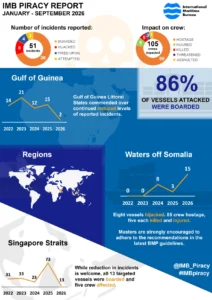
The Gulf of Guinea, once considered the world’s most dangerous maritime region, reported only 12 incidents during this nine-month window. This represents the lowest number of reported cases since record-keeping began in 1996. While this decline is statistically significant and reflects the success of regional and international intervention, the human toll remains unacceptable. Within these 12 incidents, 11 crew members were kidnapped, and 21 were taken hostage, underscoring that even in a region of declining volume, the severity of individual encounters remains high.
The Singapore Straits: The Persistence of Opportunism
In the Singapore Straits, reports of incidents dropped to 23, a welcome decrease from the 33 incidents recorded during the same period in 2023. Nevertheless, the efficiency of the perpetrators remains a point of deep concern. In a staggering 96% of these 23 cases, the perpetrators were successful in boarding the vessels. This high success rate indicates that current deterrent measures—such as high-speed maneuvers and early warning systems—are frequently being bypassed by opportunistic groups targeting large, slow-moving commercial ships.
Somalia and the Gulf of Aden: A Return to Hostility
The eight incidents reported in this region during the first nine months of 2024 represent a critical shift. The inclusion of three successful hijackings and two instances of vessels being fired upon serves as a stark reminder of the volatility of these waters. While the third quarter saw no new reports, the threat level remains categorized as "elevated" by the IMB.
Official Responses and Strategic Recommendations
The International Maritime Bureau has been vocal in its response to these trends, emphasizing that while statistics provide a snapshot, they do not replace the need for constant vigilance.
Strengthening Best Management Practices (BMP)
The IMB continues to urge all masters, owners, and operators to strictly adhere to the latest version of the Best Management Practices (BMP). These guidelines, which include hardening ships, maintaining a constant bridge watch, and implementing strict citadel procedures, remain the first line of defense. The IMB stresses that the "human element" is the most critical component; crew training and situational awareness drills are often the deciding factors in whether a vessel successfully repels an attack.
Regional Cooperation and Naval Presence
Official responses from regional governments, particularly in West Africa and Southeast Asia, have focused on increasing the density of patrols. The decrease in Gulf of Guinea incidents is largely credited to more aggressive patrolling by regional navies in collaboration with international partners. However, the IMB emphasizes that such patrols cannot cover every square mile of the sea, necessitating a "whole-of-industry" approach where private operators and state authorities work in tandem.
Implications: The Future of Maritime Security
The implications of the current data are twofold: the nature of the threat is changing, and the consequences of complacency are rising.
The Risk to Navigation
The IMB has highlighted a critical, often overlooked implication regarding the Singapore Straits. Given the immense volume of traffic and the narrow, complex nature of the navigational channels, an opportunistic boarding is no longer just a theft issue—it is a safety issue. If a boarding occurs while a large vessel is navigating through high-traffic zones, the distraction of the crew or the disruption of the bridge could lead to groundings or collisions. The IMB warns that "low-level" incidents carry "high-level" risks, potentially turning a robbery into a major environmental or maritime disaster.
The Human Cost
Beyond the balance sheets and the insurance premiums, the psychological impact on seafarers is profound. Being kidnapped or held hostage is a traumatic event that leaves lasting scars. The fact that 32 crew members have been subjected to these experiences in 2024 alone highlights that the industry’s "security" is still failing those who serve on the front lines of global trade. Shipowners are now being pushed to invest more heavily in crew wellness programs and post-incident support services.
Technological Advancements and Challenges
The 2024 data suggests that while criminals are using more basic, opportunistic methods in the Singapore Straits, they are becoming more tactical in the Indian Ocean. The use of motherships and sophisticated surveillance tools by pirate groups means that the shipping industry must accelerate its own adoption of technology. Increased use of long-range acoustic devices, automated identification system (AIS) monitoring, and satellite-based surveillance is expected to become the industry standard for vessels transiting high-risk areas.
Conclusion: Sustaining Momentum
The maritime security reports for the first nine months of 2024 present a narrative of cautious optimism tempered by realistic concern. The decline in incidents in the Gulf of Guinea is a milestone, but the resurgence of piracy off Somalia and the persistent boarding rates in the Singapore Straits prove that the maritime domain remains a challenging theater for global trade.
As the industry moves into the final quarter of the year, the mandate for all stakeholders is clear: there is no room for complacency. The monsoon season in the Indian Ocean will eventually end, and the opportunistic nature of crime in Southeast Asia is unlikely to vanish overnight. By combining rigorous adherence to established Best Management Practices, fostering deeper cooperation between state navies and commercial interests, and prioritizing the safety and mental health of the crew, the maritime community can build a more resilient infrastructure.
The progress made thus far in 2024 should not be viewed as a finish line, but rather as a foundation. Protecting the global supply chain requires sustained investment, constant technological vigilance, and an unwavering commitment to the safety of those who navigate the world’s most dangerous waters. The sea remains a vital, yet perilous, highway, and the statistics of the last nine months serve as both a success story and a warning for the months ahead.