
The intersection of horological craftsmanship and space exploration has long been a pursuit of the world’s most prestigious watchmakers. However, few have approached this celestial challenge with the singular, disruptive vision of Nuncier—the independent Middle Eastern brand formerly known as Nuun. In a landmark move that cements its status as a serious contender in the global sports-watch arena, Nuncier has announced its second official collaboration with NASA. The result is the Nuncier Lunar Mission, a timepiece that serves as a tactile tribute to the monumental achievements of the Apollo era and the pioneering spirit of humanity’s first steps on the Moon.
As the first watch brand from the Gulf Cooperation Council (GCC) to secure official NASA approval for a bespoke design, Nuncier is not merely producing a timepiece; it is staking a claim in the history of space-themed horology. By merging a contemporary sporting silhouette with high-concept design elements, the Lunar Mission represents a significant evolutionary step for the brand.
The Core Concept: A Lunar Canvas
At the heart of the Nuncier Lunar Mission is a design language that prioritizes texture and atmospheric storytelling. While the watch utilizes the brand’s established 40.5mm sports-watch architecture, the execution is a departure from its previous iterations.
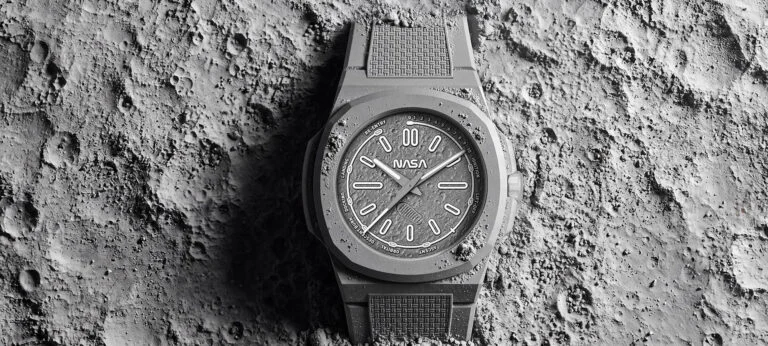
The case is crafted from Grade 2 titanium, a material chosen for its exceptional strength-to-weight ratio and its ability to withstand the rigors of exploration. To capture the essence of the lunar environment, Nuncier has applied a "concrete" matte finish. This granular, medium-gray aesthetic mimics the desolate, dusty plains of the Moon’s surface. It is a bold, monochromatic approach that strips away the flash of traditional luxury to favor a utilitarian, industrial look that feels right at home on the wrist of an explorer.
The dial is perhaps the most ambitious aspect of the design. Rather than a flat, traditional surface, Nuncier has opted for a cratered, topographical texture that provides immediate visual depth. The most striking detail is located at the 6 o’clock position: a meticulously recreated boot print, an homage to the iconic impression left by Neil Armstrong in 1969. Surrounding this are raised, futuristic lozenge indices, replacing the brand’s signature Eastern Arabic numerals to lend the watch a modern, aerodynamic feel. The integration of the NASA logo at the 12 o’clock position serves as the final seal of authenticity, grounding the whimsical design in the reality of space flight.

A Chronology of Collaboration
To understand the weight of the Lunar Mission, one must look back at the trajectory of the brand formerly known as Nuun. The transition to the name "Nuncier" was more than a rebranding; it signaled a shift toward a more global, technically ambitious identity.
- The Nuun Era: The brand established its reputation in the GCC by focusing on accessible luxury, blending minimalist design with a distinct Middle Eastern aesthetic.
- The First NASA Partnership: The brand made headlines by becoming the first in the region to partner with NASA. This initial project served as a "proof of concept," demonstrating that the brand could adhere to the stringent design guidelines required by the space agency while maintaining its unique identity.
- The Pivot to Technical Innovation: Following the success of their first collaboration, the design team at Nuncier spent the last 24 months refining their approach to case materials and movement customization.
- The October 2026 Announcement: The unveiling of the Lunar Mission marks the current pinnacle of this journey. By incorporating specific technical references—such as the flight-stage markers on the outer ring—the brand has moved from simple "space-inspired" watches to narrative-driven, functional art.
Supporting Data and Technical Specifications
The Nuncier Lunar Mission is powered by the reliable Miyota 9039 automatic movement. While some collectors may look toward Swiss alternatives, the 9039 is a workhorse that fits the "independent, utility-focused" ethos of this specific release.
Performance Metrics:
- Movement: Miyota 9039 Automatic.
- Frequency: 28,800 vibrations per hour (4Hz).
- Power Reserve: 42 hours.
- Functions: Hours, minutes, and seconds (no-date configuration for dial symmetry).
- Water Resistance: 100 meters, ensuring the watch is as durable as it is aesthetic.
- Casing: Grade 2 Titanium with sapphire crystal exhibition caseback.
- Strap Technology: "Nanotech" rubber, featuring a dirt-resistant compound and a quick-release mechanism for easy swapping.
The decision to opt for a no-date dial is particularly noteworthy. In the world of design, "less is more" is a cliché, but in the case of the Lunar Mission, it is a strategic necessity. By removing the date window, the dial remains uncluttered, allowing the cratered textures and the boot-print motif to dominate the visual landscape. The exhibition caseback further adds to the experience, revealing a custom-designed rotor that features an astronaut motif, reminding the wearer that the machine driving the watch is as much a part of the "mission" as the exterior casing.
Official Perspectives: The Vision Behind the Design
In discussions regarding the release, Nuncier representatives have emphasized that the Lunar Mission was designed for "the modern dreamer." Unlike heritage brands that lean on their own archives, Nuncier views its role as a bridge between the past achievements of space exploration and the future of independent watchmaking.
"The goal was never just to put a logo on a dial," a brand spokesperson noted during the unveiling. "We wanted to create a feeling. When you look at the dial, you aren’t just seeing a watch; you are looking at a snapshot of a moment that changed humanity. The grainy, concrete finish of the titanium is meant to make you feel the grit and the reality of the lunar surface."

The inclusion of the NASA flight-stage markers on the raised outer ring serves as a functional nod to the engineering prowess required to reach the Moon. It acts as a compass of sorts, reminding the wearer of the complex sequence of events—from lift-off to lunar module separation—that allowed for the mission’s success.
The Implications for Independent Horology
The release of the Nuncier Lunar Mission carries significant implications for the broader watch market. First, it highlights the increasing sophistication of independent brands in the Middle East. For years, the region has been a massive consumer of luxury watches; now, it is transitioning into a creator.
Second, it challenges the hegemony of "space-themed" watches. For decades, the market has been dominated by a few established players. Nuncier’s success in securing a second NASA contract proves that the space agency is willing to work with younger, smaller, and more agile brands, provided they can deliver a high level of design integrity.
Finally, the Lunar Mission sets a benchmark for "lifestyle" horology. By utilizing their proprietary "Nanotech" strap and a highly scratch-resistant titanium case, Nuncier is clearly targeting the active professional. It is a watch meant to be worn, scuffed, and used, rather than kept in a collector’s safe.
Conclusion: A Giant Leap for the Brand
The Nuncier Lunar Mission is more than a timepiece; it is a declaration of intent. By successfully navigating the complexities of a NASA partnership and executing a highly detailed, thematic design, Nuncier has signaled that it is no longer just a regional player—it is a global force in the independent watch space.

Whether one is drawn to the technical specifications of the Miyota 9039 movement, the tactile appeal of the cratered dial, or the sheer history of the NASA collaboration, the watch offers a compelling narrative. It captures a moment in human history and brings it to the wrist with a modern, gritty, and refined aesthetic. As the brand continues to evolve, the Lunar Mission will likely be remembered as the project that solidified their identity as a daring, innovative, and historically conscious watchmaker.
For those looking to secure a piece of this lunar-inspired journey, the watch stands as a testament to the idea that the sky—or in this case, the Moon—is no longer the limit for independent horology.