The contrast could not be more jarring. In the manicured expanse of London’s Regent’s Park, within the climate-controlled, white-walled sanctuary of the Frieze London art fair, the global elite gathers to trade in beauty, status, and capital. Yet, the vibrant, shimmering textile works anchoring the booth of New York-based gallery Fort Gansevoort tell a story born of a vastly different reality—one of systemic collapse, urban warfare, and a desperate struggle for survival.
Adam Shopkorn, who co-founded Fort Gansevoort in 2015 with his wife, Carolyn Tate Angel, has brought a solo presentation of Haitian artist Myrlande Constant to the prestigious fair. It is a move that underscores both the meteoric rise of Constant’s international profile and the harrowing logistical minefield required to bring her work to the global stage while her home country exists in a state of near-total emergency.
Main Facts: A Solo Spotlight Amidst Global Turmoil
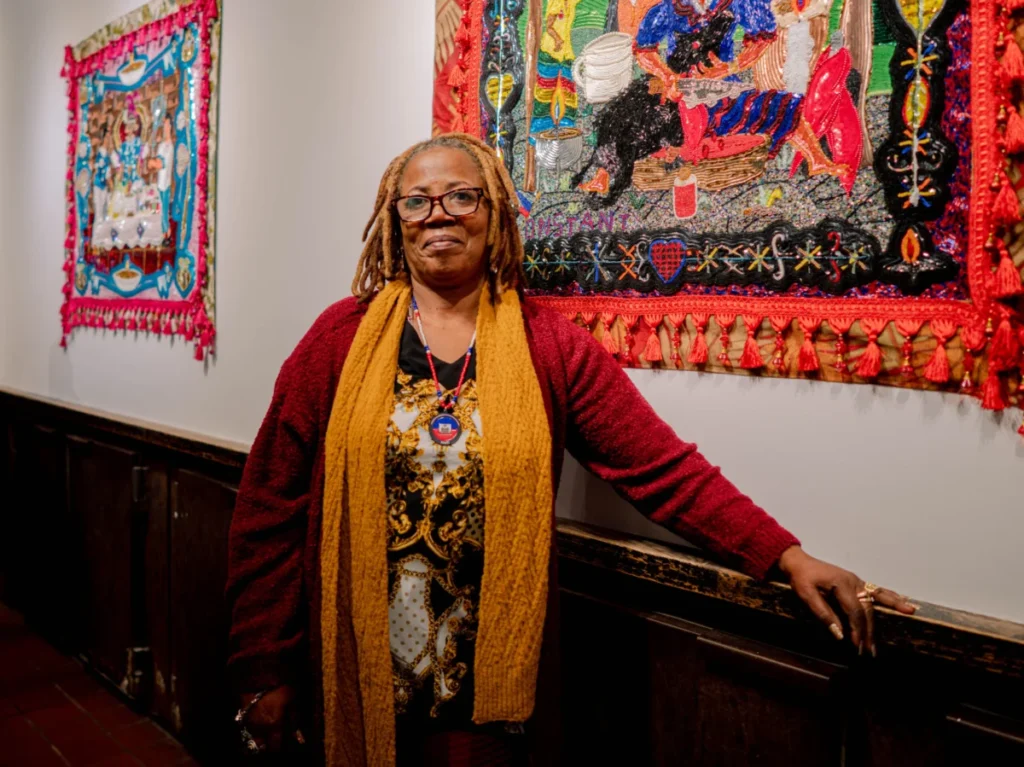
At Frieze London, Fort Gansevoort is presenting five of Constant’s monumental textile works. These are not merely decorative pieces; they are "Drapeaux Vodou" (Vodou flags) reimagined on a scale and with a technical complexity that has redefined the medium. The works on display are priced between $90,000 and $450,000, reflecting a market valuation that has caught up with the artist’s critical acclaim.
The presentation follows a significant period of institutional recognition for Constant. Her work was a highlight of the 2022 Venice Biennale, curated by Cecilia Alemani, and she is slated for inclusion in Prospect.6 in New Orleans (2024) and the 2025 São Paulo Bienal. Despite this acclaim, Constant remains trapped in the volatile geography of Haiti, where gang violence has paralyzed the capital, Port-au-Prince, and forced the artist into a nomadic existence.
Key Works at Frieze London
- Amwan Agwe… (2026): A massive textile measuring over 10 feet by 9 feet. It depicts a lush but haunted landscape of green hills and blue waves, populated by skulls, candles, and fish—iconography central to Fèt Gede, Haiti’s annual festival honoring the spirits of the dead (the Gede).
- Lasirène Diamant (2025): This piece focuses on Lasirène, the powerful Vodou spirit of the sea. On one side, she wears a diamond necklace symbolizing prosperity; on the other, she is depicted in a raft surrounded by offerings of fruit and sweets, accompanied by a menagerie of sea creatures including dolphins and octopuses.
Chronology: From the Atelier to the Exodus
The trajectory of Myrlande Constant’s career is a testament to resilience. To understand the significance of her current showing in London, one must look at the evolution of her practice and the deteriorating environment in which she works.
The Rise of a Master (1990s – 2019)
Constant began her career working in a factory that produced wedding dresses, where she mastered the intricate tambour embroidery technique. In the 1990s, she transitioned this skill to the creation of Vodou flags, traditionally used in religious ceremonies. Unlike traditional makers who used sequins sparingly, Constant pioneered a "densely beaded" style, creating massive, pictorial narratives that functioned more like tapestries than ritual banners. For decades, she operated a bustling atelier in Port-au-Prince, employing a team of women and serving as a pillar of her local community.
The Pandemic and the Pivot (2020 – 2022)
Shopkorn’s relationship with the fair circuit was interrupted by the global pandemic. His last fair appearance prior to 2024 was in January 2020. During this hiatus, the political and social situation in Haiti began to spiral. Following the assassination of President Jovenel Moïse in 2021, gang control over Port-au-Prince expanded. Despite this, Constant’s work reached the 2022 Venice Biennale, marking her transition from a "folk" or "vernacular" artist to a contemporary master on the world stage.

Displacement and Survival (2023 – Present)
By late 2023, the security situation in Haiti reached a breaking point. Constant was forced to abandon her permanent atelier. The "on the go" nature of her current work is a direct result of fleeing violence. She no longer has the luxury of a stable team of assistants or a fixed location. Her latest works, including those appearing at Frieze, were created while moving between different cities for safety, often with limited access to materials or communication.
Supporting Data: The Economics of Representation in a Conflict Zone
The financial and logistical data surrounding Constant’s work highlights the extreme measures required to sustain an artistic practice in a failing state.
The Market Context
The pricing of Constant’s work—reaching up to $450,000—places her in the upper echelon of contemporary textile artists. This valuation is supported by a dwindling supply and increasing institutional demand. As Shopkorn noted, the demand has "soared" following her inclusion in major biennials. However, the cost of bringing these works to market is significantly higher than that of an artist based in New York or London.
Logistical Hurdles
There is no "white-glove" art handling service operating in Port-au-Prince. The journey of a single textile from Constant’s hands to a London gallery involves:
- Courier Transport: Moving the work through gang-controlled territories.
- Border Crossing: Often transported overland into the Dominican Republic.
- International Freight: Shipped from Santo Domingo to New York or directly to Europe.
- Communication Gaps: Shopkorn reported going months without hearing from Constant due to internet and power outages, only to have a masterpiece arrive unexpectedly in New York.
Official Responses: A New Model of Gallerist Ethics
Adam Shopkorn’s approach to representing Constant deviates from the standard industry model, born out of necessity and a sense of moral obligation. In the traditional gallery-artist relationship, a 50/50 split is the norm, with payment issued only after a sale is finalized and the funds have cleared.
The Stipend Model
"If we did that, she would be waiting forever," Shopkorn told ARTnews. Instead of the traditional model, Fort Gansevoort provides Constant with a regular stipend. This "old-school" approach ensures she has the liquidity needed to secure food, housing, and safety for her family in real-time, regardless of when a collector decides to purchase a work. Shopkorn describes the proceeds as being "sliced and diced in many different ways" to accommodate the immediate needs of the artist’s survival.
The Artist’s Perspective
Through Shopkorn, the artist’s current priorities are made clear. While the art world celebrates her permanent collection acquisitions and biennial invitations, Constant is largely disconnected from these accolades. "The moment an artwork leaves her hands, she’s not terribly interested in what happens after that," Shopkorn said. Her focus is entirely on the safety of her family, making the "prestige" of Frieze London a secondary concern to the practical support the fair participation provides.

Implications: The Art World’s Responsibility to Conflict Zones
The presence of Myrlande Constant’s work at Frieze London raises profound questions about the role of the global art market in supporting artists living under duress.
1. The Commodification of Resilience
Constant’s work is inextricably linked to the Vodou faith—a system of belief that has historically served as a tool of resistance and survival for Haitians. By bringing these works into the commercial heart of London, the gallery is not just selling art; it is selling a testament to human endurance. There is a delicate balance to be struck between celebrating this resilience and ensuring that the artist is not merely being "mined" for content while her physical reality remains unchanged.
2. Redefining "Emerging" Markets
Typically, "emerging" refers to artists early in their careers. In Constant’s case, she is a seasoned master whose market is "emerging" because of the physical barriers to entry. Her success suggests that the traditional art world is becoming more adept at—and perhaps more interested in—navigating "high-risk" geographies to find authentic, narratively rich work that stands in contrast to the often-derivative outputs of more stable Western art hubs.
3. The Gallery as a Lifeline
The relationship between Fort Gansevoort and Constant may serve as a blueprint for other dealers working in conflict zones. When the state fails, the gallery often becomes the only infrastructure an artist has. This places a heavy burden on dealers to act as more than just sales agents; they must become logistical coordinators, financial conduits, and occasionally, advocates for the artist’s physical security.
In conclusion, the shimmering sequins of Myrlande Constant’s flags at Frieze London are more than just a triumph of craft. They are a signal—a "Drapeau" in the truest sense—flown from a distance to remind the world that even in a state of emergency, the impulse to create, to document the spirits, and to seek beauty remains unextinguished. For Adam Shopkorn and Fort Gansevoort, the success of the London fair will be measured not just in sales, but in the continued safety and productivity of an artist who is currently one of the most vital voices in contemporary art.